






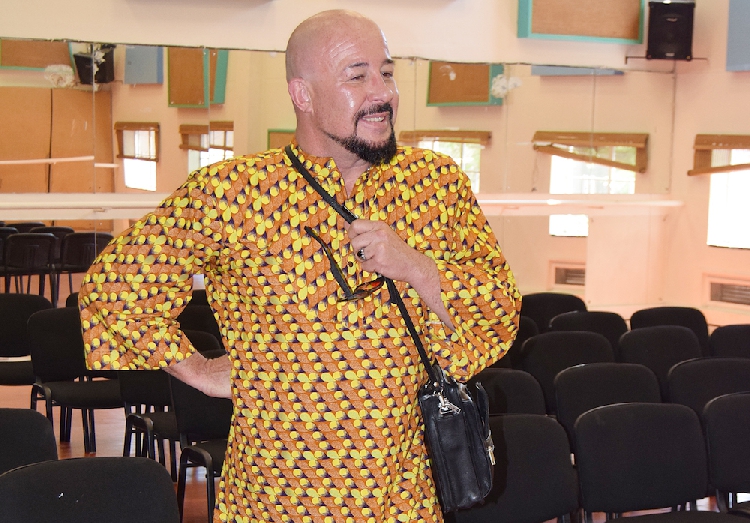
Speaking to the actor behind the villain, it’s pretty surprising to meet a sweet, humble and very entertaining person in Jamie Bartlett
With his recent visit to the capital for an acting workshop with Namibian actor Dalton Ashikoto, Bartlett, who’s been playing the character for about a decade, took time to speak about his career as an actor and the developments he’s experienced in the industry.
Bartlett attended the drama school of the University of Cape Town, which he describes as a ‘pure bred’ drama school. “There aren’t really academic subjects there, which sets it apart from places like University of Witwatersrand (Wits), where you actually get a full degree. So you focus much more on the practical elements of acting, improvisation, much more voice, much more performance,” Bartlett revealed. He described his training as very simple, classical, and hard work in all the different genres ranging from comedy, theatrical plays, Shakespearean and contemporary.
Bartlett spoke of his first big break in theatre, a role which had him pushing the boundaries of sexuality and masculinity. “I became a theatre actor for a long time, just trying to work with the best directors and pushing as hard as you can. I started my career in a play called ‘Cock and Bull Story’, which had me totally naked [on stage] for the first time in South Africa,” he said.
“The play is a story revolving around a boxer, who, when clinched in the ring, got so excited that he got an erection, and he hated himself for it.
“So it was a wonderful kind of play, it almost had a gay theme which was fascinating to be able to play this very aggressive boxer. And that was my first kind of real claim to fame. After that, just a series of sh*t,” he said jokingly.
“I was a very classical actor, so it was a lot of Shakespeare and I gritted my teeth on something you can see as sort of the backbone of Genaro – a very big massive Greek, Shakespearean kind of anger that he has and it’s all really based on classical theatre.”
At the same time, Bartlett cut his teeth in film, doing what he called “cheap American action movies”. ‘American Ninja 2’, ‘American Ninja 5’ and ‘Warlord’. “That’s where I learnt my trade – doing films that were effectively a bit of an apartheid government tax break that they offered to people like Nu Metro and those guys in those days. Essentially it’s just sh*t,” he said.
However, his stint in these low budget flicks provided the opportunity to learn more about the business side of things and hone his craft as an actor. “I learnt about cameras, cinemas, action, stunts, high speed cameras – just doing that sort of stuff,” he said.
Somewhat surprising is the fact that Bartlett’s big breaks came from working on films in our very own Land of the Brave.
“My first really big film was a movie called the ‘The Sandgrass People’. It was a beautiful film apposite Sand Schultz – a big budget film, it was a very special movie shot in Namibia. The second big movie I shot here was with Angelina Jolie, ‘Beyond Borders’.”
Bartlett went on to discuss the boundaries the film pushed, the issues it interrogated and how that has changed over time.
“We were debating just how un politically correct it was. I played the most racist man, and they were petrified for him to be a South African. They rather went with me with an accent, knowing I came from the United Kingdom and to discuss and interrogate huge racial things that you would never be allowed to interrogate even now in any soapie in South Africa,” Bartlett said.
They are so PC now in terms of the kissing scenes, the sex scenes, race in the room – the elephant in the room. Especially compared to the way we were in the original ‘Isidingo’ going back 19 years. Today ‘Isidingo’ is a very different programme.
The actor also shone a light on how the time slots in which soapies are aired influence the story of the show. “Obviously the time slots have changed. It was 18h30 then. Look at ‘Rhythm City’, it’s struggling in that time slot. The dynamic of the country has changed. Even the traffic has changed. At 19h30 you’re still in a traffic jam, where 19 years ago you wouldn’t be in that situation at 18h30.”
Bartlett expounded on different ways the world of South African soapies has changed over the years, in terms of pushing boundaries.
“The dynamics have changed and the audience has changed unfortunately. Even if I look at ‘Rhyhm City’, the kind of stuff I was doing in the beginning just 10 years ago has changed, especially in terms of the things we don’t allow now like the topless t*tty dances we used allow in David Genaro’s study! Today it’s quite tame,” he said.
“It does take away from the story. For me it’s a big issue. However, in South Africa, tackling issues on Mzansi Magic at the 20h30 to 21h00 time slot, when children have gone to bed – there you can now get into risky stuff. You are interrogating race, you’re interrogating sexuality, you’re interrogating a drunk man hitting a woman. You’ll have that on Mzansi Magic, there is no way that ‘Rhythm City’ is going to interrogate those stories.”
“So it gets in the way of the character Genaro, who I would like to be a little bit more x-rated. However, let’s be honest, we’ve got four- and five-year-olds in the room at 19h00 so you have that constraint. But sometimes it feels a little bit like a jockstrap, it’s got you by the b*lls – it’s a catch 22,” Bartlett explained.
Early on in his career, Bartlett mentioned that he had a hard time with the sort of roles he was getting because of his size, and they didn’t allow him to explore himself as an actor.
“I was often type cast in the beginning. I was a very big, a very muscular actor when I was younger. I used to be a huge guy, I was a rugby player that went into acting. Consequently I was never allowed to play myself, at the time a 19, 20, 22-year-old guy. I was constantly playing Henry IV, the bully… I was never allowed to be young Jamie. I found that very challenging.”
He simply had to bide his time until he started playing Mike O’Riley on ‘Isidingo’ in 1997, he felt content with the character. Like he could really thrive in the role.
“He was just obscene and ugly and vicious. We used to really go for it in those days. And I sort of felt that it landed,” he said.
Bartlett also touched on how technology has influenced acting and ultimately the industry. The move from analogue to digital and High Definition (HD) brought about a lot of changes.
“Remember in those days we were working on analogue, which was a 4:5 format, nowadays we work on HD and HD is incredibly cruel. You see a freckle on somebody’s face. Nowadays we have very professional sets, you can’t cut and paste like in the old days. Today it’s much more exacting than it was back then,” he explained.
“Nowadays we slave cameras, so in other words with the modern technology there can be a camera rolling all the time – it slaves. And the other two cameras could be moving. You can cover fights better – punches. You can get the exact edit, you don’t have to worry about the live cutting, cutting in the edit room. It’s on a slave, and that work can be done with much more skill in the post production facility. So I love this kind of modern technology. However, having said that, some things about the old way just are better,” Bartlett concluded.

