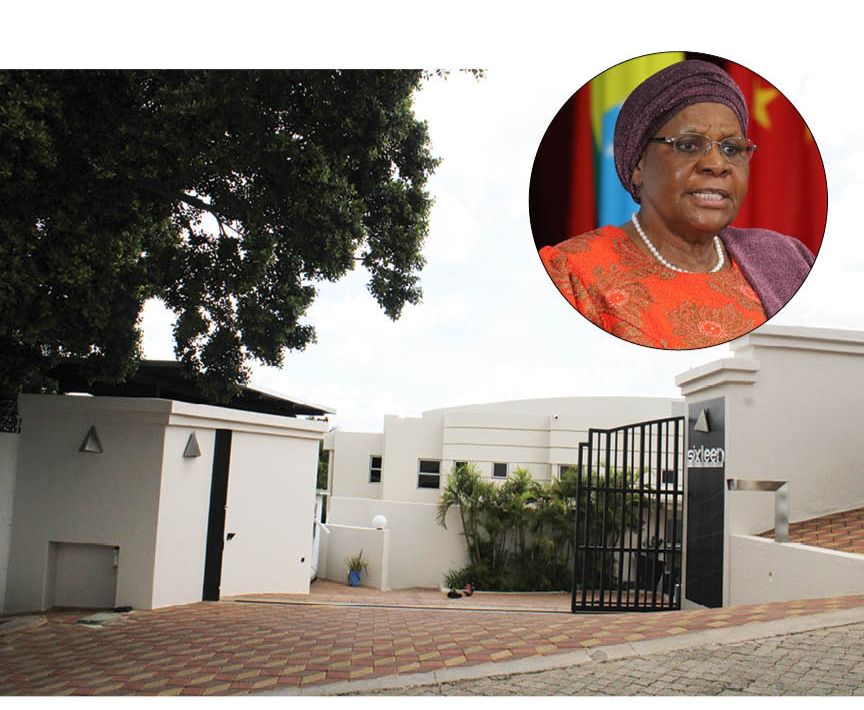





Independent Patriots for Change (IPC) president Panduleni Itula has questioned president Netumbo Nandi-Ndaitwah’s decision to appoint herself as minister of industries, mines and energy.
He says she is effectively reporting to herself.
Speaking to Desert FM yesterday, Itula said while the president has the constitutional authority to hire and fire ministers, her decision to appoint herself as minister contravenes both the Namibian Constitution and the Assignment of Powers Act of 1990.
“We have no objection to the president exercising her prerogative to dismiss a minister. However, appointing herself to that position is a violation of the Constitution, her oath of office, and the law,” he said.
‘DANGEROUS PRECEDENT’
Itula warned that the president’s actions could set a dangerous precedent where constitutional violations become normalised.
While acknowledging the importance of fighting corruption, Itula said if the law is violated, it undermines Namibia’s democratic principles.
“The correct step would have been to appoint another minister to temporarily oversee the portfolio.”
Itula further said the president should dismiss the attorney general (AG), accusing him of failing to properly advise her on the constitutional limits of her powers.
“If I were to advise the president, and not as her political opponent, I would tell her to first fire the AG for providing wrong or negligent advice. Then she should resign as minister of mines and energy and appoint another minister to act lawfully in that position,” he said.
He criticised what he described as “systemic corruption” within successive administrations, warning that recent dismissals reflect a deeper leadership and accountability crisis.
‘QUESTIONABLE VETTING’
“Within seven months, two senior officials have been fired or resigned. That raises questions about the president’s vetting of her appointees. It’s time Namibia strengthens the rule of law, not personalities.”
Questions sent to AG Festus Mbandeka were not responded to at the time of going to print yesterday.
Nandi-Ndaitwah’s office has not yet issued a detailed statement explaining her decision or clarifying whether a new minister will be appointed to the portfolio.
However, presidential spokesperson Jonas Mbambo yesterday told The Namibian while the reasons for Ithete’s dismissal have nothing to do with allegations of corruption, “they are, however, well known to honourable Ithete, the president, and those who were entrusted with or privy to that information”.
DEMANDS
Meanwhile, Landless People’s Movement (LPM) Bernadus Swartbooi yesterday demanded an explanation from the president as to why she fired Ithete.
“What is the issue around the former deputy prime minister and mines and energy minister Natangwe Ithete, who had such a heavy responsibility? What could have shifted in six months? We deserve to know,” he said.
Swartbooi said the president cannot hire people in public and tell the public she has confidence in them, but when she fires them in private, it is kept secret.
He said Nandi-Ndaitwah’s office is not a private company which has to protect Ithete’s integrity.
“We want to know if it was an issue of gross misconduct. Does it warrant further legal investigation?
“If it was an issue of corruption, it warrants investigation, and to what exact level to which this was if it is an issue of corruption. I am not saying it is,” Swartbooi said.
He said if Ithete’s removal is linked to alleged corruption, it is questionable to have such an individual remain a member of the parliament.
‘DUMPING GROUND’
“This can be easily misconstrued that the parliament is a dumping ground for everyone who has mismanaged the responsibilities of society as an executive.
“She is saying the executive is the most important place to test a person’s competence and trustworthiness, and the National Assembly is an unimportant body where you can dump bodies.
“If she is saying that, then we also take note,” Swartbooi said.
He said this implies an elective position in the National Assembly allows an individual to act against the public interest, knowing they would be retained.
Swartbooi said he would engage Ithete because they are good friends, a friendship that started at the Namibian National Students Organisation.
On Sunday, National Unity Democratic Organisation parliamentarian Vetaruhe Kandorozu said the president controlling national resources should not be tolerated.
“She must quickly appoint a replacement who will be part of the executive and be accountable to the parliament on a daily basis. Now you have all the minerals outside the parliament,” he said.
This is tantamount to anarchy and dictatorship, he said, which would put off possible investors.
“She is emulating everything from central African countries that operate in a dictatorship,” Kandorozu said.
‘PRESIDENTIALISM’
Senior government officials have not objected to the president firing Ithete, but some are concerned that Nandi-Ndaitwah is leaning towards “presidentialism”.
Former president Hage Geingob defined presidentialism in his thesis, titled ‘State Formation in Namibia: Promoting Democracy and Good Governance’, in reference to Bratton and Van de Walle, saying: “Presidentialism implies the systematic concentration of political power in the hands of one individual, who resists delegating all but the most trivial decision-making tasks.”
Geingob believed this trend seemed to emerge in Namibia during Sam Nujoma’s presidency, which ended in March 2005.
“For instance, in 2003, president Nujoma issued a circular stating all members of government, including leaders of the legislative organ, should obtain permission from the ‘appointing authority’, i.e. from him, to travel out of the country.
“This authority was in the past delegated to the prime minister as the head of government administration.”
Geingob said at that point there is an attempt or desire to make all decisions at the head of state level.
“In the same year, the president [Nujoma] also assumed the responsibility of the portfolio of information and broadcasting as he wanted to ‘put that house in order’, which presumably no minister could do,” Geingob said.
“Such attempts at micromanagement are the beginning of presidentialism.”
Geingob quoted former Malawian dictator Kamuzu Banda of Malawi who said in 1972: ‘’Nothing is not my business in this country: Everything is my business, everything. The state of education, the state of our economy, the state of our agriculture, the state of our transport, everything is my business.”
Geingob said Namibia has not yet reached that level of assumption of power over everything by one person.
“At the last Swapo congress, many of the ‘impositions’ by the president were resisted, and the president, although not happy, had to live with the objections. We are thus at the crossroads of presidentialism. Time will tell which way Namibia will go.”
In an age of information overload, Sunrise is The Namibian’s morning briefing, delivered at 6h00 from Monday to Friday. It offers a curated rundown of the most important stories from the past 24 hours – occasionally with a light, witty touch. It’s an essential way to stay informed. Subscribe and join our newsletter community.

The Namibian uses AI tools to assist with improved quality, accuracy and efficiency, while maintaining editorial oversight and journalistic integrity.
Stay informed with The Namibian – your source for credible journalism. Get in-depth reporting and opinions for
only N$85 a month. Invest in journalism, invest in democracy –
Subscribe Now!