


ASTI — In the five months it took Becky to reach Italy from Nigeria, she was jailed, raped at gunpoint, forced into an abortion, nearly drowned at sea, and saw several fellow travellers die.
The 15-year-old survived her trials by clutching onto her vision of studying in Italy, so it felt like “a dream come true” when she finally got off a rescue ship in Sicily.
Like thousands of young Nigerian women lured to Italy by the prospect of education and work – a beautiful, new life – Becky soon learnt her fate would be different.
A fresh ordeal was thrust upon her; she was forced to become a sex worker – one of the thousands of Nigerian women drawn to Europe for a better life, only to be snared in prostitution.
“We leave the house in the night. We stand in the middle of the road, whether it’s raining, (whether) it’s cold. If you don’t work and go home, madam’s going to beat you,” said Becky, who did not give her surname for fear of reprisal. “It was hell.”
‘Madam’ is the Nigerian woman who promised schooling, and whose mother Becky worked for back home. Her arms still bear scars from the beatings she got for refusing to sell sex.
Yet, she found the courage to flee to a camp for migrants.
“I’m glad I was able to change my situation. Because if not, I would still be on the streets … (or) probably dead,” Becky said, four years after she fled.
Becky was one of the more than 40 million people estimated by the United Nations to be trapped in modern slavery worldwide.
Nobody knows how many victims are freed or escape, but most suffer stigma and trauma, and struggle to access counselling, healthcare, work, study or housing.
Becky is one of the luckier ones.
She is rebuilding her life in northern Italy, where she works and attends school legally.
This came after two years of therapy and support from the regional government, and from Piam Onlus, an anti-trafficking group based in the small city of Asti.
Key to Becky’s rehabilitation was a pioneering law that activists say protects, not criminalises, trafficking victims.
Despite Italy’s rising anti-immigrant rhetoric and policies, the 1998 law allows foreigners exposed to violence or serious exploitation to get a six-month, temporary residence permit.
It can be renewed for a year or longer, lead to a residence permit for study or work, and allows access to services, according to Amarilda Lici, a specialist immigration lawyer.
Lici said the permit provides “a path of social inclusion that can change lives.”
There are fears, however, that a new law clamping down on asylum-seekers’ rights may curtail such protections.
“The system will slowly get poorer both in … the number of people we’ll be able to host, and projects to implement,” said Monica Cerutti, an official with the regional Piedmont Assembly.
“If we don’t manage to intercept (victims) straight away, we risk not being able to fight for their conditions,” she said.
TRAUMA
Becky now lives in a flat in a village near Asti with two families, including a single mother who shares her room.
She attends school in the mornings.
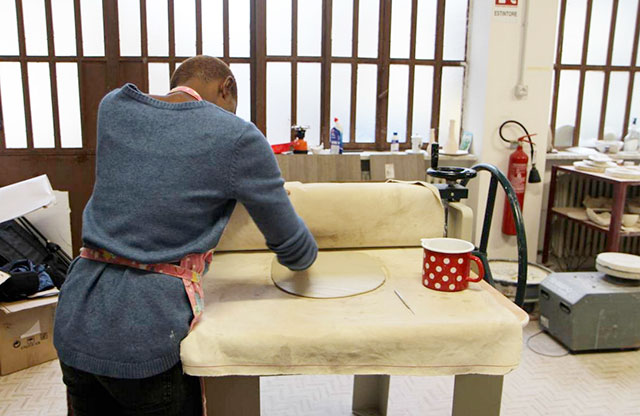
In the afternoon, she works at a social enterprise producing ceramics, which she said helped her recover and learn a skill.
Others are not as fortunate.
About 11 000 women and 3 000 lone children from Nigeria arrived by sea in Italy from Libya in 2016 – with four in every five Nigerian women and girls destined for sex trafficking in Europe, according to the United Nations.
Since 1999, Piam has helped nearly 300 women and girls who have been sex trafficked to Italy, including Becky. But that is just a drop in the ocean, Mossino said.
After a crackdown on migrant boats leaving Libya, arrivals by sea in Italy have plunged – to 23 000 in 2018 from a peak of 181 000 in 2016, UN data shows.
This does not mean an end to the forced sex trade, since traffickers use all possible routes – not just the sea – said Flavio Digiacomo, a spokesman for the IOM in Italy.
In an age of information overload, Sunrise is The Namibian’s morning briefing, delivered at 6h00 from Monday to Friday. It offers a curated rundown of the most important stories from the past 24 hours – occasionally with a light, witty touch. It’s an essential way to stay informed. Subscribe and join our newsletter community.

The Namibian uses AI tools to assist with improved quality, accuracy and efficiency, while maintaining editorial oversight and journalistic integrity.
Stay informed with The Namibian – your source for credible journalism. Get in-depth reporting and opinions for
only N$85 a month. Invest in journalism, invest in democracy –
Subscribe Now!