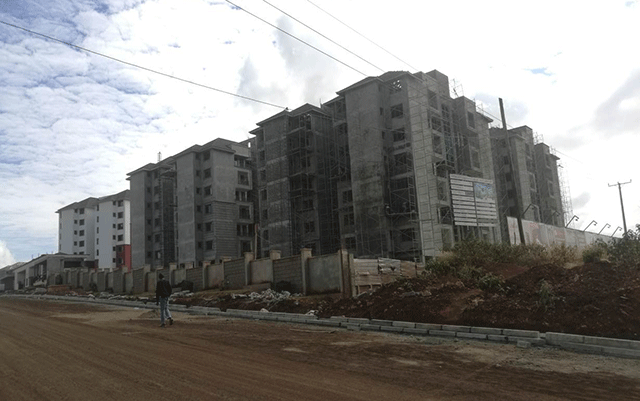
NAIROBI — On the outskirts of Nairobi, vast tracts of agricultural land are seeing a new type of growth, as steel rods and concrete pillars set into the red earth reach into the Kenyan sky.
More than 6 900 hectares of farmland that was home to coffee bushes and cattle is being turned into satellite cities as developers eye the nation’s growing middle class.
Nairobi, Kenya’s capital, is home to about four million people, but – said urban development agency UN-Habitat – decades of unplanned growth amid rapid urbanisation mean more than half of its residents live in slums.
Satellite cities Tilisi, Tatu City and Northlands City offer an alternative, say developers, and will provide homes, offices, schools and recreational facilities for half-a-million people.
“People are desperate to come into a city where they are not going to worry about power outages or water shortages, or traffic congestion,” said Ranee Nanji, co-chief executive officer at Tilisi Developments, which manages the 400-acre Tilisi site.
“That is why plans like ours work,” she said.
But satellite cities are not without controversy. Urban planners like Constant Cap, who lives in Nairobi, warn they could increase inequality.
“These (new) developments rarely explain how they will deal with challenges like low-cost housing,” Cap told the Thomson Reuters Foundation.
“They run the risk of creating further divisions between the rich and the poor, which will be visible by the proliferation of informal settlements at the edges of these cities.”
INCENTIVES
Kenya has one of Africa’s fastest-growing middle classes, according to services firm Deloitte, and has seen greater investment in real estate as private developers capitalise on high housing demand.
According to property agency Knight Frank, Kenya has Africa’s fourth-highest number of wealthy individuals, and is one of the continent’s leading destinations for real estate investments by its super-rich.
Nairobi is also one of Africa’s most expensive cities for housing, the World Bank has said, with prices in 2013 nearly three times those of 2000.
Tilisi, which lies 30 kilometres west of Nairobi, is the smallest of the four planned satellite cities.
Like the others, which include the government-led Konza Technopolis, it will have residential and commercial areas, with schools and shopping centres promising residents “an all-round lifestyle experience”, Nanji said.
Other African countries are following the same path, with more than a dozen satellite cities being developed, said Alfred Omenya, an architect and principal researcher at Eco-Build Africa, a sustainable urban planning and housing organisation.
They include Rwanda’s Vision City, Waterfall City in South Africa, Roma Park in Zambia and Appolonia in Ghana.
Their focus on housing the middle and upper class is one bone of contention, as is the domination of foreign developers, who he said enjoy unfair government incentives like tax breaks.
“This can only deepen class exclusion, segregation and conflicts,” said Omenya.
“These new cities are also drawing resources like taxes from existing ones as authorities try to lure foreign real estate investors.”
Added to that, the country for years neglected building the two million affordable homes its cities need in order to meet its housing deficit and stem the growth of slums.
Last year, the government embarked on a housing programme under its Big Four development plan aiming to entice private investors to build half-a-million low-cost homes by 2022.
Charles Hinga, Kenya’s principal secretary for housing, estimates this will cost about US$13 billion.
“We will be financing this through private capital,” he told the Thomson Reuters Foundation, adding that the government would provide incentives such as free land and tax breaks for developers and buyers.
Nick Langford, who heads the country office for Tatu City developer Rendeavour, said private satellite cities could only provide affordable housing if they received subsidies for aspects such as infrastructure, as well as tax holidays and special economic zones.
“There is no magic wand to providing housing to the urban poor who cannot afford it,” Langford said on the sidelines of a home-buyer’s site tour at Tatu City, 22 kilometres north of Nairobi.
SOCIAL FABRIC
At Tatu City, high-rise flats are already located where coffee bushes once stood as agriculture gives way to a concrete jungle that will house 150 000 people.
Where there were coffee-pickers, there are now construction workers in multi-coloured jackets and yellow helmets, while hoes have been replaced by shovels.
In an age of information overload, Sunrise is The Namibian’s morning briefing, delivered at 6h00 from Monday to Friday. It offers a curated rundown of the most important stories from the past 24 hours – occasionally with a light, witty touch. It’s an essential way to stay informed. Subscribe and join our newsletter community.

The Namibian uses AI tools to assist with improved quality, accuracy and efficiency, while maintaining editorial oversight and journalistic integrity.
Stay informed with The Namibian – your source for credible journalism. Get in-depth reporting and opinions for
only N$85 a month. Invest in journalism, invest in democracy –
Subscribe Now!