YOUNG Namibians recruited into an alleged N$8-billion international romance scam syndicate were promised iPhones, cars and houses to lure victims into fake cryptocurrency investments.
Court documents seen by The Namibian reveal that employees of the close corporation Raylon Investment were promised lucrative rewards on top of their N$3 000 monthly salary and N$1 000 performance bonus if they persuaded foreign victims to invest more money.
According to an application for a forfeiture of property order under the Prevention of Organised Crime Act, filed by prosecutor general Martha Imalwa in the High Court in January 2025, one of the Namibians recruited into the syndicate, who cannot be named, says he joined the close corporation in April 2023 after responding to a job advertisement.
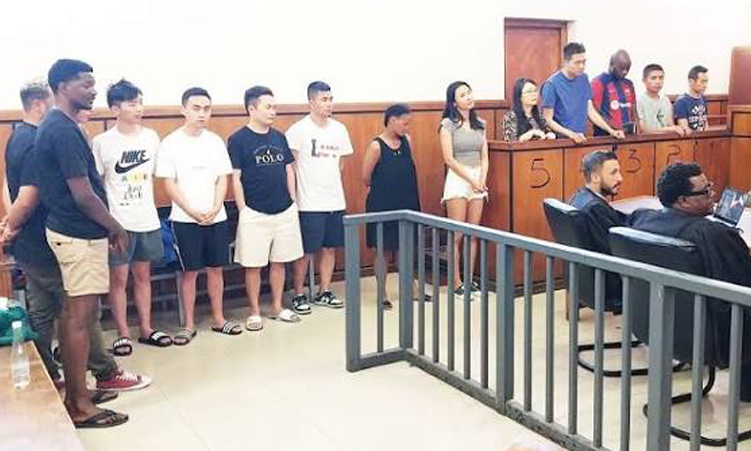
The recruit is one of the witnesses in a case involving Chinese nationals and Namibians who were arrested and charged in 2023 with 65 serious offences, including human trafficking, racketeering, money laundering and fraud.
The accused in the matter are Chinese nationals Fan Jia, Guo Linjie, Zheng Haifeng, Shi Zi Jun, Lin Shu Lin, Chen Wuyu, Neng Jun Wu, Wu Weiyang and Chen You Yi, Cuban citizen Carlos Alejandro Batista Valdes, Singapore citizen Ghim Hwee Chris Ang, and Namibian citizens Tango Muulyau, Mclanda Mamelodi Domingo and Toivo Herman, all of whom were arrested and granted bail.
A Namibian close corporation, Raylon Investment, is also charged in the matter, which is pending in the Windhoek High Court.
Several of the foreign nationals were released on bail between February and September 2024 after paying amounts ranging from N$30 000 to N$100 000.
However, when the matter was scheduled for pretrial proceedings in the Windhoek High Court in April this year, eight of the accused failed to appear.
The state later established that six of the missing Chinese nationals had fled Namibia and returned to China.
The recruit says he underwent a week-long training programme in Windhoek before being deployed to the company’s offices at Shapumba Towers in the city.
According to a statement made by the recruit, every recruit was issued with an iPhone 8, a desktop computer and a notebook before being instructed to create five fake social media profiles across Facebook, Instagram and LinkedIn.
The recruits were taught how to disguise the accounts by tightening privacy settings and stealing photographs of attractive women to create convincing online identities.
“They were given lucrative promises for bringing in significant investments, ranging from money, an iPhone 14 Pro Max, a car and a house,” the recruit says.
He says employees were also promised free accommodation and transport, but only on condition that they moved into the close corporation’s house in the Auasblick area of Windhoek.
Failure to stay at the residence meant losing the job.
STRICT CONTROL
The recruit says more than 150 employees lived in the house, which had about 20 bedrooms. He says he shared a room with 12 other recruits and slept on bunk beds.
The compound operated under strict rules.
Employees were only allowed to leave twice a week for two hours at a time, visitors were prohibited, and company transport had to be used at all times.
Although workers were allowed to keep their personal phones and laptops, they were forbidden from connecting to the house’s Wi-Fi or taking photographs.
The property was monitored by closed-circuit television cameras covering the entrances, corridors and the kitchen.
Chefs prepared meals for the workers, leaving them responsible only for buying toiletries and other personal items.
The recruit says employees signed non-disclosure agreements after completing a one-week probation period.
BECOMING ‘CHARLOTTE CAMPBELL’
The recruit says he created a fake social media personality called Charlotte Campbell, using photographs stolen from another woman’s Instagram profile.
The syndicate allegedly instructed each employee to send at least 150 direct messages every day to wealthy men, mainly from the United States and Europe.
The fake accounts were designed to appear authentic by purchasing followers and regularly posting content.
Once contact was established, employees built emotional relationships by pretending to be divorced women looking for companionship.
According to the recruit, conversations often included explicit sexual messages and intimate photographs to strengthen the victims’ trust.
After gaining their confidence, the men were introduced to cryptocurrency investments.
Victims were instructed to download Crypto.com and MetaMask before buying Ethereum and transferring it to digital wallets controlled by the syndicate.
SCRIPTED LIVES
The syndicate allegedly supplied employees with detailed scripts.
These included fictional life stories about divorce, childhood experiences, education, employment and family backgrounds.
The recruits were also given a seven-day conversation guide designed to quickly determine whether a target had substantial financial resources.
If a victim appeared wealthy, supervisors would take over conversations or involve a supposed cryptocurrency expert known only as “Uncle” to persuade them to invest larger amounts.
The recruit alleges that senior employees withdrew cryptocurrency proceeds from Bitcoin automated teller machines at Maerua Mall and Grove Mall in Windhoek before handing the cash to senior managers.
The money was allegedly stored in a safe inside the chief executive’s office.
MILLIONS INVESTED
The recruit says the close corporation’s teams regularly celebrated successful investments.
The police allege the syndicate operated from Windhoek between December 2022 and October 2023, and defrauded victims in countries including the US, Canada and Britain of more than N$8 billion.
The matter remains before the Windhoek High Court.
Imalwa told The Namibian this month many Namibians fall victim to scams because they want to get rich quickly, while unemployed youth accept any job opportunity without verifying it.
“Namibians have a tendency of reacting too quickly, even putting your money in fake accounts which include cryptocurrency.
There is nothing like getting rich quicker,” she said.
Imalwa said it is difficult to investigate scams.
“l know it is not good being unemployed, but just go slow and your time will come. Don’t throw yourself into the fire otherwise you will be burned, these things of cryptocurrency scams are real.”
She added that many people do not understand how criminals are weaponising artificial intelligence.
“It is very difficult for Namibia currently. Our young people are anxious to find employment. They read in the newspaper and see adverts that require them to pay and click on a link where these criminals are taking your details and using them to commit crimes.
“Call and find out if these jobs really exist before you submit your documents,” she said.
Imalwa said TikTok has also emerged as one of the tools criminals are using to scam people through identity theft.