









Asteroids are rocky or metallic objects mainly found orbiting the Sun in a region called the asteroid belt between Mars and Jupiter.
Some are large – the biggest is Ceres with a diameter of nearly 950km – and are sometimes called minor planets or planetoids. There are millions of small asteroids. The smallest are sometimes called meteoroids. It is thought that asteroids are material leftover from the time that the planets formed.
Meteors are dust-sized particles that burn up as they plummet through Earth's atmosphere. Meteorites are larger, more durable objects that survive heating in the atmosphere and land on Earth.
Asteroids are minor planets, especially those of the inner Solar System. The larger ones have also been called planetoids. These terms have historically been applied to any astronomical object orbiting the Sun that did not show the disk of a planet and was not observed to have the characteristics of an active comet, but as minor planets in the outer Solar System were discovered, their volatile-based surfaces were found to more closely resemble comets and so were often distinguished from traditional asteroids. Thus the term asteroid has come increasingly to refer specifically to the small bodies of the inner Solar System out to the orbit of Jupiter. They are grouped with the outer bodies — centaurs, Neptune trojans, and trans-Neptunian objects — as minor planets, which is the term preferred in astronomical circles. In this article the term "asteroid" refers to the minor planets of the inner Solar System.
There are millions of asteroids, many thought to be the shattered remnants of planetesimals, bodies within the young Sun's solar nebula that never grew large enough to become planets. The large majority of known asteroids orbit in the asteroid belt between the orbits of Mars and Jupiter or co-orbital with Jupiter (the Jupiter Trojans). However, other orbital families exist with significant populations, including the near-Earth asteroids. Individual asteroids are classified by their characteristic spectra, with the majority falling into three main groups: C-type, S-type, and M-type. These were named after and are generally identified with carbon-rich, stony, and metallic compositions, respectively.
Only one asteroid, 4 Vesta, which has a relatively reflective surface, is normally visible to the naked eye, and this only in very dark skies when it is favorably positioned. Rarely, small asteroids passing close to Earth may be visible to the naked eye for a short time. As of September 2013, the Minor Planet Center had data on more than one million objects, of which 625 106 had enough information to be given numbered designations.
When learning about space it can sometimes be difficult to know the difference between all of the amazing objects out there. The following terms are often confused with each other so let’s answer the question: What’s the difference between a comet, asteroid, meteoroid, meteor & meteorite?
Although there can sometimes be a blurry line between categories the following definitions should help you understand the difference between comets and asteroids, why Halley’s Comet is not a meteorite and more.
– bbc.co.uk
Descriptions:
Meteoroid
A meteoroid is a small rock or particle of debris in our solar system. They range in size from dust to around 10 metres in diameter (larger objects are usually referred to as asteroids).
Photo: http://throughthelookingflask.files.wordpress.com
Meteor
A meteoroid that burns up as it passes through the Earth’s atmosphere is known as a meteor. If you’ve ever looked up at the sky at night and seen a streak of light or ‘shooting star’ what you are actually seeing is a meteor.
Photo: mirror.co.uk & wikipedia
Comet
A comet is a relatively small solar system body that orbits the Sun. When close enough to the Sun they display a visible coma (a fuzzy outline or atmosphere due to solar radiation) and sometimes a tail.
Photo: space.com
Meteorite
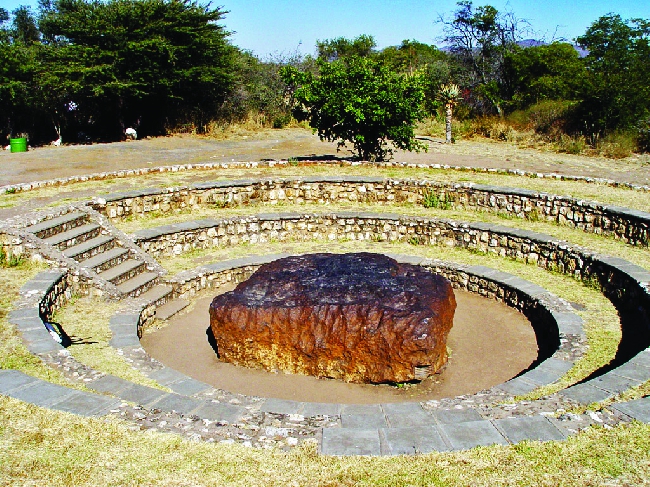
A meteoroid that survives falling through the Earth’s atmosphere and colliding with the Earth’s surface is known as a meteorite.
Caption:
Photo: www.wondermondo.com