



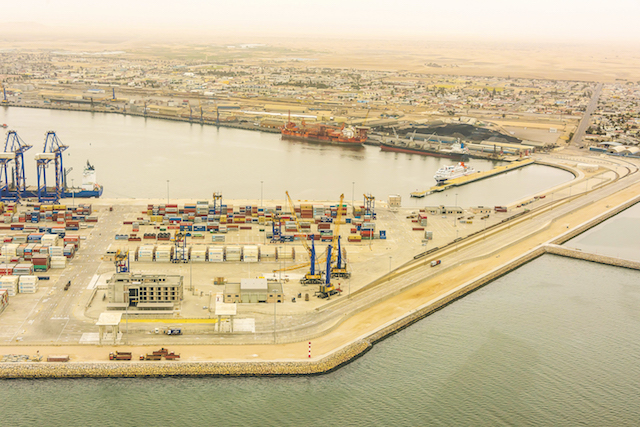
FLORIS STEENKAMP THE Namibian Ports Authority (Namport) is scouting for an international port terminal operator to take over the Walvis Bay container terminal on a 25-year concession.
Namport chief executive officer (CEO) Andrew Kanime confirmed this at a stakeholder event at Walvis Bay last week.
He said the container terminal on reclaimed land at the Port of Walvis Bay is not economically viable due to persistently dropping container cargo volumes – hence the hunt for an international operator.
Kanime said the drop in container cargo volumes can be attributed to two main factors: container vessels growing in size, and declining global economic conditions hampering imports and exports through Walvis Bay.
Kanime said the process to solicit a concessionaire for the container terminal has advanced significantly.
A process of a request for proposals is closing early May, and eight international port terminal operators have positively responded.
Operators who are interested have until the first week of May to submit their proposals to Namport.
According to Kanime the successful concessionaire can be in business as the terminal operator by January next year.
In his briefing to port users and the media, Kanime said when the new container terminal was in its planning stages, projections of the container terminal at the Walvis Bay harbour at the time were used as a basis.
Also referring to it as the “old” container terminal, Kanime said it was operating to near full capacity, vessel calls were high, and container trade into southern Africa via Walvis Bay and vice versa was high.
However, since the construction project commenced in 2013, circumstances changed. As shipping lines started to introduce larger container vessels to streamline their operational capacities, that came at the expense of smaller ports. To Walvis Bay that translated into fewer container vessels calling, as the larger container vessels cannot enter the port safely or prefer to dock at larger ports in West Africa.
Macroeconomic conditions included the declining global economic climate in the last few years before the container terminal became operational in 2019, and the Covid-19 lockdown that ravaged economies worldwide, he said.
“The decision to embark on this watershed project followed various studies which pointed at the capacity of the old container terminal, which then stood at an annual throughput of 350 000 20-foot equivalent units [TEUs],” he said.
“Unfortunately the dynamics in the shipping industry have significantly shifted. On the back of depressed macroeconomic conditions which negatively impacted industries across all sectors with attendant decreases in imports and exports handled through Namibian and other ports across the region, shipping lines have moved to larger-size vessel deployment as part of their own drive to cost rationalisation,” Kanime said.
He said the container terminal would not be sold, but would only be leased to a private operator.
He said this operator has to return the facility after 25 years, or renew the concession.
Strict conditions would be attached to this concession, Kanime said.
That includes such operator having to pay a take-on fee in advance, be committed to grow container volumes through trans-shipment business, and growing business through the various trade corridors between Walvis Bay and Namibia’s landlocked neighbours.
Kanime gave his assurance that there is dialogue between Namport and employees of the ports authority who will be transferred to the new private-sector operator.
He said the operator would have to make job creation a priority and growing cargo volumes through the terminal beyond its current capacity of 750 000 TEUs per annum.
Namport’s executive of commercial services, Elias Mwenyo, last week said the concessioning of the terminal falls within the ambit of the Namibian Ports Authority Act.
As a state-owned enterprise, Namport is guided by specific legislation, and according to Mwenyo the ports authority is within its jurisdiction to put the terminal operation out on concession.
Namport’s executive of finance, Kavin Harry, said of the N$4,2 billion price tag for the construction and development of the new container terminal on reclaimed land, an amount of N$2,4 billion is still repayable to the African Development Bank.
Namport has funded a significant portion of this from its own resources and from government contributions, Harry said.
had reported in 2020 that then transport executive director Willem Goeiemann wanted the government to give control of the then newly constructed Walvis Bay container terminal to a Dubai state-owned company for 30 to 50 years.
Documents seen by The Namibian at the time showed that Goeiemann favoured a company called DP World, previously known as Dubai Ports Authority.
The same emirates company had partnered with real estate dealer Titus Nakuumba in another state land transaction.
reported at the time that Namport had rejected Goeiemann’s recommendation, warning that it lacked procurement transparency and could impact Namport’s future.
DP World had presented a basket full of promises if an agreement with Namport was approved.
In an age of information overload, Sunrise is The Namibian’s morning briefing, delivered at 6h00 from Monday to Friday. It offers a curated rundown of the most important stories from the past 24 hours – occasionally with a light, witty touch. It’s an essential way to stay informed. Subscribe and join our newsletter community.

The Namibian uses AI tools to assist with improved quality, accuracy and efficiency, while maintaining editorial oversight and journalistic integrity.
Stay informed with The Namibian – your source for credible journalism. Get in-depth reporting and opinions for
only N$85 a month. Invest in journalism, invest in democracy –
Subscribe Now!