






NAMIBIA’S repo rate is going up. This is either good or bad news, depending on whether one is a net borrower or net saver.
For net savers with commercial banks, this means interest on savings will edge up, but net borrowers’ wallets will feel more pressure.
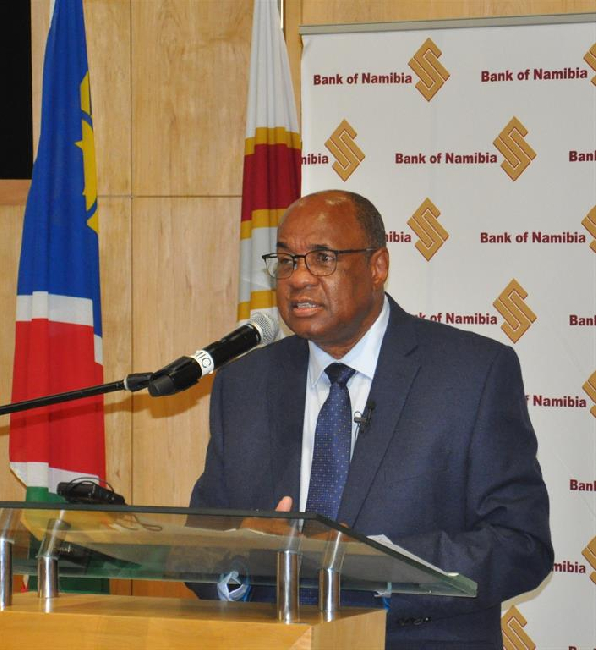
Announcing the increase yesterday, Bank of Namibia (BoN) governor Johannes !Gawaxab said it was about time the central bank pushes the rate up from an all-low 3,75% to 4%. This will bring Namibia now at par with South Africa.
This will shift the prime interest rate up from 7,5% to 7,75% – a similar 25 basis point increase is expected to spiral to mortgage rates, personal loans and overdrafts.
On the reflex, interest on savings is also expected to edge up, although not in the same proportion.
!Gawaxab said edging up interest rates was appropriate to safeguard the one-to-one link between the Namibia dollar and the South African rand, while meeting the country’s international financial obligations.
Normally, the governor would say that the rate is appropriate to support domestic economic activity, but he did not make mention of this yesterday.
He, however, said all monetary policy committee (MPC) members voted for a 25 basis point (bps) increase.
“This decision was taken following a review of the global, regional and domestic economic, as well as financial developments. The MPC is of the view that the increase is appropriate,” he said.
The governor further said this monetary policy stance is also a step towards normalising the current negative real interest rate environment and establishing a positive real interest rate that is conducive to long-term economic growth.
Negative interest rates occur when the average interest rate earned on savings slips below average inflation, a bad state for savers who lose money by keeping such in savings accounts.
At the end of the third quarter last year, Namibians had over N$22 billion sitting in fixed-deposit accounts, earning below inflation.
The governor said Namibia’s overall inflation is projected to average around 4,4% in 2022 and 4,5% in 2023 – up from 3,6% registered in 2021.
This is expected to be almost at par with the average deposit rates, which on an annual basis stand at 5,5%.
Analysts at Simonis Storm Securities say they anticipate the repo rate would increase to 5% at the end of this year.
“We expect the Bank of Namibia to hike the repo rate by 125bps in 2022, increasing the repo rate from 3,75% to 5%, and subsequently taking the prime interest rate from 7,5% to 8,75% by the end of 2022,” read their outlook in January.
The governor said although overall inflation remains within a reasonable range, its food and transport components are expected to increase in the near future and may continue to have a disproportionate effect on the low-income segment of society, and therefore require close monitoring.
This is bad for many wallets, and the banks are most likely not lending to overly stressed households.
Increases of interest rates in a stagnant economy would place households in a very bad position, and some banks pursuing prudence are rejecting loan applications.
Simonis Storm has indicated that demand for credit would remain subdued – not only due to solvency concerns among the private sector as a result of a low growth environment, but also due to commercial banks growing more cautious and risk averse in lending to the public.
“For example, we are aware that many clients at various dealerships see their car loans rejected by the banks. Another factor would be that banks will start to earn higher interest rates on shorter-term deposits and money market securities, increasing the risk trade-off between lending money to clients versus safely earning higher yields,” analysts have said.
Salomo Hei, the head of research at High Economic Intelligence yesterday said although not everyone is impacted by the rate increases, it will definitely impact the living standards of the average Namibian.
“It is going to get tougher,” he said.
The governor said although the repo rate is mainly used to regulate prices in the country, there has been somewhat of a disconnect of what the repo is able to achieve as most price increases are stemming from supply constraints for certain food categories, a rise in international oil prices, and an increase in dwelling rent.
Going forward, the domestic economy is expected to grow around 3% in 2022, and risks to the domestic economic outlook in the medium term remain amid sudden surges in Covid-19 cases and vaccine hesitancy.
“The MPC would like to reiterate that addressing vaccine hesitancy remains key to the extent, speed, and sustainability of the economic recovery,” said the governor.
On reserves, the governor said at the end of January 2022, the preliminary stock of international reserves stood at N$42,9 billion, compared to N$43,9 billion at the end of December 2021. A higher interest rate rate will also reduce capital flow to South Africa said the governor.
Email: lazarus@namibian.com.na
Twitter: @Lasarus_A