



Some oral history says that on the morning of the German colonial forces’ attack on Hornkranz, it was raining.
This quietly devastating note about the weather ahead of the massacre fades from the screen at the National Art Gallery of Namibia (NAGN) as various documentaries play on loop as part of a presentation titled ‘Inherited Testimonies – Re-tracing the Genocide with Nama and Ovaherero Descendants’.
Alhough the rain may seem a negligible detail, it speaks to the depth of the multi-year investigation that underpins the exhibition by Forensic Architecture and Forensis in collaboration with Ovaherero and Nama traditional leadership and genocide activist groups.
Identifying execution locations and skull-scraping chambers on Shark Island, detecting additional unmarked graves at Swakopmund, tracing the enduring environmental impact of German colonialism on Namibia’s once sprawling grasslands and reconstructing Hendrik Witbooi’s settlement through a synthesis of oral history, archival imagery and digital modelling, the exhibition layers trans-generational testimony over the colonial era archive to reconstruct, augment and interrogate existing records relating to significant sites of the Herero and Nama Genocide (1904 -1908).
“Central to our approach is an interviewing practice called ‘situated testimony’. This practice, developed by Forensic Architecture, invites the memories of witnesses and descendants to be ‘performed’ and reconstructed within a realistic digital environment,” reads an exhibition text explaining the presentation’s methodology in a segment titled ‘Cumulative Histories’.
“In this way, the fabric of ancestral landscapes is gradually revealed, as the land is populated by structures, objects, and plants, informed by live testimonies and archival photographs re-situated in space and time,” reads the exhibition text.
“In this practice, digital models are not only analytical tools but acts of ‘world-building’, a reconstruction of environments lost to time.”
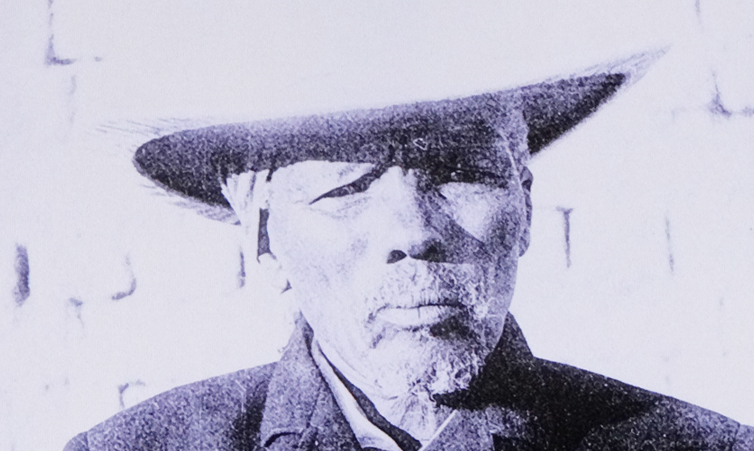
On the back wall of the NAGN, ‘Inherited Testimonies’ uses a combination of ‘repeat photography’, aerial and satellite imagery and oral testimony to illustrate the extent of environmental change at Hatsamas.
Once stewarded by indigenous inhabitants who described the biodiversity of the grasslands to their descendants, Hatsamas is the case study for a ‘Bush Index’ representing 150 years of environmental shifts characterised by encroaching bush in the area.
“Colonialism brought death and destruction not only to Namibia’s people, but also to its natural environment. One of the enduring legacies of a century of colonial land use practices is ‘bush encroachment’ – a process by which woody vegetation overtakes perennial grasses, increasing soil aridity and leading to desertification,” reads an exhibition text in a segment titled ‘The Environmental Continuum of Genocide’.
The ‘Bush Index’ demonstrates that, in contrast to precolonial environmental governance by indigenous communities which included fire management which in turn supported drought resilience and ecosystem health, the extractive priorities and consequences of colonial rule resulted in groundwater depletion, overhunting, ecological exhaustion and multifaceted environmental stress. This environmental degradation continued as indigenous people were displaced and dispossessed of their ancestral lands both under German and South African rule.
“Following the genocidal campaigns perpetrated against the Nama and Ovaherero, European-style sedentary commercial farms were imposed, and native wildlife nearly eradicated, while the surviving Indigenous populations were confined to ‘communal lands’ a fragment of the size of their original territories,” the exhibition text reads.
“This project seeks to demonstrate what descendant communities have always known: that the genocide that began at the hands of German colonisers was not a single event that ended at some fixed point in history – rather, it should be understood as a continuous violence, unfolding over more than a century.”
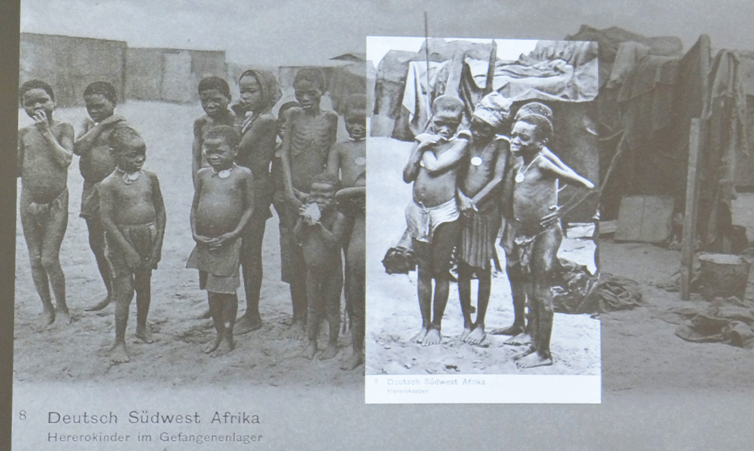
Though ‘Inherited Testimonies’ highlights Herero and Nama Genocide denialism and people may place varying stock in oral history, the exhibition often quotes Germany’s own texts, authors, perpetrators, photographs, postcards and archives of the time.

From German ethnographer Friederich Ratzel describing the country as a place in which “the possibility of profitable agriculture would be created for hundreds of families” to German military officer Kurd Schwabe sketching and describing the Hornkranz massacre as looking “terrible” in its scene of “burning houses, corpses of people and animals”, the exhibition draws on both Namibian and German archives to present counter-readings that refute, animate or expand the accepted or uncontested frame.
“Guided by oral testimonies of traditional leaders and historians of the Nama and Ovaherero, we used digital architectural models to meticulously reconstruct the Shark Island concentration camp, rock by rock” says Forensis’ Dr Mark Mushiva in his narration of the featured documentary ‘German Colonial Genocide in Namibia: Shark Island’.
Throughout the exhibition, the painstaking compilation of forensic evidence through digital models, geolocation, photo mapping, photogrammetry and ground penetrating radar in segments on Swakopmund, Hornkranz, Otjozondjupa, Omaheke and Khomas is a point of fascination.
Finding evidence in the witnessing rocks of Shark Island, underscoring the indigenous knowledge that ensured the Herero people’s survival in the ‘Waterless Omaheke’ and expanding on the fate of the ancestral homeland of the Maherero clan at Okahandja, the exhibition is a call for accountability as digital technology gives voice to latent history.
“This exhibition examines the evidentiary traces registered in rocks, sands, wind, and vegetation, and undertakes critical ‘counter-readings’ of colonial-era photographs, re-narrated through inherited stories,” says an opening exhibition text.
“In bringing visibility to the overlooked and erased histories of the genocides as told by their survivors, the exhibition seeks to support those communities’ calls for manifold forms of repair, recognition, and remembrance.”
‘Inherited Testimonies’ with its wealth of colonial imagery, texts, postcards, photographs, untold stories, descendant testimonies and cultural wisdom, activist features, discoveries, digital memorials, calls to action and harrowingly humanising details closes at the NAGN tomorrow. The documentaries are free to view on forensic-architecture.org.
In an age of information overload, Sunrise is The Namibian’s morning briefing, delivered at 6h00 from Monday to Friday. It offers a curated rundown of the most important stories from the past 24 hours – occasionally with a light, witty touch. It’s an essential way to stay informed. Subscribe and join our newsletter community.

The Namibian uses AI tools to assist with improved quality, accuracy and efficiency, while maintaining editorial oversight and journalistic integrity.
Stay informed with The Namibian – your source for credible journalism. Get in-depth reporting and opinions for
only N$85 a month. Invest in journalism, invest in democracy –
Subscribe Now!