



The 2020s HAVE felt expensive.
Even when headline inflation has cooled, the cost-of-living pressure has not eased in the way people expected.
In 2024, Namibian confidence in price stability fell to an all-time low of 14%.
Namibia’s inflation outcomes over the past decade have been noticeably lower and more stable than in the preceding period.
Since 2014, inflation averaged 4.6%, and very high inflation outcomes (10%+) have disappeared entirely.
Yet this conclusion sits somewhat uneasily with the lived experience of many households in recent years.
There have been periods of low inflation (during the Covid-19 pandemic and in 2025), but the perception of a cost-of-living struggle still lingers due to the high inflation in 2022 and 2023 (post-pandemic demand rebound plus the oil crisis).
Globally, inflation in both 2022 and 2023 was the highest since the global financial crisis in 2008 – but Namibia’s 2022 inflation (averaged 6.1%) was meaningfully lower than 70% of countries for which data exists, including South Africa, most first-world countries, and the global average.
This appears more subdued than what households perceive partly as the Namibian inflation basket itself is now significantly outdated.
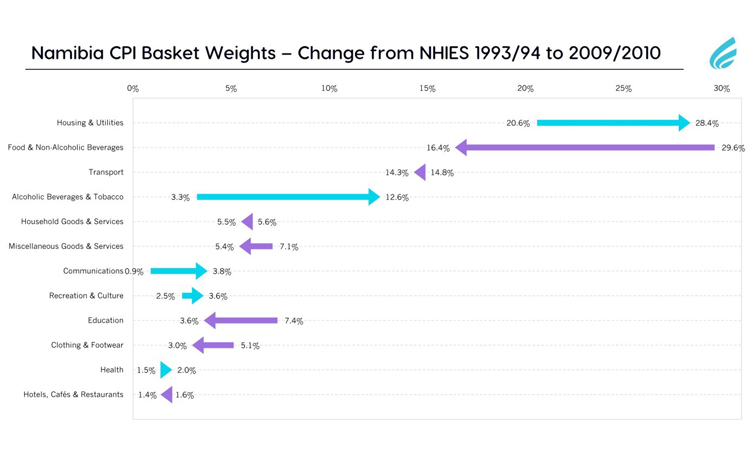
The basket currently used was introduced in December 2012, and the data is based on Namibian consumption data from 2009/10.
A difference in methodology in the latest Namibia Household Income and Expenditure Survey (NHIES) (2015/16) meant the basket could not be updated.
OLD DATA
So, important economic decisions – policy, wages, pricing, expectations, etc., have been anchored to consumption data that is now over 15 years old.
An increase in a basket’s weight means this category represents a larger share of household spending, so its price changes will have a bigger influence on the overall inflation rate.
Since then, spending patterns have shifted considerably due to both the structural changes in consumption – inelastic nature of spending on food and fuel, substitution effects following prolonged relative price changes, the emergence of new goods and services – and the prolonged period of weak income growth following Namibia’s post-2015 economic slowdown.
The Namibian Consumer Price Index is therefore no longer a representative indicator of the actual consumption patterns of Namibian households.
Items of which the importance in household budgets has increased are underweighted, while items of which the importance has declined are overweighted.
Some goods that are no longer consumed in meaningful quantities still carry relatively high weight, while many newer items that households spend a sizeable amount on are not included in the index because they entered the market after 2009/10.
In some cases, prices are not being observed any more, yet the weights are still applied when calculating inflation.
This includes hospital services, which has never once been priced in the current basket, so the index remains unchanged and mechanically dampens measured inflation.
In that sense, headline inflation has literally been biased downward by missing price collections.
WHAT WILL CHANGE IN 2027?
As we consume newer goods and services today, several items will be added to the basket for the first time when the basket is implemented in 2027.
This includes subscription-based spending, such as Netflix, computer software, and even online gaming subscriptions; as well as goods that have become more common in recent years, such as smart TVs, air fryers, vapes, and so on.
Even plastic bags will enter the basket because consumers now pay for this (a useful proxy for economic activity, by the way).
At the same time, several outdated items that are no longer typically consumed will be removed.
Generally, if an item accounts for less than 0.01% of total expenditure in the survey, it is not included in the basket.
There are reasons to expect that an update to the basket would modestly lift measured inflation. Real wage growth in Namibia has not improved over this period.
In the 2012 Labour Force Survey, 71% of employed income earners earned less than N$5 000 per month.
In the 2023 Labour Force Survey, 65% of employed income earners who stated their income earned less than N$5 000 per month.
However, broad unemployment literally doubled over this period, from 27.4% to 54.8%.
Weakening wages and employment tend to push households towards a more essentials-heavy basket, especially for items like food that cannot be avoided like other items.
These categories typically show higher and more volatile inflation than discretionary categories.
So, if updated expenditure weights place greater emphasis on these categories, the measured inflation rate could increase, even if the underlying price dynamics remain the same.
For that reason, it would not be surprising if inflation measured under the next basket comes in higher than the recent historical average purely due to this change.
The precise effect will depend on the updated weights and exact methodology, but a modest upward adjustment – potentially on the order of one to two percentage points – would be consistent with the direction of change in household consumption patterns observed over the past decade.
WE’RE NOT ALL IN IT TOGETHER
To give an example of inflation disparity, South Africa publishes inflation rates for different expenditure groups (by decile, i.e., households in the bottom 10% of expenditure, then the next 10%, and so on).
These figures show that the bottom 10% of households have seen their basket increase by about 40% since the start of 2019, while the top 10% have seen their basket increase by about 30% – the same as the headline Consumer Price Index.
As food prices saw the most sustained increase over the past three years, and because low-income households typically have a higher food weight in their basket, their cost-of-living has diverged from the headline index.
Poorer households have faced higher inflation than the headline rate, as food expenditure is a larger portion of their budget.
Even though the top 10% spends more on food in absolute (rand) terms, food spending makes up a lower share of their budget.
Although Namibia does not publish inflation by expenditure deciles, an analysis on Namibian inequality and inflation shows similar findings: from 2014 to 2024, inflation for the bottom 10% has been higher than that of the top 10% in 112/127 months (88%) of the time.
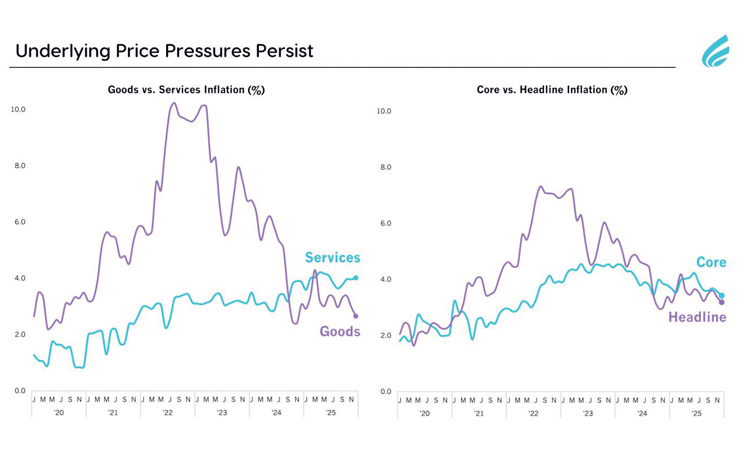
In 2025, Namibia averaged 3.5% inflation, the lowest rate since 2020 (2.2%, the lowest on record).
However, core inflation finished the year above the headline rate, and services finished above goods inflation.
Service price increases are stickier, because the domestic cost structures (wages and rents) adjust more slowly, some of which through contracts.
They are repriced differently from goods, frequently with reference to inflation in the preceding year (or inflation + X%).
Services inflation continues to trend upwards since 2020. Core inflation, which excludes volatile items such as food and fuel, finished 2025 above headline inflation as underlying price pressures persist.
There has been no slowdown in the price increase of services, as operators and businesses have still been playing catch-up after the 2022 and 2023 shock. In this sense, the relatively mild inflation feels misleading.
A few base effects, outdated weights, and gaps in price collection can all contribute to a softer headline number than what households experience.
Perhaps surprisingly, fuel prices finished 2025 higher than the start of the year, despite oil dropping 20%, the rand 12% stronger, and freight costs down 30% from the start to the end of 2025.
Fuel prices actually finished higher than at the start of 2023. So even though the conditions are rewinding back to pre-2022, fuel prices are still stuck in 2022/23.
But because fuel prices were more stable in 2024 and 2025, the rate of increase slowed, therefore contributing to lower annual inflation.
DISPROPORTIONATE ADJUSTMENTS
Consider that low-income earners often experience higher inflation than high-income earners, as already explained.
For simplicity, imagine a company with one person receiving N$5 000 per month, while the other receives N$50 000 per month. Both receive a 4.5% cost-of-living adjustment to “keep up” with inflation.
But if the higher-income earner’s experienced inflation is lower, the same 4.5% adjustment delivers a larger real percentage gain for them than for the lower-income earner (even before considering the difference in starting salaries).
Higher earners also have more room to buffer cost pressures through interest-bearing assets, shifting money into products that preserve or grow purchasing power.
They are also more able to substitute when inflation is high (e.g., switching from beef to chicken when beef becomes too expensive).
By contrast, the lower earner has much less ability to protect purchasing power.
On top of facing higher experienced inflation and a lower base, their adjustment literally does not fully cover the inflation they actually face.
They also have limited room to substitute downwards, because they are already consuming the cheapest available options.
Over time, this compounds.
Those with the lowest effective inflation are often those best able to out-earn inflation, while those facing the highest effective inflation have the least capacity to protect themselves from it.
This is why it is important to update the inflation basket regularly, so that the number informing wage negotiations, pricing, and public expectations better reflects lived reality.
The basket is expected to be updated in 2027, following the conclusion of the NHIES 2025/26 in April 2026.
- Tannan Groenewald is the head of data and analytics at Cirrus.
In an age of information overload, Sunrise is The Namibian’s morning briefing, delivered at 6h00 from Monday to Friday. It offers a curated rundown of the most important stories from the past 24 hours – occasionally with a light, witty touch. It’s an essential way to stay informed. Subscribe and join our newsletter community.

The Namibian uses AI tools to assist with improved quality, accuracy and efficiency, while maintaining editorial oversight and journalistic integrity.
Stay informed with The Namibian – your source for credible journalism. Get in-depth reporting and opinions for
only N$85 a month. Invest in journalism, invest in democracy –
Subscribe Now!