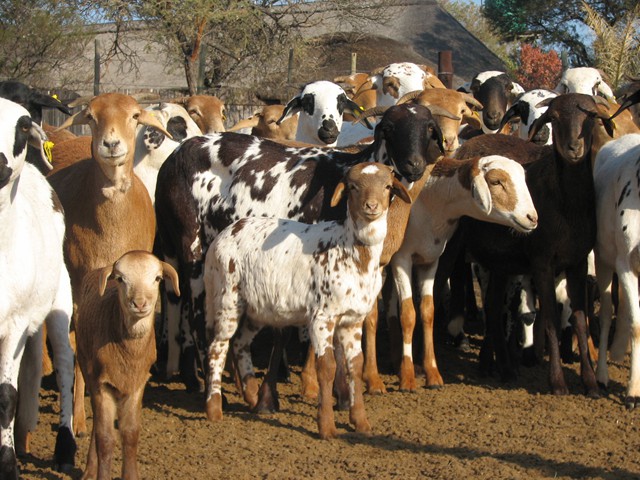
THE fat-tailed sheep arrived in South Africa between 200 and 400 AD. The Damara, Herero, Namaqua and the Kam Karrin Khoisan tribes farmed and traded with what has become the Damara sheep of today. The name is derived from the Damaraland area of Namibia.
The commercialisation and characterisation of the breed started at the Omatjienne Research Station near Otjiwarongo in the late 1950s and early 1960s. Information from Omatjienne generated interest in the breed in South Africa and led to the export of animals to South Africa and the establishment of the South African Damara Sheep Breeders’ Society in 1992.
Description
The Damara sheep is a fairly large sheep. It is a long-bodied, fat-tailed sheep. They can be uni-coloured (black, brown or white) or multi-coloured (combination of colours).
The hair is mostly short. Young sheep have longish hair with more woolliness. They shed this when they get older. Glossy hair is the desired type.
The Damara sheep is predominantly a horned sheep, polls do occur, though more in ewes than in rams. Rams have well-developed spiral horns which stand well away from the head. The legs are long and strong, with well shaped hooves. The fat tail is wedgeshaped, narrow and long, stretching to below the hock.
Damara ewes can be mated throughout the year and are ideally suited for accelerated lambing systems.
Age at first lambing is 15 months.
Damara ewes have very strong maternal characteristics. Damaras always gather in a group with the lambs on the inside, making it difficult for jackal and lynx to get to them. A Damara ewe will always protect her lamb (flock / herd instinct).
Products
• Meat – The carcass is regarded as a fat-tailed type. The meat of the Damara sheep is juicy and tasty, has a fine texture and not mottled with fat. The fat on the carcass is generally a thin layer of 1 – 2 mm, which makes it ideally suited to the preferences of the modern consumer.
• Fat tail – External fat is mainly located in the tail. This tail fat is of the highest quality with a fine white texture and is an ideal ingredient in sausage.
• Skins – The low fat content of the skin and the superb fineness of the grain of the skin is the reason why Damara sheepskins produce leather that is among the best quality in the world. Damara leather is superior as far as tensile and tear strength are concerned.
The normal production environment is the arid, semi-desert. The Damara is well adapted to the hot, dry savannah country.
In an age of information overload, Sunrise is The Namibian’s morning briefing, delivered at 6h00 from Monday to Friday. It offers a curated rundown of the most important stories from the past 24 hours – occasionally with a light, witty touch. It’s an essential way to stay informed. Subscribe and join our newsletter community.

The Namibian uses AI tools to assist with improved quality, accuracy and efficiency, while maintaining editorial oversight and journalistic integrity.
Stay informed with The Namibian – your source for credible journalism. Get in-depth reporting and opinions for
only N$85 a month. Invest in journalism, invest in democracy –
Subscribe Now!