


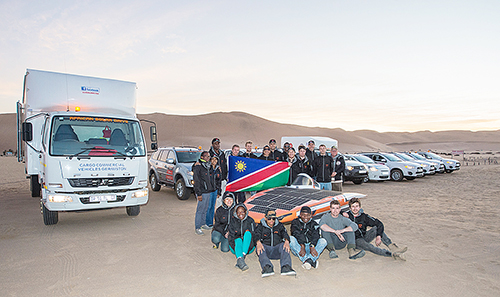
After travelling 4 160 kilometres across Sub-Saharan Africa (1 040 of those kilometres were solar powered), the University of Johannesburg’s 2015 African Solar Drive team have safely arrived back in Johannesburg.
The 2015 African Solar Drive kicked off on 18 June and saw Ilanga II, the University of Johannesburg (UJ) Energy Movement’s solar powered electric car, traverse the northern parts of South Africa and cross the border into Namibia and Botswana, gathering and analysing data along the way. The team also very successfully engaged with local communities to raise awareness around green technology.
The 2015 African Solar Drive route kicked-off in Kimberley and continued through to Upington, Keetmanshoop, Rehoboth, Windhoek, Walvis Bay, Swakopmund, Buitepos, Kang and finished in Gaborone on 29 June.
“It was an epic journey for the team in terms of knowledge transfer and practical experience – to develop the technology, the logistics and everything it took to go on this drive,” says Mechanical Engineering Science lecturer and the UJ Energy Movement programme manager, Nickey Janse van Rensburg.
Aside from testing and fine-tuning the mechanics, the project was also intended to test the new team and initiate them into what it takes to function as a professional team under race conditions in preparation for next year’s Sasol Solar Challenge. Both the Ilanga II and the team performed very well, reaching a top speed of 95 km/h and travelling at an average speed of 75km/h.
Along the way, the team faced several technical challenges which led to some astounding on-the-road engineering feats including redesigning and manufacturing internal components in Windhoek to optimise the motor for the road conditions. This taught the team a valuable lesson in trouble shooting.
The 2015 African Solar Drive was a great initiative for not only promoting solar energy and green technology but also because it raised awareness around fields of Science, Technology, Engineering and Mathematics with hundreds of scholars along the way.
The project provided opportunities for UJ’s community engagement team to actively engage with schools and local communities through public lectures. The team hopes that their continued engagement with these communities and schools will result in some of the schools participating in the Shell Eco-Marathon race in October this year and to grow more chapters of the Energy Movement in other universities to champion the overall objectives of the initiative.
“This was an experience like no other,” says team and technology Manager of the Energy Movement programme, Warren Hurter. “Seeing the young children’s faces when they saw the car for the first time and having the team see their responses, and for them to realise that this is more than a car.
They should feel privileged to be a part of something like this that inspires others. In the end, this showed. We finished the trip with a clinical and motivated team who took ownership of the project and will take it forward to the next solar challenge with new ideas and a drive to be the best.”
“We have realised that through community-driven research initiatives we can make a huge impact in local communities. This project allowed us to make contact and build a network with schools, universities and industry partners along the way. It was the first step,” says Janse van Rensburg.
“Building on this will be a multi-disciplinary effort including securing funding to further support this work. We will be relying on enterprise development and socio-economic development funding to support the initiatives, but also to create an opportunity to develop local skills to drive and implement these projects through multi-stakeholder participation.”
Janse van Rensburg added: “Most of all it was a wonderful adventure which opened up new worlds of opportunity in energy innovation. There truly are so many possibilities and opportunities in this region and through responsible research and innovation we can make a massive impact on the global energy crisis. Africa should be the leaders in sustainable energy solutions, the future is here and we need to take the lead”.
The journey can be seen here: ujsolar.co.za and at facebook.com/UJSolarCar.
– UJ African Solar Drive Team
In an age of information overload, Sunrise is The Namibian’s morning briefing, delivered at 6h00 from Monday to Friday. It offers a curated rundown of the most important stories from the past 24 hours – occasionally with a light, witty touch. It’s an essential way to stay informed. Subscribe and join our newsletter community.

The Namibian uses AI tools to assist with improved quality, accuracy and efficiency, while maintaining editorial oversight and journalistic integrity.
Stay informed with The Namibian – your source for credible journalism. Get in-depth reporting and opinions for
only N$85 a month. Invest in journalism, invest in democracy –
Subscribe Now!