







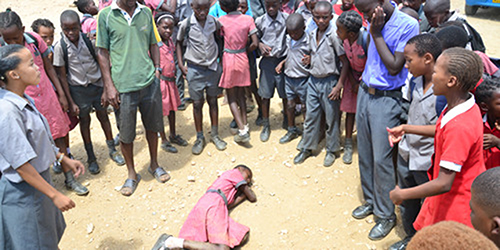
SOME superstitious community members see it as witchcraft, while others say it is a sign of demonic possession.
Education and health professionals are, however, unanimous in describing the increasingly common phenomenon known at schools as ‘mass hysteria’, a problem that is easily solved by merely ignoring it.
In the past few years, incidents of mass hysteria amongst pupils were reported at schools in the Oshikoto, Ohangwena, Oshana, Omusati and Kunene regions, as well as other parts of the country.
Affected pupils, mostly girls, exhibit strange behaviour such as wailing, fainting, crawling or rolling on the ground, or running around uncontrollably and speaking strange languages.
Some children have claimed that it starts with a severe headache, followed by everything going blank.
Speaking to The Namibian earlier this year, psychiatrist Mnubi Farahani identified mass hysteria as a mental condition which affects people who share similar social problems or challenges.
The phenomenon is generally of short duration, lasting from a few hours to a few days, and mostly affects pupils around examination time.
“This is mass hysteria, and children only need counselling. But in most cases, there is no need for any treatment,” said Oshakati hospital superintendent Korbinian Vizcaya Amutenya.
He said he witnessed the hysteria at one school in Omusati some time ago. “The affected pupils were counselled, and the problem was immediately solved there and then,” he stated.
Oshikoto education director Lamek Kafidi said the problem is easy to solve, but is exacerbated when publicised.
Kafidi, who deliberately avoided mentioning names of schools, related how mass hysteria was brought under control at a school in his region by merely placing all the affected pupils in one classroom.
“They were sitting there calmly until noon when an NBC TV crew arrived, and parents demanded that the pupils be released to be filmed. Then, the problem started again. This shows that if ignored, mass hysteria would stop,” he added.
However, many parents find the education and health professionals’ explanations unsatisfactory. They would like to believe that their children were bewitched, or are being haunted by evil spirits. They prefer prayer sessions at schools, or demand permission to take their children to traditional healers.
“It is not witchcraft. It could be that they just have the same social problems,” Farahani said.
Writing in The Namibian last year, psychologist Shaun Whittaker described the phenomenon as functional neurological symptom disorder (FNSD), a neurological or physical symptom that serves a particular psychological function.
“This could involve many different kinds of neurological indications, such as losing the use of one’s voice, the loss of consciousness or fainting, fits or dissociative attacks, numbness, muscle weakness, visual blurring, blindness, paralysis, etc.,” he said, dismissing talk about spirits, witches and demons.
He said FNSD could typically occur between the ages of 10 and 35.
“This kind of behaviour is especially common among young persons around examination time. It is more frequent among youthful girls as they tend to have close social bonds, and are often more susceptible,” he noted.
Whittaker warned teachers, parents, journalists and community members not to perpetuate the “non-empirical perceptions” around the disorder, but to emphasise that a logical explanation exists.