




“I will continue to risk my life by trading in this area.”
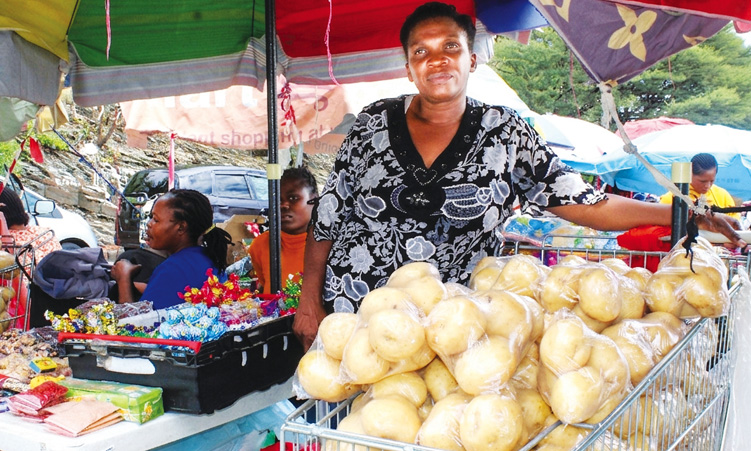
This is what vendor Ester Andreas vows. She has been illegally selling fruit and vegetables in Windhoek’s central business district (CBD) for 20 years.
This is despite several warnings from city authorities not to sell at the spot.
“The moment you see the city police, you want to grab your stock and run, but sometimes the stock is a lot, and we leave it behind,” she tells The Namibian.
“We do not fight the police nor their work, we just want to put bread on the table,” she says.
Andreas is among hundreds of illegal vendors trading around the CBD, regularly facing evictions by the Windhoek municipality.
These encounters happen at least once or twice a month, she says.
“The most traumatising experience was when a police officer pointed a gun at me during the Covid-19 pandemic, telling me not to move.
I will never forget that day,” she recalls.
Andreas (48) came to Windhoek from northern Namibia in 1995 after securing a job at the garden of a local institution.
She turned to street vending after losing that job.
Andreas, who resides at Okahandja Park, is her family’s sole breadwinner.
She prefers trading at the forbidden area because customers are plenty.
The busier the place, the better it is for trading, she says.
She does not sell at designated open markets.
“At open markets, people grab stuff and get into taxis,” she says.
On a good day, she can make around N$300. “But sometimes I don’t earn enough to get a taxi back home,” she adds.
Andreas calls for vendors to be recognised as legal traders and to be given permits.
NO MARKET
Fernanda Eduwardo (35) is another vendor affected by the crackdown. She was removed from the area alongside 20 other vendors last month.
Eduwardo says the police allegedly tried to remove her stock while her 11-month-old baby was on her back.
“It’s heartbreaking not knowing how we will make a living. This is our source of income.”
The mother of four told The Namibian last month that she is the breadwinner after the father of her children died.
She had sold items worth only N$60 on that day.
After her plea for new stock went viral on social media, supporters, including Nawa Zone, raised N$4 700 to help her recover.
Another vendor, International University of Management student Victoria Shampoko (24), also sells at the same spot.
She says her mother has been the family’s breadwinner, providing food and covering transport costs through her work as a vegetable vendor.
“Back home, there’s nothing to eat without her working.
My mother is responsible for paying cattle herders, our taxi money and for putting food on the table. I am the middle child and none of my siblings work.
“We were hoping things with the city police would get better, but every time we come here, it gets worse,” “They’ve been saying this for more than 20 years, according to my mother.
If they put it on paper, we might see progress, but right now, it’s just words,” she says.
The informal economy remains the heartbeat of survival in Windhoek, absorbing thousands excluded from formal employment.
Yet the City of Windhoek continues to enforce municipal bylaws that vendors say lack clear policies, proper infrastructure and basic services such as water and sanitation.
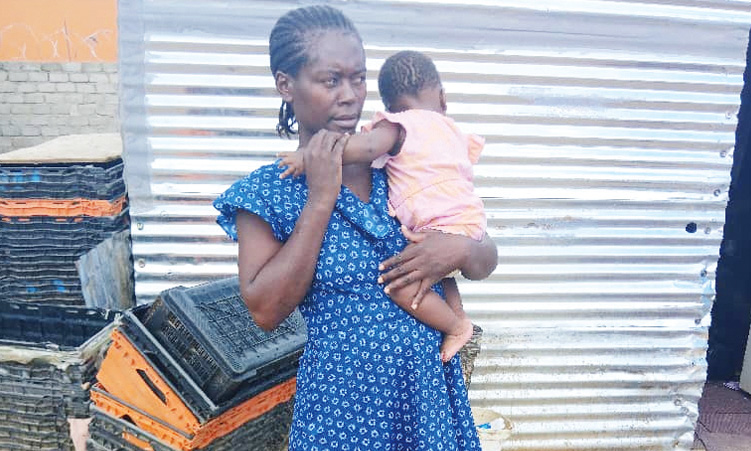
VENDORS VS CITY POLICE … Fernando Eduwardo (35), is a mother of four who was evicted from her trading spot in the Windhoek CBD along with other vendors a month ago. She lost her stock in the process.
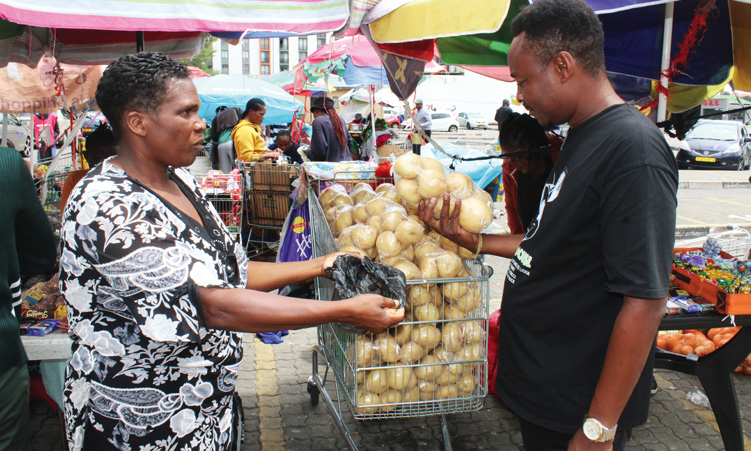
Vendors are required to pay monthly fees ranging from N$221 to N$1 600 without corresponding support.
Trade representative Ruti Malungu says vendors have agreements permitting them to legally sell at certain venues, but ongoing enforcement actions undermine their livelihoods.
Observers say a long-term solution should include formal policies, permanent structured engagement with vendors, proper markets and basic services to stabilise the informal economy.
Swapo member of parliament Tobie Aupindi told The Namibian “I am not endorsing anarchy in the city, however, I believe it’s primitive and degrading to any human to be removed from trading at the CBD.”
Aupindi says in most cases, the vendors’ goods are damaged and there is no compensation.
This practice is also being implemented in other towns countrywide.
Many of these vendors are from extremely disadvantaged communities and are trying to make a living in an already difficult economic environment, he says.
“I condemn this act. I advise the Windhoek City Council and other town councils to make proper provisions around the central business area and build proper infrastructure for these traders to trade in an organised manner,” Aupindi says.
City police spokesperson superintendent Marcelline Murapo says street vendors are currently restricted from trading along Independence Avenue and certain parts of the CBD, as these areas are not designated for trading purposes.
THE WAY FORWARD
City of Windhoek spokesperson Lydia Amutenya says the city has adopted a regulated and structured approach to informal trading within the CBD.
Some of the trading venues pending approval include the Semi Mall Market at Independence Avenue and the Post Street Mall Market, which will accommodate 62 arts and crafts traders, she says.

Amutenya says the Windhoek Flea Market accommodates 71 traders offering a range of services and goods, including fresh produce, cooked food, salon and barber services, cellphone repairs and accessories.
These sites form part of the city’s long-term strategy to balance economic inclusion with urban order, safety and cleanliness in the CBD.
She adds that the municipality continues to engage street vendors through ongoing consultations.
In an age of information overload, Sunrise is The Namibian’s morning briefing, delivered at 6h00 from Monday to Friday. It offers a curated rundown of the most important stories from the past 24 hours – occasionally with a light, witty touch. It’s an essential way to stay informed. Subscribe and join our newsletter community.

The Namibian uses AI tools to assist with improved quality, accuracy and efficiency, while maintaining editorial oversight and journalistic integrity.
Stay informed with The Namibian – your source for credible journalism. Get in-depth reporting and opinions for
only N$85 a month. Invest in journalism, invest in democracy –
Subscribe Now!