



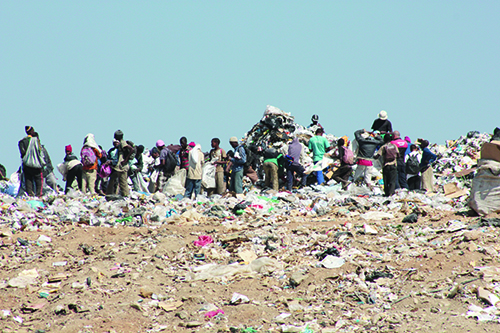
Worldwide, there are more than one billion starving people, yet one third of all food produced for human consumption is lost or wasted before it is eaten.
In Namibia, the Kupferberg landfill site on the edge of Windhoek is still a haunting memory for many. Only two years ago embarrassing reports were published about the hundreds of people who were scavenging rotten and stale food which was being dumped at the waste site. At its peak, there were an estimated 450 people living off the waste from the landfill.
Only streets away, people who cannot eat another bite scrape food from their plates which will inevitably end up at the dump.
It is estimated that organic food products make up 19% of household waste in Windhoek, according to an audit published by the cities Solid Waste Management Division.
Although Kupferberg has now been fenced off, hunger sticken communities still exist and food waste continues as usual.
Around the world this problem is universal. An estimated 33% of all food worldwide is wasted before it reaches a plate, according to a recent report published by The United Nations Food and Agricultural Organisation (FAO). This annually costs the global economy US$750 billion.
The report concludes that there is enough food for everyone, just a lot of inefficiency.
In different parts of the world there are different reasons for food waste. In poorer nations across Africa and Asia, losses mainly occur in the food supply systems where food is damaged or ruined before it reaches the stores.
“Losses result from wide-ranging technical and managerial limitations in harvesting techniques, storage, transportation, processing, cooling facilities and infrastructure,” says FAO representative to Namibia, Babagana Ahmadu.Extreme temperatures and poor infrastructure are the primary causes for this.
In developed nations however, it is another story. Wealthy countries waste the majority of their food only once goods reach their stores. Most western supermarkets operate under strict rules to dispose of food with any imperfections, although these goods may still be perfectly edible. Food also only takes up a small proportion of people’s income in these nations, so many households can afford to throw food away as they please.
To tackle some of the problems within Namibia, the government proposed a food bank in 2012. Although building has not yet been started, the plans were recently confirmed by the Deputy Prime Minister Marco Hausiku to be at an advanced stage near completion.
According to Hausiku, food that will be banked will come from local retailers who have signed agreements with the government. Their food will be used on condition that it is still consumable.
This partnership between the government and the private sector has also been recommended by the FAO.
“Retailers could have measures of stock management that would reduce the risk of inefficiency and facilitate re-distribution for human consumption in case safe and nutritious surplus becomes available,” Ahmadu says.
Once the bank is completed, it will then be accessed by organisations that are assisting hungry people, such as churches and NGOs.
Another force in Namibia for efficient waste disposal is the recycling company, Rent A Drum. Since 1989 they have operated a free service for businesses and households, collecting and disposing of their recyclable waste.
“We are only one of five companies in Africa recycling on this scale,” says business developer, Rohan Louw.
Although hospitality businesses in Windhoek have signed up for Rent A Drum’s service, they have not been adopted universally by the city.
“On average we transport 60 to 65 tonnes of waste a day,” Louw says. A figure that accounts for less than half of the city’s recyclable waste.
The Namibian Institute of Culinary Excellence (NICE) is another establishment creating unique solutions to tackle food waste. The Windhoek restaurant operates a disposal policy that focuses on environmental conservation. All waste from the kitchen is either composted in their expansive garden or recycled through Rent A Drum’s services.
“A lot of food comes through our doors and we have a responsibility to dispose of it correctly. All our organic food products are composted, and everything else which can be is recycled,” sous chef Michael Hattingh said.
NICE’s all encompassing approach to waste disposal is a rare but shining example amongst businesses in Windhoek.
After dinner has been served, the dishes washed and leftovers scraped into the bins of most households, there are still hungry mouths to feed across country. This is a problem that can’t be allowed to continue and urgently needs to be solved.
Reduce Food Waste
Write a list
Menu plan your meals for a week. Check the ingredients in your fridge and cupboards, then write a shopping list for just the extras you need.
Take your list with you and stick to it when you’re in the store. Don’t be tempted by offers and don’t shop when you’re hungry – you’ll come back with more than you need.
Don’t throw it away
Fruit that is just going soft can be made into smoothies or fruit pies. Vegetables that are starting to wilt can be made into soup.
In an age of information overload, Sunrise is The Namibian’s morning briefing, delivered at 6h00 from Monday to Friday. It offers a curated rundown of the most important stories from the past 24 hours – occasionally with a light, witty touch. It’s an essential way to stay informed. Subscribe and join our newsletter community.

The Namibian uses AI tools to assist with improved quality, accuracy and efficiency, while maintaining editorial oversight and journalistic integrity.
Stay informed with The Namibian – your source for credible journalism. Get in-depth reporting and opinions for
only N$85 a month. Invest in journalism, invest in democracy –
Subscribe Now!