



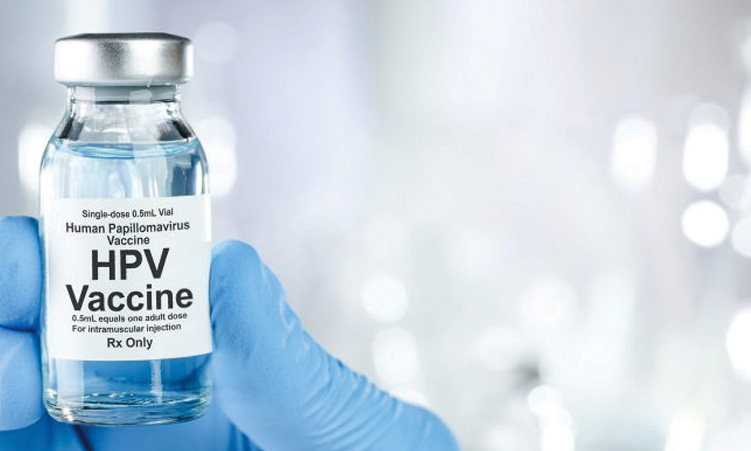
The government has assured parents that the human papillomavirus (HPV) vaccine for girls currently being rolled out at schools is safe, following concerns.
Executive director of health and social services Penda Ithindi says the government “cannot conspire to kill its own people”.
Recently, schools sent parents letters of consent to sign, allowing their children to be vaccinated against HPV, however, some have refused.
They have raised concerns over the safety of the vaccine for their children, with many having taken to social media warning people to not allow their children to be vaccinated.
PROTECTION
According to the World Health Organisation (WHO), the HPV vaccination is the most cost-effective public health measure against cervical cancer.
The vaccine is currently being rolled out for girls between the ages of nine and 14.
“As a ministry, we are aware that there is always talk and negativity being spread when there is a vaccine involved.
However, it should be known that the government will always administer safe vaccines for its people,” Ithindi says.
He says Namibia is not the first country to roll out the HPV vaccine and that the country has been lagging behind in the exercise.
“There is always a cost involved with inaction.
However, it should be noted that the purpose of the vaccine is to protect young girls against HPV,” Ithindi says.
He says the country has experienced an increase in cervical cancer and deaths.
“We are high up there, because we are not administering vaccines at public health facilities, only private healthcare administers HPV vaccines. However, we all know that prevention is better than cure.
“The results will tell over time. It is not correct to say the government wants to kill its own people,” he says.
Education minister Sanet Steenkamp says her ministry has, through its regional structures, sent schools all the information provided by the health ministry.
She says extensive sensitisation has taken place and is ongoing.
“Vaccination did not happen until parents were fully informed and have given informed consent. No pupil was forced to take the vaccine without their parents’ consent,” Steenkamp says.
She says there have been challenges due to misinformation, which is why the vaccination campaign had been postponed.
Cancer Association of Namibia chief executive Rolf Hansen says the association has been inundated with queries about the HPV vaccine and cervical cancer.
He says the roll-out of the vaccine will ensure HPV and cervical cancer become “a thing of the past”.
“HPV and cervical cancer have affected so many lives for so long. However, the vaccine has been tried and tested for decades.
Therefore, as a country, we must come together, be united, driven by facts, and understand that this is a life-changing moment. Cervical cancer is preventable, detectable, and treatable,” Hansen says.
“No woman has to suffer if the tools at our disposal are used,” he says.
“This is a national mission.
We need to support the minister of health and the ministry of education in this initiative.”
Social activist Rosa Namises says there is a need for the government to provide more information, clarity, and education on the vaccine.
“I am speaking from personal experience as a guardian and a mother who lost a child in September of 2024. I lost my child six hours after she was administered the Covid-19 vaccine, and the post mortem disclosed that my child died of a type of shock.
“I asked for explanations from the former executive director of health, and up to now, there are no answers,” she says.
“People don’t even know what HPV is.
They don’t know its magnitude or impact. Instead of first insisting that people get their children vaccinated, they should teach the parents. I, myself, am cautious of the depopulation control theories going around,” she says.
A parent, Tulimo Johannes also expresses scepticism about the HPV vaccine.
“I saw the letter from the health ministry which asks that we give permission to get our children vaccinated.
My daughter is 13, and because of the information on social media, I’m really not sure if I should allow her to get vaccinated.
“What if something bad happens? I will not be able to live with myself knowing I was the one who consented to it,” she says.
Another mother, Hilaria Festus, asks: “Why is it that all along we have not heard of this so-called cancer vaccine, but suddenly our children should be vaccinated.
Why only our girls? Something is not right here. Don’t boys also get cancer?”
Moses Haifena says: “We don’t want our children vaccinated, we don’t trust this whole thing from foreigners telling us to get our children vaccinated.
What about their children? We don’t hear about them getting vaccinated with this HPV vaccine.”
The vaccination campaign started on 4 August and concludes on Friday.
In an age of information overload, Sunrise is The Namibian’s morning briefing, delivered at 6h00 from Monday to Friday. It offers a curated rundown of the most important stories from the past 24 hours – occasionally with a light, witty touch. It’s an essential way to stay informed. Subscribe and join our newsletter community.

The Namibian uses AI tools to assist with improved quality, accuracy and efficiency, while maintaining editorial oversight and journalistic integrity.
Stay informed with The Namibian – your source for credible journalism. Get in-depth reporting and opinions for
only N$85 a month. Invest in journalism, invest in democracy –
Subscribe Now!