



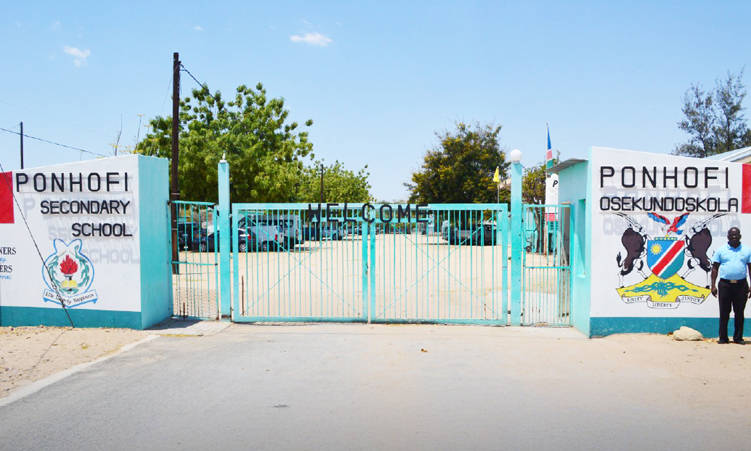
The first high school in the Oukwanyama kingdom, Ponhofi (meaning ‘a central place where most people meet’) was opened in 1976.
Twelve years after its establishment, Ponhofi Secondary School became the rallying point of the 1988 school boycott.
A South African Defence Force (SADF) and police base were built near the school in the late 1970s.
This strategy was used by the SADF to discourage attacks on the base by the People’s Liberation Army of Namibia (Plan) and to isolate Swapo from the population.
This strategy inevitably led to pupils being shot, killed and injured by South African soldiers, as well as being caught in the crossfire when Plan attacked the base.
The names of those killed during the war are inscribed on a plinth at the Ponhofi schoolgrounds. A teacher, Benjamin Nakale, died when he set off a landmine on his way to the school on 9 April 1981.
Hilka Mwanyekange, a pupil, was shot dead, and another pupil lost her leg when they left the schoolgrounds to look for wild fruit and were fired on by the South African forces on 10 February 1982.
Again, on 3 March 1986, a schoolgirl was shot dead and another wounded in the leg.
Then, in the early hours of 12 March 1987, a mortar hit the girls’ dormitory, killing Albertina Nghikongelwa.
Another pupil, Victoria Nghikofa, fell into a coma and died of her wounds at the Oshakati hospital on 16 April 1987.
Seven more girls were injured. Resistance against the presence of South African military bases close to schools in the north of the country reached boiling point when pupils at Ponhofi Secondary School staged an indefinite school boycott, demanding the removal of the base, on 17 March 1988.
The boycott soon spread to 40 primary and secondary schools in solidarity with Ponhofi in other places like Tsumeb, Windhoek, Gibeon, Walvis Bay, Swakopmund and Arandis.
By June 1988, about 40 000 pupils were boycotting school and called for the abolition of Bantu education and for the implementation of United Nations Resolution 435.
In solidarity with the striking pupils, the National Union of Namibian Workers called a three-day stay-away in June 1988 and some 60 000 workers heeded the call.
The strike was called off by the Namibia National Students Organisation in July 1988, but pupils of Ponhofi and two other schools continued their boycott for some time.
The 1988 school boycott, which started at Ponhofi Secondary School, marked the first time pupils challenged the South African government’s continued presence in Namibia on a national scale.
– #PadlangsNamibia #Owambo #Namibia #Africa-Padlangs Namibia (Gondwana)
In an age of information overload, Sunrise is The Namibian’s morning briefing, delivered at 6h00 from Monday to Friday. It offers a curated rundown of the most important stories from the past 24 hours – occasionally with a light, witty touch. It’s an essential way to stay informed. Subscribe and join our newsletter community.

The Namibian uses AI tools to assist with improved quality, accuracy and efficiency, while maintaining editorial oversight and journalistic integrity.
Stay informed with The Namibian – your source for credible journalism. Get in-depth reporting and opinions for
only N$85 a month. Invest in journalism, invest in democracy –
Subscribe Now!