



RACHEL BEZNER KERRSCIENTISTS, politicians and the Pope are not the only ones calling for action on climate change these days.
Farmers are observing changes in rainfall, temperature and other patterns in weather that have spurred them into shifting their farming methods. In fact, while climate change is not a source of scientific contention, how to farm in the future is a hot topic in the scientific realm.
As a social scientist with a background in soil science, usually working in collaboration with other scientists as part of a transdisciplinary approach, I’ve studied different agricultural methods with small-scale farmers in Africa. Perhaps surprisingly, I’ve found that certain low-cost and low-technology techniques, combined with community-led education, offer the most promise.
AGROECOLOGY
Farming, it turns out, produces high levels of greenhouse gas emissions – fertilisers, tilling soil, pesticides and livestock production are responsible for about one third of global greenhouse gas emissions.
At the same time, increased global temperatures are expected to have dramatic impacts on our current abilities to produce food. In Africa, some scientists predict crop yields could be reduced by 20% or more unless changes are made.
Some call for ‘climate smart’ agriculture, which sounds a little bit like more and improved. There could be a number of improvements: fertilisers and pesticides, but applied with greater efficiency; cellphones for farmers in poor countries to get up to date weather advice; genetically-modified seeds that are more drought-resistant.
To be sure, the conventional cocktail of fertiliser and herbicides will help some farmers increase food production in the short term – if farmers can afford these inputs. For many poor farmers, though, such methods would only increase their costs and debt, making it harder for them to compete and leaving them in a more vulnerable situation.
Such was the story of the last Green Revolution from the 1930s to 1960s. The environmental costs of these technical improvements are well known – increased water pollution, reduced biodiversity, and increased greenhouse gas emissions. So not really a ‘smart’ solution at all. Others call for “agroecological” methods – farming practices that mimic nature by adding organic material to soil, planting trees on cropped fields and using natural enemies to attack insect pests. Largely underfunded, this is nonetheless a growing scientific field.
Studies have also shown that agroecological methods can build resilience in the face of climate change. Hurricane Mitch, one of the five most powerful hurricanes of the 20th century in the Caribbean, caused over 10 000 deaths and over US$6,7 billion in damage in 1998. But it came attached with a small blessing: a chance to see whether farm techniques mattered for recovery. Scientists at the University of California, Santa Cruz found that farmers using agroecological methods before the hurricane had more vegetation, lower soil erosion and less economic loss.
Other studies examined the impacts of different farming practices on the response to hurricanes and droughts in Mexico, Tanzania, Sweden and Cuba, all of which found that agroecological methods helped farms withstand damage and recover faster).
CASE STUDY MALAWI
The Soils, Food and Healthy Communities project– in which I’ve been a collaborating partner – has been teaching agroecological methods in hundreds of Malawian villages over the last 15 years and the results have been impressive.
Farmers started planting crops that enhance soil fertility such as peanuts, beans and pigeonpea, which provide a food source as well as other benefits such as a source of cash, livestock feed and even fuelwood.
Families had improved child nutrition and food security was enhanced as well as land quality. These methods are now expanding to thousands of farmers through the Malawi Farmer to Farmer Agroecology project.
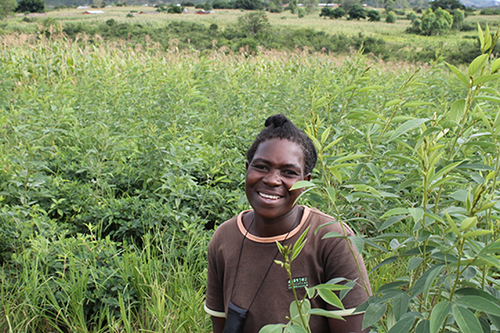
Anita Chitaya is one such farmer. Two years ago, Anita Chitaya faced a tough decision: help her neighbours survive that summer or ensure her family survived for the next two years. Severe drought had decimated her northern Malawi village’s food supply and many of her neighbors’ crops had failed. Unlike everyone else though, she and her husband had enough harvest to last several years, with a bounty of corn, millet, groundnuts, beans, soya, sweet potatoes and cassava. Why? Because Anita had supplied her soils with a rich source of organic material from crop residue.
She used innovative farming techniques such as growing different soil-enriching legumes and rotating her crops. Her hard work led to improved soil quality, which allowed her to grow a wider diversity of crops, and as a result, minimise risks. It turns out that diversifying crops can play a crucial role in helping rural communities adapt to climate change.
Anita joined at a time when her family had poor soils, low food supply and her children were malnourished. She took up the call for experimentation, trying all sorts of different combinations in her fields, and also became a farmer research leader, teaching other villagers about what she was learning.
DEPENDENCE ON LOCAL FOOD
However, Anita and her colleagues face an uphill battle. This year, the Malawi government has indicated that overall crop yields will be even lower, by almost one third, due to drought in the north and floods in the south. Recent reports anticipate severe impacts, particularly on the poor in the next few months. In a country in which the majority of people grow at least half of their own food supply, this news suggests that the coming year will be grim for Anita’s village and many more families across the country.
A recent study found that Africa contributes about 2% of all greenhouse gas emissions, and that is only based on current emissions, not even taking historical emissions into account.
It is not too late – and certainly not too soon – to take heed of Anita’s example, and to support this innovative, farmer-led approach to adapting to climate change, while working to reduce our own climate impacts on our shared planet.
–The Coversation
In an age of information overload, Sunrise is The Namibian’s morning briefing, delivered at 6h00 from Monday to Friday. It offers a curated rundown of the most important stories from the past 24 hours – occasionally with a light, witty touch. It’s an essential way to stay informed. Subscribe and join our newsletter community.

The Namibian uses AI tools to assist with improved quality, accuracy and efficiency, while maintaining editorial oversight and journalistic integrity.
Stay informed with The Namibian – your source for credible journalism. Get in-depth reporting and opinions for
only N$85 a month. Invest in journalism, invest in democracy –
Subscribe Now!