





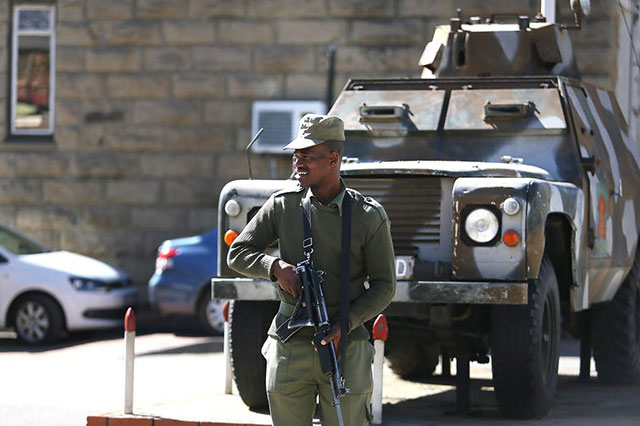
• GEOFFREY THOMAS HARRIS Lesotho allocated US$52,6 million (N$740,6) to its military in 2017 – or 3.9% of government expenditure. This is a figure that has doubled in real terms since 2008.
By any standards – and particularly for a country as impoverished as Lesotho – this is an indefensible amount of money.
The case for demilitarising the tiny country of over 2,2 million is threefold.
First, Lesotho’s military serves no significant security function.
The country is completely surrounded by South Africa, one of Africa’s military superpowers that spends almost 70 times more on its military. It would easily overwhelm the Lesotho Defence Force, which has just 3000 soldiers.
Second, from its inception, the Lesotho military has interfered with democratic processes and engaged in human rights abuses.
Historically, it has been used by the government to thwart political opposition. In 1986, of its own volition it staged a coup and took over political power. In April 1994, a group of soldiers took four government ministers hostage, and killed the deputy prime minister. And in August 2014, the military attempted another coup, but failed.
Third, the country’s poverty levels and poor socio-economic indicators mean that government’s budgetary resources must be allocated with particular care.
Almost 60% of its population earns less than US$1,90 (N$27) a day. At the same time, Lesotho ranks 159th of the 189 countries on the UNDP’s Human Development Index.
Previous attempts to reform the Lesotho military have come to naught. But I still believe that there’s a strong case for Lesotho to demilitarise completely.
Can a country exist without a military?
The simple answer is yes: According to the America’s Central Intelligence Agency there are 36 nations without a regular army although sometimes their police act as de facto military forces.
Take Costa Rica, for example. It’s a country of 5 million people, which demilitarised in 1948 following a civil war.
For decades, the country has been a haven of peace, democracy and prosperity in a region bedevilled by violence and insecurity. In terms of various international indices, it is far ahead of its neighbouring countries. The fact that it doesn’t spend on a military has enabled much higher allocations to areas like education and health.
There are five requirements, however, that seem necessary for a successful demilitarisation. These are:
• widespread acceptance by citizens,
• willingness by political leaders to make the decision,
• a detailed plan,
• an implementing agency such as a ministry of peace, and
• adequate financing.
My focus is on the money it would take for Lesotho to demilitarise.
Compensating former soldiers is a necessary investment to successfully demilitarise. Compensation of personnel in Lesotho’s military for their loss of employment would have to meet the requirements of Lesotho’s Labour Code Order, which stipulates a severance payment equivalent to two week’s wages for each completed year of continuous service. This would cost US$12,1 million (N$170 million).
A more generous approach would be to pay the equivalent of, say, two years of their gross income. This would cost US$59,3 million (N$835 million). Both these amounts would need to be funded by donors.
Evidence from recent reviews of grant-related programmes worldwide shows that cash transfers – like basic income grants – result in improved health and education and lead to higher incomes in the long term.
I would suggest, therefore, that Lesotho would benefit from a basic-income-grant programme, and that monies saved from a long-term demilitarisation initiative could be used to support it.
Data from the Lesotho’s Household Budget Survey estimated the country’s average income – for almost 95% of households – to be US$346 (N$4 871) a year.