


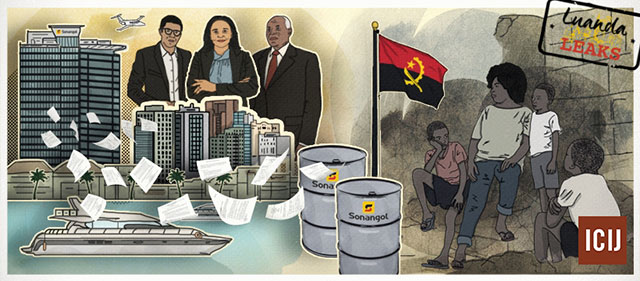
SYDNEY FREEDBERG, SCILLA ALECCI, WILL FITZGIBBON, DOUGLAS DALBY and DELPHINE REUTERISABEL dos Santos made a fortune at the expense of the Angolan people, a leak reveals.
She spun a story the world wanted to believe: a self-made billionaire who had risen in a male-dominated business world in an African country ravaged by civil war and poverty.
In public appearances in 2017, Isabel dos Santos, then head of Angola’s giant state oil company, Sonangol Group, mingled with Hollywood legends and charmed oil tycoons with tales of hard work and accomplishment.
Wearing her trademark black blazer at the London Business School, the then 44-year-old chairwoman told a packed audience that leaders should be chosen on their merits.
“I’ve been managing companies for a long time, starting them from small, building them up, going through every single stage of what it takes for a company to be successful,” she said.
Left unmentioned in London: That she had been installed in the top job at Sonangol by her father, José Eduardo dos Santos, the long-time Angolan autocrat.
That over the years he had awarded her companies public contracts, tax breaks, telecom licences and diamond-mining rights.
Luanda Leaks, a new investigation by the International Consortium of Investigative Journalists and 36 media partners, exposes two decades of unscrupulous deals that made Dos Santos Africa’s wealthiest woman.
Based on more than 715 000 confidential financial and business records and hundreds of interviews, Luanda Leaks offers a case study of a growing global problem: Thieving rulers, often called kleptocrats, and their family members and associates are moving ill-gotten public money to offshore secrecy jurisdictions, often with the help of prominent Western firms.
From there, the money is used to buy properties, businesses and other valuable assets, or it is simply hidden away, safe from tax authorities and criminal investigators.
“The movement of dirty money through shell companies into the international financial system to be laundered, recycled, and deployed for political influence is accelerating,” said Larry Diamond, a senior fellow at Stanford University’s Hoover Institution.
The Luanda Leaks documents were provided to ICIJ by the Platform to Protect Whistleblowers in Africa, a Paris-based advocacy group.
ICIJ found that Dos Santos, her husband and their intermediaries built a business empire with more than 400 companies and subsidiaries in 41 countries, including at least 94 tax havens like Malta, Mauritius and Hong Kong.
Over the past decade, these companies got consulting jobs, loans, public works contracts and licences worth billions of dollars from the Angolan government.
Dos Santos and her husband used their shell companies to avoid scrutiny and invest in real estate, energy and media businesses.
In one case identified by ICIJ, thousands of families were forcibly evicted from their Luanda homes on land that was part of a redevelopment project involving a Dos Santos company.
They also secured large stakes in banks, allowing them to finance this empire even as other financial institutions backed away amid concerns about Dos Santos’ ties to the Angolan state.
Angolan government officials told ICIJ that they are investigating whether Dos Santos and associates looted hundreds of millions of dollars from the state’s oil and diamond-trading companies.
That includes a N$549 million (US$38 million) payment in November 2017 from Sonangol to a bank account in Dubai controlled by a Dos Santos associate, a transfer ordered hours after Angola’s new president fired her from her job as head of the state oil company.
The officials also said that public contracts awarded by her father’s regime to her companies were inflated by more than N$14,4 billion (US$1 billion).
In December, two weeks after ICIJ questioned Angola’s government about Dos Santos’ business dealings, an Angolan court froze her major assets, including banks, a telecom company and a brewery.
The government is trying to recover N$15,8 billion (US$1,1 billion) that it says is owed by Dos Santos, her husband and a close associate of the couple.
Dos Santos and her husband denied wrongdoing and said they did not profit from political connections. Her lawyers denied any wrongdoing, including any allegations of looting, fraud, contract overcharging and other misconduct.
The law firm said Dos Santos did not use offshore vehicles to avoid paying taxes.
In recent interviews, Dos Santos, whose fortune is estimated at about N$28,8 billion (US$2 billion), said the government is on a “witch-hunt” against her family.
Her husband, Dokolo, told Radio France Internationale, one of ICIJ’s partners in France, that the Angolan government is wrongfully targeting him and his wife.
Isabel dos Santos was born on 1 April 1973 in the Azerbaijan oil town, Baku, where her parents met while attending a state university devoted to oil and chemistry.
Her Russian mother, Tatiana Kukanova, was studying geology. Her father – the future Angolan president and “Comrade Number One” – was then an exiled guerilla leader in the Popular Movement for the Liberation of Angola (MPLA).
In an age of information overload, Sunrise is The Namibian’s morning briefing, delivered at 6h00 from Monday to Friday. It offers a curated rundown of the most important stories from the past 24 hours – occasionally with a light, witty touch. It’s an essential way to stay informed. Subscribe and join our newsletter community.

The Namibian uses AI tools to assist with improved quality, accuracy and efficiency, while maintaining editorial oversight and journalistic integrity.
Stay informed with The Namibian – your source for credible journalism. Get in-depth reporting and opinions for
only N$85 a month. Invest in journalism, invest in democracy –
Subscribe Now!