






IT took Shirley Tjijombo about 50 minutes to go through the process of applying for a passport on Thursday at the home affairs offices in Windhoek.
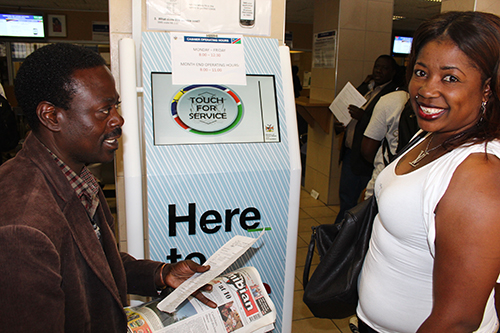
Tjijombo walked in at exactly 12h00. Her first stop was the information desk where she was attended to by Felix Shimooli who helped her to get a ticket with a number for her preferred service.
Armed with ticket number P231, Tjijombo joined the queue, together with 35 others. Checking whether she had all her documentation, Tjijombo’s turn came after about 30 minutes and at 12h50 she walked out, armed with her receipt.
She will expect an SMS from the home affairs office informing her when she could collect her passport. Or better still, Tjijombo can SMS to inquire when the passport will be ready.
“This process is fast and effective. One knows what you are doing from the first point, unlike in the past when one would stand in the wrong queue and when you reach the counter, you are told to move to the other queue,” she told The Namibian.
Although there are still some glitches at home affairs, Tjijombo’s case proves that things have changed for the better in the past three years. However, The Namibian still receives complaints through its SMS pages from dissatisfied citizens.
One of the issues raised by those unhappy with home affairs services is the failure to get death certificates on time, while complaints about delays in issuing IDs have largely come from the northern parts of the country. There has also been unhappiness expressed by foreigners who say they are still waiting too long for permanent residence permits.
Home affairs public relations officer Sacky Kadhikwa confirmed some of the complaints, saying they have also received negative reports on poor responses to client problems by some officials in the ministry.
Kadhikwa said the ministry is planning to call for a retreat where some staff members will be helped to understand customer relations.
Some officials working at the counters said their work has been made easy by the use of computers, because they do not have to process applications manually. At times some applications would get lost and people would have to re-apply.
Caroline Mukanwa who is in the human resources department said that, apart from the computers, they feel more appreciated by minister Pendukeni Iivula-Ithana, who visits offices engaging officers on various issues.
“She has a motherly heart which accommodates everyone, from cleaners to top managers,” Mukanwa said.
She also said the turnaround strategy group taught them how to prioritise to reduce the backlog in leave applications and overtime payment.
In an interview with The Namibian last week, Iivula-Ithana said it was no secret that home affairs was in the spotlight for all the wrong reasons for many years, because of poor service delivery. She vowed to change this when she took office in 2012.
First, she identified the root causes of the problems and then came technology that saved the day. She said the ministry had not been given enough attention in terms of resources such as human capital. “Having been here once before, I probably came in from the entrance where everyone enters. As minister, I use another entrance. It showed me how old the building was. I got frightened, literally. I thought the building was going to collapse on me,” she said.
She said apart from the dilapidated building, staff members were also overwhelmed by the amount of work. “When someone works in such conditions they reach a point where it does not matter any longer. Even if you try, you can only achieve so much. That spirit kind of sets in and those who were entrepreneurial found a way of doing it in another way,” she said.
She also said if information is not captured digitally, officials have to check through loads of files. “That can take up to a day and there is no one at the counter to deal with new arrivals.”
Iivula-Ithana said they have put systems in place to help capture information and the process has become much faster and easier.
She further said her ministry has a mission to bring services closer to the people, and advocates that all children should be registered at birth, even in remote areas. All deaths should also be recorded for planning purposes.
“Centres are very far and people walk long distances. If we can reach there, then I can sit back and say we have provided services,” she asserted.
The minister said for children of the liberation struggle who have no documentation, home affairs relies on affidavits from a village headmen, the police or anyone in authority.
She hopes that by July or August 2015, the ministry will have mobile registration for identification documents in rural areas and that village headmen should inform communities accordingly.
“We want to register all children turning 16. Adults can also make use of that opportunity, particularly the elderly, so they are not deprived of their N$1 000 [monthly pensioins]. I put my mind to what I do. I push it through at any cost. It’s not just a matter of pushing, however, it’s taking others with you,” she said.
So far the ministry has eliminated a backlog of 45 861 applications, some dating back to July 2013. A backlog of more than 3 000 passport applications was eradicated within the first month, reducing the average waiting period for a passport to two to three days.