



The 80s were the height of the fight against apartheid in South Africa.Cape Town saw the rise of various anti-apartheid activists and warriors from the Cape Flats who fought alongside the African National Congress (ANC).
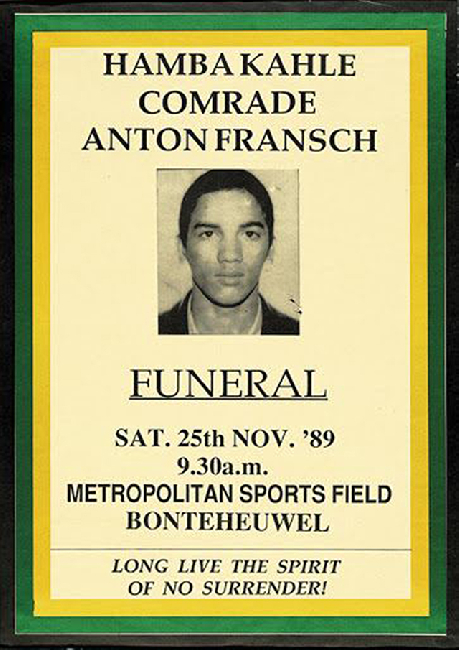
Anton Fransch was one of the fallen heroes of this battle and his story, although short and tragic, echoes of heroism and a spirit of ‘never surrender’.
Born in Bonteheuwel in 1969, Fransch was the second youngest of seven siblings and is said to have been a child always up to mischief, however, eager to help where he could. He attended Modderdam High School and joined the Congress of South African Students as resistance against the apartheid regime was intensifying. He also joined the Bonteheuwel Military Wing. Inspired by fellow resident and freedom fighter, Ashley Kriel, Fransch became involved with the armed-forces wing of the ANC, uMkhonto we Sizwe (MK). Along with Kriel, Fransch became a target for the Bonteheuwel unit of apartheid security police and in 1986, a year after Kriel left for Angola, Fransch was also instructed to leave and receive military training. This decision came after the 17-year-old was featured as a fugitive and terrosist on the apartheid television show, ‘Police File’.
Following in Kriel’s footsteps, Fransch quickly achieved a reputation amongst the ranks for his natural gift as a fearless guerrilla soldier receiving training in various weaponry, explosive engineering, first-aid and warfare. He led several successful raids and military operations against the apartheid South African army. Best friend and comrade, Adil November, described Fransch as a “guerrilla of a special type and a special calibre” and fellow soldiers under his command say he always ensured everyone was in high spirits, especially during the gloomy times.
A natural charmer and skilled smuggler, Fransch had the ability to always obtain food and luxuries while fighting in the bush as a guerrilla.
More than two years later, in 1989, Fransch returned to South Africa under the alias David Govender and was tasked to intensify the armed struggle in the Western Cape. He rented a room in a double-storey house in Athlone, with the Noordien family, who knew him as Mohammad. On 6 November that year, the security police interrogated another comrade who knew Fransch’s whereabouts and threatened to kill his mother and nephew, and as a result he gave up his location – a move that would be frowned upon by Fransch’s close friends and brothers in battle. What followed was one of the most epic and iconic stand-offs in the entire fight against the oppressive government – Fransch’s last battle, ‘The Battle of Athlone’.
Just past midnight on 17 November 1989, security police and the South African Defence Force started building a perimeter around the Noordien house in Church Street. Taking up positions all around leaving Fransch with no escape route, they called out for him to surrender. With no response, the police headed towards the house and entered and fearfully retreated quickly with only the Noordien family in their possession – they would battle on Fransch’s terms. Close to 01h00, the police opened fire on Fransch who refused to surrender, responding only with a defiant laugh and “come and get me if you can!”. He was only armed with explosives, a pistol and an AK-47 assault rifle.
A gun fight ensued with Fransch managing to dodge each and every bullet fired at him and shooting back from strategic points within the house. Frustrated, the forces called for more reinforcements and at around 03h00, a Casspir rammed the wall of a neighbouring house and was positioned where they though Fransch was hiding. The fighting became more intense from this point onwards with Fransch seemingly having an unlimited supply of ammunition.
The battle lasted for another three to four hours, with Fransch refusing to surrender and taking on an entire small army by himself.
After a six-hour gun battle, an apartheid riot squad sergeant was authorised to make use of grenades. Making his way to a nearby roof a short while later, he pulled the pin and tossed the grenade through a window where they thought a tired Fransch had positioned himself, a loud bang ensued with a deafening silence falling over Athlone.
The Truth and Reconciliation Commission final report, Volume 2, on the matter states: “A Riot Squad sergeant was finally authorised to throw a grenade into his room, but security forces allege that, before it was thrown, there was a detonation in the room. Police penetrated the house and found the disfigured body of Anton Fransch with the rest of the ammunition. There has been persistent speculation as to whether the last grenade was self-detonated in a final act of suicide, or whether it was thrown by the security forces.”
At 20 years old, a brave son of the Cape soil laid down his life for his people and a worthy cause.
With a personality and qualities that not only made him a pleasant young man, but also a fearless guerrilla fighter able to take on squads on his own, Fransch’s name is synonymous with selflessness and courage as he became martyr of Athlone.
– With additional information from colouredsa.co.za and sahistory.org.
– @JonathanSasha on social meda.