



Read that headline again – I bet you read it wrong.
I was reading an article a few days ago by a colleague on the skyrocketing prices of a basic food standard in most Namibian households – beef stew.
Beef being so prominent in many dishes and cuisines in Namibia makes it a hallmark of home cooking, with each family having its own variation of the dish.
Therefore, it becomes highly problematic when the one thing we depend on starts becoming out of reach. If we can’t eat at an affordable price, what then are we doing?
Without politicising a food blog, I thought perhaps exploring alternative proteins should be normalised beyond the current.
I’ve championed the consumption of game meat, but its acquisition is not easy at times, making it a challenge for some.
If you’re in Windhoek, the options are endless, but start moving outwards and you can see first-hand that it is not readily available.
The availability of goat meat – chevon – or mutton has become more and more essential.
Well, one can eat as much chicken as one can handle, until you feel like you are not biting into real meat any more.
I journey to and from our neighbour Botswana quite often, and one thing I’ve discovered is that more often than not you will find yourself in a home where goat is consumed more during the week than any other protein.
At an average of N$1 500 for a decent beast, you can feed the family for quite a bit. A leg can even go to the annoying cousin who visits and never leaves until after dinner.
Goat has been seen as polarising by a lot, with the preparation seemingly daunting. The main issue? Some say it’s the smell of the meat cooking.
But that seems to be the case only when you’re not used to preparing goat on a regular basis. The same could be said to someone who is not big on the smell of beef as it boils.
Cue the vegans.
The Approach
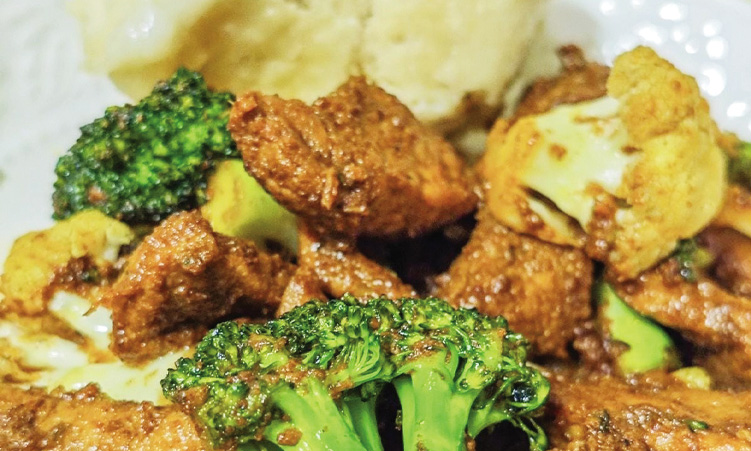
Cooking goat meat lies in the approach. There are a few standards that have to be within my reach for me to have a good cooking session. Some like it braaied or cooked whole on the fire, but for me, it is a meat I almost always stew.
So, when it gets a bit chilly or I want something hearty, the goat comes out. Warm, fiery spices like paprika, turmeric, black pepper, onion powder and a whole lot of fresh garlic, ginger and tomatoes are the foundation.
Cooking the meat from start in those spices eliminates the horrid scent you’re worried about and is guaranteed to provide a flavourful dish.
The Process
A three-legged pot is the ultimate approach, but apartment living has limited my options on that front, leaving me with my trusted pressure cooker. You want your meat cooked through, soft, falling off the bone. So if you don’t have the luxury of outdoor camping/village style cooking or time, get a pressure cooker, throw everything in there and get going with something else. Alternatively you can try a “pulled goat” version, where all you cook it in is salt and you let it boil down till the bones come off clean, pound it, and serve. Brilliant.
The Supporting Act
The sides are as essential as the protein itself. Pap is a standard. That’s not debatable.
African dumplings are a close second; you know the ones that will leave you feeling like you can’t do anything for the rest of the day. Spicy cabbage, kale or spinach are good additions, and because all the tomato jazz is in the stew itself, you’re on your way to a winning dish.
So take a look at that goatie and consider throwing it on your plate, and hopefully it will put less pressure on your pocket.
Don’t forget bulk is your friend.
If you have no space, share with friends.
Enjoy!
In an age of information overload, Sunrise is The Namibian’s morning briefing, delivered at 6h00 from Monday to Friday. It offers a curated rundown of the most important stories from the past 24 hours – occasionally with a light, witty touch. It’s an essential way to stay informed. Subscribe and join our newsletter community.

The Namibian uses AI tools to assist with improved quality, accuracy and efficiency, while maintaining editorial oversight and journalistic integrity.
Stay informed with The Namibian – your source for credible journalism. Get in-depth reporting and opinions for
only N$85 a month. Invest in journalism, invest in democracy –
Subscribe Now!