



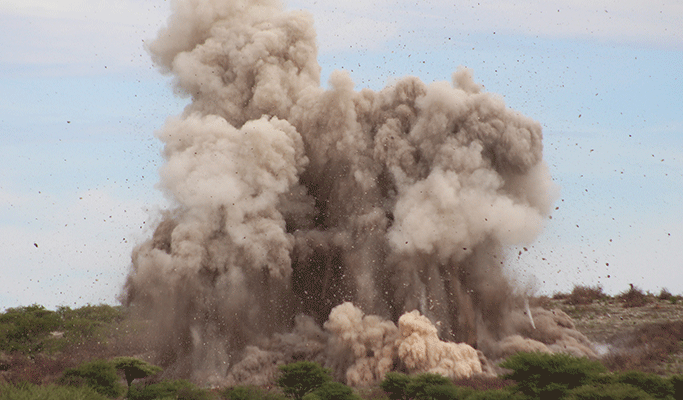
ABOUT 30 Cleveland farmers outside Otjiwarongo town fear for their health if the blasting for limestone that started on the farm on Friday leads to the contamination of their only source of water.
Whale Rock Cement, through the Cheetah Cement brand, started blasting at the site during an event attended by land reform minister Utoni Nujoma, several government officials and members of the public.
The company is a joint venture between Namibian and Chinese investors.
The Otjiwarongo municipality leased a portion of the farm to Whale Rock Cement for 50 years in 2005 on the understanding that the company will make a once-off payment of N$10 million to the community development fund.
The farmers have been staying illegally at the farm since around 2005 after which they were allowed by the late governor of Otjozondjupa, Rapama Kamehozu, to stay on, pending resettlement.
Otjozondjupa governor Otto Iipinge, whose cattle also once grazed at the farm, said the farmers should move out.
Iipinge confirmed he had moved his cattle from Cleveland to another farm in the Kalkfeld area.
Nujoma said as far as he is concerned, the farmers at Cleveland do not exist.
“Which farmers? I do not know them,” he told at the site on Friday.
Although he denied the farmers’ existence, Nujoma said they were there illegally, and should move out.
Nujoma could, however, not say where the farmers should move to after declaring that the matter was not supposed to be addressed at the event as it is a different issue altogether.
Addressing the gathering, Nujoma praised Whale Rock Cement, and wished the company good luck.
Whale Rock Cement director Zhengwen Wang assured the public that the company will try to uphold regulations and standards concerning environmental protection, labour safety and laws as well as industrial health.
Zhengwen also said the project was divided into two phases – the construction of a cement grinding system, and the construction of the cement clinker line. Clinker is the mixture of clay and limestone from which the cement will be made.
He further said the first phase started in April 2017, and was completed in November 2017.
According to Zhengwen, the cement production will promote Namibia’s construction industry, improve people’s living environment, improve the level of urbanisation and significantly stimulate the development of the local economy and add a large number of jobs and associated industries.
Whale Rock Cement chairperson Zedekias Gowaseb spoke about some technical aspects of the project and how they have complied with various assessments before the operations started.
Deputy finance minister Natangwe Ithete told n that the cement plant is one of the foreign direct investments that should be encouraged.
“It has an automatic value of 1,2 tonnes of cement, and we only need half of that, and the rest can be exported. It means employment for our people, and it will inspire the youth to study in related fields such as engineering,” he said
Ithete said the investment would be permanent even when the Chinese move out.
He, however, expressed hope that Whale Rock would not become another white elephant like the defunct Ramatex factory in Windhoek.
Ramatex was a Malaysian textile factory set up in Windhoek’s Otjomuise location back in 2001, only to close shop overnight in 2005, leaving more than 4 000 people jobless.
In an age of information overload, Sunrise is The Namibian’s morning briefing, delivered at 6h00 from Monday to Friday. It offers a curated rundown of the most important stories from the past 24 hours – occasionally with a light, witty touch. It’s an essential way to stay informed. Subscribe and join our newsletter community.

The Namibian uses AI tools to assist with improved quality, accuracy and efficiency, while maintaining editorial oversight and journalistic integrity.
Stay informed with The Namibian – your source for credible journalism. Get in-depth reporting and opinions for
only N$85 a month. Invest in journalism, invest in democracy –
Subscribe Now!