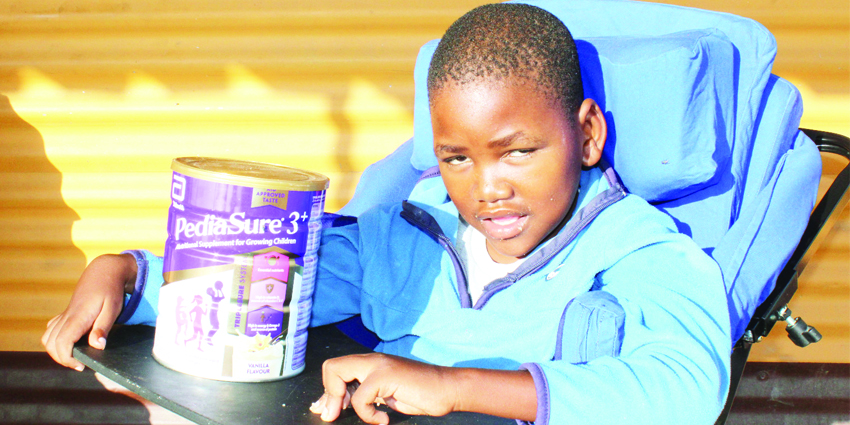
An Okahandja mother says she has spent the past 10 years caring for her son, who developed tuberculosis (TB) meningitis as a baby and still struggles to eat, speak and breathe properly.
Benovia Kock (39) says her son, Daniel Ndakolote (10), was born healthy, but everything changed when he was six months old.
“He just got sick. He was feverish and he couldn’t breathe properly,” she says.
Kock says repeated hospital visits initially focused on Daniel’s breathing difficulties and persistent fever, before doctors diagnosed him with tuberculosis, which later developed into TB meningitis.
From there, Daniel was admitted to Katutura State Hospital, where he spent nearly two years, including one full year in the intensive care unit (ICU).
“We stayed there almost two years. He spent a whole year in ICU,” Kock says.
The prolonged hospital stay took a heavy emotional and financial toll on the family.
Kock says she was working as a domestic worker at the time, but eventually lost her job.
“It was very difficult financially. I lost work and stayed with him at the hospital,” she says.
Kock says nurses often stepped in to support her with toiletries and other essentials while Daniel was admitted.
After her son was discharged, doctors warned Kock that he may never speak and develop like other children.
“They were saying he would not talk,” she remembers.
Today, Daniel can speak English and Afrikaans, but continues to face serious health challenges, particularly with eating.
Kock says he can only tolerate soft porridge with milk or softened cereal mixed with butter and milk.
“Any other food goes in and comes out. We don’t know what the problem is,” she says.
Because of this, the family still makes regular trips to Windhoek Central Hospital, where Daniel receives speech therapy and ongoing assessments.
Kock says doctors are expected to conduct further checks later this month to determine why he continues to vomit.
Daniel depends on specialised milk supplied by the hospital, as well as vitamins, juice and nappies.
His mom says the cost of these items has become overwhelming, especially when hospital supplies run out and she has to buy them herself from a pharmacy.
‘THE MONEY IS TOO SMALL’
“The money is too small. The milk is very expensive, and if it finishes at the hospital, I must go buy it myself,” she says.
Daniel needs about four nappies a day, with a pack of about 14 costing around N$460.
Kock, who now stays home full-time to monitor her son’s condition, says she can no longer take regular cleaning jobs because her son requires constant supervision.
“The doctor says I have to stay with him 24 hours a day.
I can’t leave him with people,” she says.
But her care-giving responsibilities extend beyond her child.
Kock is also looking after her brother, who suffered a stroke last year after falling during an epileptic episode, leaving him with speech difficulties and mobility challenges.
Despite both her son and brother receiving social grants, Kock says the money is not enough to cover milk, nappies and transport to hospital appointments.
“I just need help with milk and nappies. Those are the most important things for Daniel,” she says.
For Kock, her son’s survival is already a victory after the grim prognosis she was once given in the ICU.
Still, every day remains a struggle to meet his medical and nutritional needs.
TB MENINGITIS
Dr Tuhafeni Nakale says TB meningitis is a life-threatening infection of the brain and spinal cord membranes caused by Mycobacterium tuberculosis.
“It is the deadliest form of tuberculosis, often causing significant mortality and long-term neurological damage if not treated immediately,” he says.
“Symptoms usually develop gradually over weeks, beginning with fever, feeling sick, headaches, vomiting, confusion, neck stiffness (often absent in young children), and cranial nerve palsies, lethargy, coma, seizures, and severe neurological deficits which can last for the rest of the patients lives,” he says.
Nakale says TB meningitis is difficult to diagnose in paediatric patients as it presents with different pictures or symptoms.
General practitioner Dr Cornelia Ndifon says when a person has the bacteria that causes TB in the lungs, that bacteria travels from the lungs through the bloodstream to the brain and infects the brain and the spinal cord.
“It is a severe form of TB and it causes the person that is so affected or infected to complain about a severe headache.
“Sometimes the person becomes confused.
If it is not treated promptly, it could cause permanent brain damage and it does have a high fatality rate, particularly when people are unable to get to the right hospital on time or maybe they are not able to detect that it is TB meningitis,” she says.
Ndifon says the condition is also called extra-pulmonary TB, travelling from the lungs through the bloodstream to the brain.
“Then it infects the brain and the spinal cord.
It can kill and requires aggressive treatment so the person is completely cured, and if they don’t die, they can lead a normal life after that,” she says.