



THE secretary general of the Namibian Paralympics Committee, Mike Hamukwaya has called for more government funding in the wake of the team’s outstanding performance at the 2016 Rio Olympic Games.
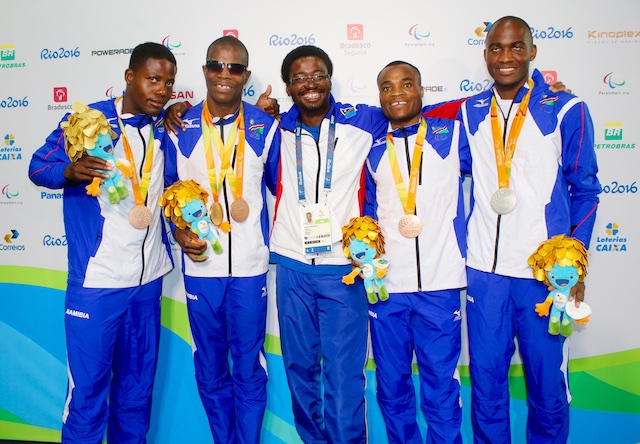
Namibia won five medals in total – one gold, two silver and two bronze – which was a marked improvement on its previous Games (two medals in 2012 and one in 2008).
In an interview with Nampa, Hamukwaya said that they received less than the Olympic athletes, but still produced more medals.
“We only got N$1,5 million to prepare for these games, while the other athletes got over N$2 million from the government. If you look at it, 90 per cent of the medals at international events always come from disabled athletes,” he said.
“We want to be in the top 10 nations in the world when it comes to medal standings, but that can only happen if we have enough money to prepare and to bring a bigger pool of athletes to competitions. The government must pump more money into the training of Paralympic hopefuls, then we can deliver more results,” he added.
Hamukwaya said they hope to take a bigger team to the 2020 Paralympic Games in Tokyo, Japan, but that would depend on better investment.
“We are getting N$1,5 million and we are delivering. I am calling on the government to avail at least N$50 million to disability sports per year, then we can do more in terms of development and finding more talent,” he said.
Namibia’s five medals in Rio were won by two athletes – Ananias Shikongo and Johannes Nambala.
Shikongo joined Johanna Benson as Namibia’s only gold Paralympic medalist when he won the Men’s T11 200m final last Thursday, 15 September.
Shikongo won in a new Paralympic record time of 22,44 seconds which was just 0,03 seconds outside the world record set by David Brown of the United States two years ago. This time, Brown didn’t even make it to the final after being eliminated in the semifinals, and Shikongo won the gold ahead of two Brazilians – Felipe Gomes (22,52) and Daniel Silva (23,04).
Four days earlier Shikongo won a bronze medal in the T11 100m final.
Nambala won two silver medals – in the T13 100m final on 9 September, and in the T13 400m final on 15 September when he broke the world record, but was pipped to the line by Mohamed Amguoun of Morocco.
Speaking to Nampa on Saturday, Hamukwaya said the coaching staff was pleased with the achievements of the athletes, as they had reached their set goals.
“We targeted five medals and we got them. The only thing we missed is winning two golds, but we managed one and we are happy that we at least reached our five-medal target,” he said.
“Shikongo has come a long way with the Paralympic Games and he has finally delivered after all these years of hard work. As for Nambala, this is his first Paralympic Games and he won us two silvers, which is a good thing,” he added.
Hamukwaya added that other athletes should use the two athletes’ performance as motivation to do better for their country at future events.
“In 2008 at the Beijing Paralympic Games, Reginald Benade won a (bronze) medal for Namibia, while Johanna Benson won Namibia’s first Paralympic gold medal at the 2012 London Paralympic Games. She also claimed a silver medal but it was still an individual athlete winning all the medals. We now have two athletes who won medals, which is motivation for us to do better if we want more medals in future,” he said.
On completion of the Paralympic Games on Sunday evening, Namibia had finished 53rd overall out of 163 competing nations, and eighth overall out of 44 African nations.
China won the most medals with 239 in total, followed by Great Britain (147) and Ukraine (117).
Nigeria was the top African nation with eight gold and 12 medals in total, followed by Tunisia (seven gold, 19 in total) and South Africa (seven gold, 17 in total).
In an age of information overload, Sunrise is The Namibian’s morning briefing, delivered at 6h00 from Monday to Friday. It offers a curated rundown of the most important stories from the past 24 hours – occasionally with a light, witty touch. It’s an essential way to stay informed. Subscribe and join our newsletter community.

The Namibian uses AI tools to assist with improved quality, accuracy and efficiency, while maintaining editorial oversight and journalistic integrity.
Stay informed with The Namibian – your source for credible journalism. Get in-depth reporting and opinions for
only N$85 a month. Invest in journalism, invest in democracy –
Subscribe Now!