




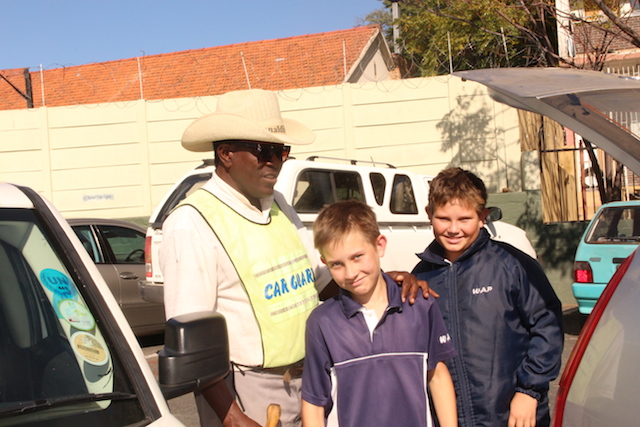
FESTUS Mukungu is a responsible family man who takes pride in doing a job that is looked down on by many.
On most days, 53-year-old Festus goes to work just before the sun rises at 05h00. His ‘office’ is a street corner located on the Woerman Brock parking area in Klein Windhoek.
Festus is a car guard, but considers himself a businessman and an entrepreneur. He and many others like him are paid by car owners to keep watch over their vehicles, while they buy groceries, eat at restaurants or run small errands.
“My work is simple but it takes a lot of discipline. I have been doing this for 13 years now,” Festus, who is always neatly dressed, says proudly.
Before he continues to tell his story, he briefly excuses himself and runs to direct a customer to a parking spot. He asks the woman emerging from the car whether she wants him to keep an eye on it. The woman ignores him.
Slightly disappointed, he returns. “That is what we go through sometimes, but even if the owners say no or ignore us, we look after the cars anyway. There is just no way one can ignore a car that is being broken into,” he says, holding a wooden stick he uses to coordinate motorists in the parking area.
When asked if he uses the stick for protection, he smiles and says “No. In the Herero culture a man must always carry a stick with him. This goes to show that he is the head of your house.”
While he tells his story, Festus keeps a keen eye on the cars driving into the parking lot. “To make it as a successful car guard, you must be respectful. Don’t steal from motorists and never fight or argue with them. It’s that simple,” he says before running to yet another customer.
The 53-year-old explains that on a good day he makes close to N$100 and at the end of the month the money goes up to N$200 a day. He says that people give anything between a dollar and N$10.
“It’s good money, especially for me. My four grandchildren live with me and they need support. My children are all grown up and I am taking care of their children. As a grandfather, it is my duty to take care of my children’s children. With this money I cover food, school uniforms, clothes and even medical expenses” Festus explains.
When told that car-guarding is usually a thing for the homeless, Festus begs to differ.
“No, no. This is a job just like any other. It would be nice if people could acknowledge that. Anyone can do it, especially in times when unemployment is so high. I support my family and make a living with what I get here. I know a lot of people, from the President when he was still the Prime Minister, to ambassadors, businesspeople and tourists. They are all my customers,” Festus says.
After a few rounds in the lot, it gets quiet and Festus decides to take a break. Sitting on an upturned milk crate in his ‘office’, he says that as a man he was often undermined and sometimes laughed at. Only when people saw how well he was doing, they started taking him seriously.
“In life, if you do something with passion and patience, people will eventually respect you. The only downside of this job is that there is no medical aid or pension, which is why I save for my December holidays, so that I have enough to feed and dress my family,” Festus says.
As his clients return to their cars–some with shopping–bags he quickly jumps to assist them. It is clear that Festus has a good relationship with most of his clients and as they pay him, he graciously accepts with a “Thank you and have a nice day.”
One of his clients, Tjikari Karuaihe, says that people should respect car guards because they provide motorists with a service.
“I really appreciate car guards, especially Festus. He always helps me with parallel parking and assists me when I drive out, especially when it is busy. I appeal to fellow motorists to really start seeing car guards in a different light,” Karuaihe pleads.
It impossible not to notice how often Festus’ efforts seem to go unnoticed, but he still continues to be friendly and is full of energy when a car enters the parking lot.Fellow car guards describe Festus as a person of integrity who shows them how to be disciplined. They see him as an inspiration during a time when hard work is no longer considered the norm.