




Namibia faces a skills mismatch, with vocational training oversupplying administrative graduates while undersupplying the essential technological expertise needed for emerging sectors like green energy.
This is according to the latest report by the Namibia Investment Promotion and Development Board (NIPDB), titled ‘State of Skills Demand and Supply’, released last week.
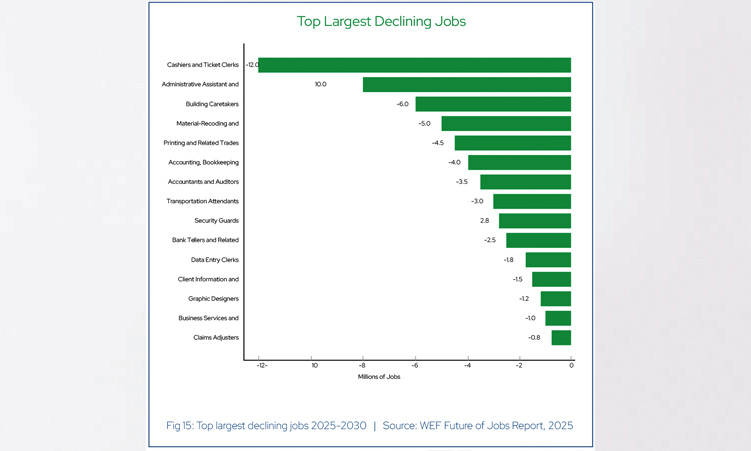
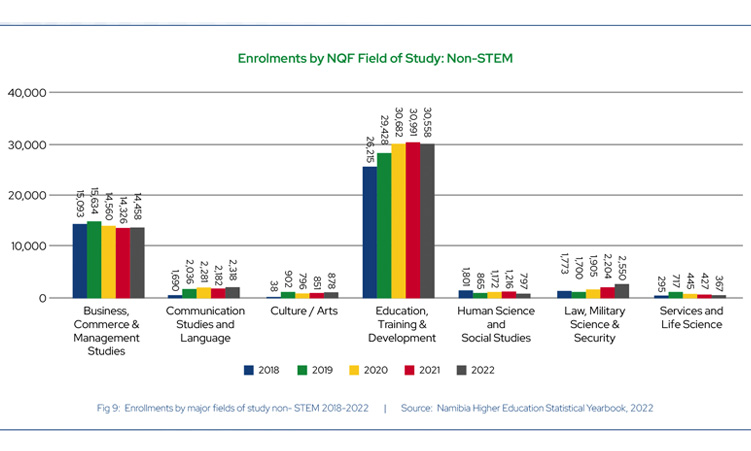
“One of the declining professions globally according to the World Economic Forum is administrative assistants and executive secretaries. According to Table 4, office administration has the highest graduation percentage.
“If the trend continues, this specific trade will be oversupplied and become redundant in years to come,” the report says.
It urges the government to import critical skills in new emerging sectors such as the energy industry by relaxing visa requirements for high-value skills not available domestically.
The report recommends that the Ministry of Education, Innovation, Youth, Sport, Arts and Culture should determine critical skills and provide a quota to higher education institutions to supply those skills to the labour market.
Office administration now accounts for the highest share of vocational training graduates in Namibia – even as the job itself ranks among the fastest-declining occupations worldwide, driven down by technology.
‘JOB MARKET TOO OLD’
The NIPDB rang the alarm, warning that Namibia’s job market is too old.
The Namibia University of Science and Technology (Nust) in September launched the Ignite GH2 project, a joint initiative with Germany, to build local expertise in the green energy sector.
Former Nust vice chancellor Erold Naomab said during the first phase, more than 700 unemployed young people will undergo practical training over the next two years, mainly through the Namibia Institute of Mining and Technology.
The programme emphasises the inclusion of women and young people to ensure the sector’s growth benefits wider society.
The university said Namibia risks a severe shortage of skilled labour in its emerging green hydrogen industry, with a gap that could reach 130 000 workers by 2040, hence the initiative.
Meanwhile, the NIPDB report says employer expectations for the evolution of skills in the next five years and technological skills are projected to grow in importance more rapidly than any other type of skills.
Skills such as artificial intelligence (AI) and big data skills top the list as the fastest-growing in importance, followed closely by networking, cybersecurity and technology literacy.
Cloud computing, artificial intelligence, robotics, digital literacy, advanced coding, advanced cybersecurity and programming, instrumental skills, digital collaboration and communication skills, as well as basic coding skills are also mentioned.
NIPDB executive for talent, innovation and productivity Julia Muetudhana wrote on social media last week that Namibia’s outdated occupational classifications aggravate the problem, noting that the current framework was last updated in 2004.
“Our top-five economic sectors and the top-five skills we are providing as a country do not match.
Globally, the question is always: How is your education system feeding your high-performing sectors? In Namibia, the answer is clear, it is not,” she said.
NIPDB chief executive Nangula Uaandja says Namibia has the potential to create more jobs if training systems, policy support and industry needs come together with a shared plan.
According to deputy minister of education Dino Ballotti, Namibia’s economy is shifting toward more complex and technology-driven sectors, shaped by global trends like digital transformation, green transition and demographic change.
“The country cannot compete or grow without a workforce equipped with the right skills, further highlighting the importance of entrepreneurship, stronger career guidance and curriculum reform to ensure young people are prepared for the future economy,” he said in a speech last week.
Ballotti reaffirmed the government’s commitment to using the report as a foundation for improved planning and a more responsive national skills system.
FARMING STILL IMPORTANT
According to Namibia’s Labour Force Survey, agriculture remains one of the most important sectors for employment, particularly in rural areas, where it provides livelihoods for about 20% of the population.
Despite its significance, this sector continues to face substantial skills gaps and challenges related to workforce development, the report states.
A key concern is the low rate of formal training and qualification among agricultural workers.
In 2022, the National Council for Higher Education reported that out of 12 140 graduates in Namibia, only 240 completed studies in agriculture, representing a mere 1.97% completion rate.
This reflects a broader issue: Only about 11.2% of people employed in agriculture are considered skilled, leaving nearly 89% of the sector’s workforce unskilled.
This lack of technical expertise and skilled labour inhibits innovation, productivity improvements, and the sector’s ability to adapt to changing market dynamics and technological advancements, the report says.
In an age of information overload, Sunrise is The Namibian’s morning briefing, delivered at 6h00 from Monday to Friday. It offers a curated rundown of the most important stories from the past 24 hours – occasionally with a light, witty touch. It’s an essential way to stay informed. Subscribe and join our newsletter community.

The Namibian uses AI tools to assist with improved quality, accuracy and efficiency, while maintaining editorial oversight and journalistic integrity.
Stay informed with The Namibian – your source for credible journalism. Get in-depth reporting and opinions for
only N$85 a month. Invest in journalism, invest in democracy –
Subscribe Now!