



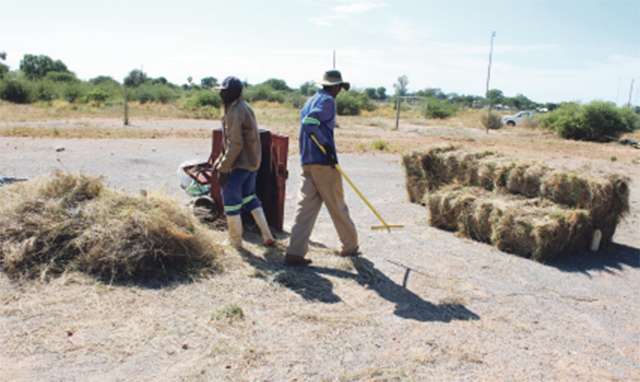
LIVESTOCK farmers, who have been forced to the roadside by the ravaging drought in their respective farming areas, are now literaly living on the edge in a bid to save their animals.
The farmers have now taken to driving their livestock into open grazing along national road corridors, where the grass has been untouched due to limited grazing activity. For them, these have become corridors of life.
The farmers travel long distances along these corridors daily with their livestock, and camp at self-designated spots along the corridors for the night, while animals are placed in makeshift enclosures.
While these attempts are made in good spirit, such actions are nonetheless frowned upon by standing regulations.
Existing laws mark the portion of land along road corridors as falling under the Roads Authority (RA). As such, any activity on it should be authorised by the RA.
Also, the same laws give preference to farmers whose farms are adjacent to these corridors for grazing rights. Simply put, these farmers can decide to grant or deny grazing rights to others.
Former president Hifikepunye Pohamba declared a drought emergency in 2013, and president Hage Geingob has declared two state of emergencies on drought – one in 2016, and another early this year.
One such area where livestock farmers are relying on corridors to save their animals from certain death, is the Ovitoto communal area.
Ovitoto-based Kambekura Farmers’ Association chairperson Japhet Karamata last week raised the alarm on the hardships faced by farmers grazing along road corridors.
He said farmers in the Hochfeld and Osire areas have had a tough time over the past few months in corridors, with no assistance coming from the owners of adjacent farms.
Karamata sexplained that some are being denied water, while others are being prevented from grazing their animals in the corridors.
He expressed unhappiness that Ovitoto is already an area where grazing has been scarce due to the overcrowding of farmers.
There are over 42 000 large livestock and close to 6 000 small stock in the Ovitoto area.
Karamata thus called on commercial farmers in the Hochfeld and Osire areas to empathise with the farmers who are looking for grazing in the face of the devastating drought.
He further said the area of Ovitoto was reduced to its current size by the colonial apartheid regime, which wanted to set up Von Bach Dam.
“The Ovitoto land used to extend all the way to Okahandja, where the NamWater facility stands on the side of the road. But farmers were pushed deeper to where they are now in the name of setting up the dam. This shows we were already suffering even more from a lack of grazing before this drought, which has now worsened things,” Karamata continued.
A farmer in the area, Merakana Kazombiaze, who has taken to the corridors himself, said the drought has affected him badly as he faces challenges of access to water and grazing.
According to him, some farm owners along the corridors threaten them every day, telling them that they will be shot if they do not leave with their livestock.
“These would be fellow black people and white people treating you this way. I want to say that the land on these corridors belongs to the government. To those who live on resettlement farms, the corridors belong to the government, and for us who come from communal reserves, we form part of the government. So please, let us help each other as per this case of emergency that we are facing, instead of them chasing us away,” he pleaded.
Venamambo Kapayi, another farmer from Ovitoto, who has taken to the Midgard corridor, said farmers often accuse him of cutting down fences in an effort to frustrate him into leaving the area.
An expert on roads infrastructure, Horst Schommartz, said the land belongs to the government because of the roads infrastructure on it, but the farmers would own the right to the grass growing in the corridors.
He said farmers trekking are allowed to graze their livestock as they go, but that they would need to apply for a permit from the Roads Authority, and also for permission of the farm owner in the area in which they are grazing livestock.
Schommartz said this is contained in the Road Ordinance Act of 1972, which is currently being amended.
Phillip Luhl, an expert on land matters, told The Namibian that the land in the corridors is owned by the respective farmers, and they pay land tax for it.
“But there is a public right of way on that land, which means the farmer has to allow others the right to pass through (trekking) with animals from point A to point B,” he added.
The act further states that there must be documents showing proof of ownership, and if that person is not the owner or a lessee, then they must get permission from the farm owner, and apply for permission from the authorities as well.
The Agricultural Employers Association’s principal officer, Danie van Vuuren, said grazing in the corridors is prohibited by the Road Ordinance Act, even for the landowners themselves.
He said the act only allows for the moving of animals from one place to another through the road reserves, and further states that the animals must travel or move at least 15 kilometres a day.