


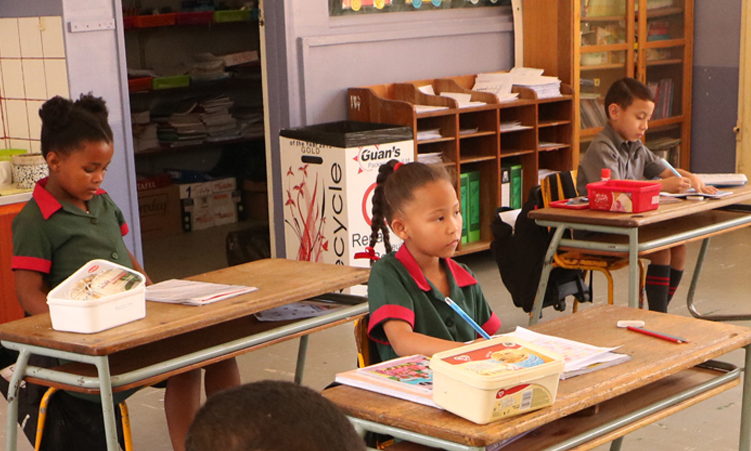
The government has developed a school grant policy to address challenges caused by a larger chunk of the education budget being allocated to teachers’ salaries, while textbooks and stationery remain underfunded.
The policy was tabled for approval in the National Assembly on Tuesday.
Budget documents show that 77.7% of the education budget goes to 33 322 teachers countrywide, while 5% represents N$970 million. The overall staff complement is 43 100.
In the 2023/2024 financial year, the government spent just over N$13 billion on personnel costs out of the N$16.6 billion budget.
For that year, operational costs went up to N$15.8 billion and N$784 million was spent on development.
The Ministry of Education, Arts and Culture in the policy says personnel expenditure is much higher than non-personnel expenditure, with the bulk of the education budget allocation going to teachers’ salaries.
“Underfunding of textbooks, stationery and other learning materials has contributed to poor-quality education as reflected by high repetition and dropout rates at junior secondary level, and high failure rates in Grade 10 school examinations,” the policy reads.
This policy is meant to redress educational disparities nationally, offer rural schools quality educational services to improve access to education, and to provide equitable teaching and learning materials to all children, including disability-friendly infrastructure, and assistive technologies for pupils with disabilities.
“This policy promotes a human-rights funding model based on equity, equality, efficiency, effectiveness, accountability and transparency in the provision of quality education for all Namibian children,” the policy reads.
The policy says a primary concern is that learning outcomes have continued to be negatively affected by, for instance, poor teaching and learning resulting in high failure and dropout rates, limited availability of textbooks, and limited information and communication technologies.
“Moreover, children from poor families, particularly in remote rural areas, and pupils with disabilities across all grades continue to face barriers to education resulting from a lack of, inter alia, qualified inclusive-education teachers, disability-friendly infrastructure and teaching and learning materials, and assistive technologies,” the policy reads.
Teachers Union of Namibia secretary general Mahongora Kavihuha yesterday told The Namibian the ministry’s analysis is misplaced and is meant to misdirect.
“It is a deliberate analysis that is aimed to distort the attention of the educationist and policymaker to a different direction,” he said.
He said the most prominent issues causing the poor quality in education has nothing to do with funding.
“We don’t have a problem with funding in Namibia, we have a problem on how those fundings are working in terms of efficiency and accountability,” Kavihuha said.
Kavihuha said the government is to blame, especially when pupils are taught under trees, and that the problem is the teachers’ salaries. “The most important thing is the lack of planning, the lack of leadership, and the lack of execution,” he said.
Another point he raised was the development of the curriculum.
“Does your curriculum respond to your resources or not? Is your curriculum there to facilitate economic growth?
Is the curriculum there to facilitate industrial growth?” he asked. The United Nations Children’s Fund in its annual budget brief on education spending says improvement is needed in procurement, reducing wastage and prioritising high impact interventions.
In an age of information overload, Sunrise is The Namibian’s morning briefing, delivered at 6h00 from Monday to Friday. It offers a curated rundown of the most important stories from the past 24 hours – occasionally with a light, witty touch. It’s an essential way to stay informed. Subscribe and join our newsletter community.

The Namibian uses AI tools to assist with improved quality, accuracy and efficiency, while maintaining editorial oversight and journalistic integrity.
Stay informed with The Namibian – your source for credible journalism. Get in-depth reporting and opinions for
only N$85 a month. Invest in journalism, invest in democracy –
Subscribe Now!