


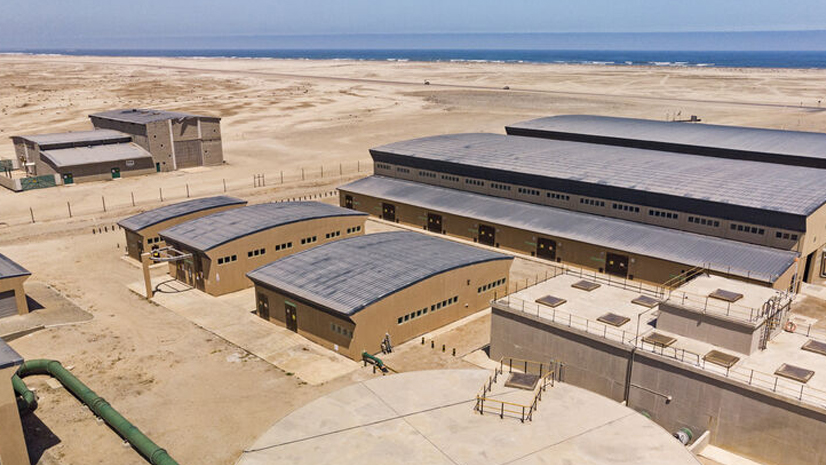
Political leaders have blasted the government’s decision to hand a foreign company a 70% controlling stake in a coastal desalination plant, leaving the state with a minority 30% in a N$3-billion project.
For years, Namibia’s only main desalination plant was owned by French state-owned entity Orano, formerly Areva.
The government has for years tried to buy that plant, known as the Erongo desalination plant, but at some point the government wanted to get its own water plant.
However, in recent years the state, through NamWater, opted to form a company with Swakop Uranium to run the desalination plant.
Swakop Uranium is a subsidiary of the state-owned China General Nuclear Power Group.
NamWater and China General Nuclear Power Group signed a joint-venture agreement to develop the desalination plant in the Erongo region.
It is estimated that the new plant will produce about 20 million cubic metres of water every year and will be fully connected to NamWater’s existing network to accommodate industrial, commercial and domestic water requirements across the region.
‘DEEPLY CONCERNING’
Independent Patriots for Change (IPC) member of parliament Imms Nashinge says the arrangement is deeply concerning since water is a public good that should remain under majority state control.
“It’s bad. It’s equivalent to privatising water, which the government said it would never do,” he says.
The project, which aims to remove minerals and salt from seawater to produce fresh drinkable water, was announced last December.
Nashinge says foreign-owned entities should not hold 70% of distribution of water in Namibia.
“The IPC categorically rejects the notion that a foreign-owned entity should hold majority ownership of 70% of any infrastructure that controls the production and distribution of water in our country,” he says.
“Water is a strategic national resource.
It is listed in the same category as land, minerals, and energy when we speak of national sovereignty.
Allowing a foreign commercial entity to own and effectively control the primary switch of water production in the Erongo region is not partnership at all.
“That is pure surrendering of our sovereign authority over a life-sustaining resource,” he says.
Nashinge warns that if water production is driven by commercial considerations, vulnerable communities could struggle to afford it.
“Poor people won’t be able to afford it, and that is the primary reason why we have a government – to provide basic needs,” he says.
The project will include not only the seawater desalination plant itself, but also bulk water pipelines, pumping stations and connections to NamWater’s existing distribution system, enabling water to be supplied to industrial, commercial and domestic users.
According to Nashinge, there will be no guarantee that communities’ access to this water would be protected.
He says NamWater is a capable institution with the financial standing, technical expertise and legal mandate to lead major water infrastructure projects.
“If NamWater lacked the capital to lead this project, the government should have strengthened it through sovereign bonds, development finance institution partnerships, or structured financing from the African Development Bank, the Development Bank of Namibia, or regional multilateral institutions,” he says.
Nashinge asks why local private sector players were not included in the ownership and financing structure, saying the current arrangement misses an opportunity to build domestic capacity in strategic infrastructure.
“Building local capacity in strategic infrastructure is an economic imperative.
The current structure bypasses that opportunity entirely,” he says.
NamWater has maintained that the project, which was the Cabinet’s approval, will see about 60% of its cost financed through debt.
However, Nashinge says if NamWater or the government is providing guarantees to support a project in which they hold only 30%, Namibia would bear financial risk disproportionate to its ownership stake.
‘NOT FAIR’
Popular Democratic Movement (PDM) spokesperson Geoffrey Mwilima says the deal is unfair to the government and should be recalled.
“You can’t negotiate 70% for an outsider and 30% for the government.
We have local people who are able to do the same work, and they are excluded.”
Mwilima says once the water is privatised it becomes expensive for locals to have access to it.
He says the government should renegotiate for an equal share.
“They could have engaged young entrepreneurs without jobs but with skills to see how they can be accommodated in this deal.
They could have made that a priority. The government should negotiate 50/50 so that when you invest in our country, our country can also benefit,” he says.
LONG-TERM RISKS
Political analyst Ndumba Kamwanyah says allowing a foreign company to hold a 70% stake in a major desalination project could create some long-term risks if strong safeguards are not in place.
“Water is a strategic public resource. When a private foreign investor has majority control, it may have significant influence over pricing decisions, operational priorities and profit distribution.
Kamwanyah warns that the desalination project could lead to high water prices for Namibians.
“Desalination is already an expensive technology because of energy and operating costs.
When loans, interest payments and investor returns are added, the operator may seek higher tariffs over time to recover costs and ensure profitability,” he says.
“This could lead to relatively high water prices for households, municipalities and industries, especially if demand increases or if operating costs rise,” he says.
NAMWATER RESPONDS
NamWater spokesperson Lot Ndamanomhata says the decision to establish the desalination plant as a joint venture followed a Cabinet resolution informed by a feasibility study.
“Swakop Uranium initially sought permission to construct its own desalination plant to secure water for its mining operations.
The government considered that allowing a private entity to independently develop such strategic infrastructure could limit broader national benefits,” he says.
“As a result, the mining company was referred to NamWater, Namibia’s national bulk water supplier, to explore a joint venture arrangement that would ensure public sector participation in the development and long-term operation of the facility,” Ndamanomhata says.
He says the structure of the project does not intend to relinquish control over a critical national resource, but rather to ensure that the government, through NamWater, remains directly involved.
“By structuring the project as a partnership rather than a purely private development, the government ensures that the infrastructure contributes to long-term regional water supply solutions in what is indeed a water-stressed region,” he says.
Ndamanomhata confirms that about 60% of the project’s cost would be financed through debt, which would be raised by the joint venture company itself.
SWAKOP URANIUM RESPONSE
Swakop Uranium vice president and spokesperson lrvinne Simataa yesterday told The Namibian that the Erongo Sunam desalination plant would primarily support industrial and coastal water supply by supplementing existing water infrastructure.
This would mitigate existing water security risks, while NamWater “will be responsible for distributing the water to end users in accordance with its existing and future water supply agreements as well as water provision prioritisation policy,” he said.
Questioned on holding 70% of shares in the project, Swakop Uranium argued that the state retains control over water resources, Simataa said.
“Swakop Uranium’s private partnership with NamWater is structured for the purposes of financing, building and operating capital-intensive water infrastructure to enable the fulfillment of key developmental objectives within the provisions of prevailing legislation,” he said.
“It is important to note that although Swakop Uranium is a shareholder in the joint venture, its Husab Mine will be supplied with water under the same commercial arrangements as other industrial customers supplied through NamWater, the sole distributor of water to all end users.
“Swakop Uranium is the owner and operator of the third-largest Uranium Producing Mine (Husab Mine) in the world.
This project is primarily for business sustainability risk mitigation, reliable and economic water supply, as well as social investment to alleviate water scarcity in the region.”
In an age of information overload, Sunrise is The Namibian’s morning briefing, delivered at 6h00 from Monday to Friday. It offers a curated rundown of the most important stories from the past 24 hours – occasionally with a light, witty touch. It’s an essential way to stay informed. Subscribe and join our newsletter community.

The Namibian uses AI tools to assist with improved quality, accuracy and efficiency, while maintaining editorial oversight and journalistic integrity.
Stay informed with The Namibian – your source for credible journalism. Get in-depth reporting and opinions for
only N$85 a month. Invest in journalism, invest in democracy –
Subscribe Now!