


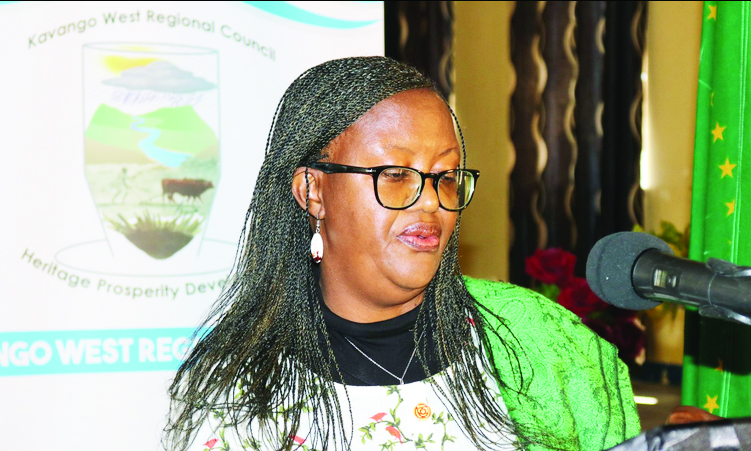
Kavango West governor Sirkka Ausiku has called on government ministries, state-owned enterprises and agencies to start making use of national statestics when allocating resources for programmes and projects per region to achieve shared prosperity for all Namibians.
Ausiku made the call earlier this week at the opening of the Ministry of Urban and Rural Development’s annual rural development review and planning workshop being held at Nkurenkuru in the Kavango West region.
Ausiku said the Kavango West marks the 10th anniversary since its formation in 2013, but it’s still undeveloped and the resources allocated to it do not speak to its needs.
She questioned why it is classified as the poorest region while it is blessed with the Okavango River, fertile land and several green schemes.
“Why is multidimensional poverty the highest in our region at 79,6%, while the region is blessed with a perennial river and fertile land with green schemes, as well as the Kavango Cattle Ranch that can create jobs, especially for our youth and the opening of the Rundu Meatco Abattoir?”
Ausiku questioned why the region is still 99% rural, with only one urban centre, namely Nkurenkuru, and one settlement, Katwitwi, and why the region does not have two to three town councils, village councils and more settlements.
“Why do all the growth points and big villages in the region not have electricity, including the five settlements recently declared by the Kavango West Regional Council?” she asked.
The Kavango West Regional Council recently declared Rupara, Mpungu, Bunya, Ncamagoro, Katjinakatjii, Tondoro, Nankudu, Ncuncuni, Ncaute and Kapako villages as settlements.
Ausiku said she hopes after the workshop the ministry would allocate enough resources to the region to bring it up to par with other regions.
She further questioned why her region is dominated by sandy roads and no feeder roads to connect constituencies.
“Why do our communities still fetch water from the river, although there is a danger of crocodile attacks? Why can the region not have a canal or pipeline along the national roads?”
Ausiku wanted to know how the region could stimulate its local economy to have more economic activities taking place in all its constituencies, and have basic services and infrastructure like potable running water, electricity, telecommunication networks, schools and health facilities.
She said all the issues experienced in the region were highlighted in the region’s profile report, developed with the support of the ministry.
The region also developed a ‘Regional Economic Investment Opportunities’ booklet, in which it identified various sectors for investment, such as agriculture, manufacturing and tourism, that need to be developed to address its developmental challenges to change the livelihoods of its communities and grow its local economy.
She said she expected key economic ministries like those of mines and energy, works and transport, industrialisation and trade, and environment, as well as the Namibia Statistics Agency and the National Planning Commission to attend the workshop to avoid planning in isolation.
Speaking at the same event, minister of urban and rural development Erastus Uutoni called on regional councils to allocate funds to viable initiatives with a greater impact on people, and to avoid the equal allocation of funds to constituencies without considering the nature of the initiatives to be financed.
The week-long planning workshop is aimed at regional councils assessing and proactively planning to collectively contribute to the realisation of the country’s national strategies and desired outcomes on rural development, as outlined in the National Development Plans.
“I would like to underscore the importance of community involvement in the planning and designing of rural development initiatives at grassroot level, because it is only through this approach that we will ensure a coordinated approach to rural development and instil a sense of accountability in our operation,” Uutoni said.
In an age of information overload, Sunrise is The Namibian’s morning briefing, delivered at 6h00 from Monday to Friday. It offers a curated rundown of the most important stories from the past 24 hours – occasionally with a light, witty touch. It’s an essential way to stay informed. Subscribe and join our newsletter community.

The Namibian uses AI tools to assist with improved quality, accuracy and efficiency, while maintaining editorial oversight and journalistic integrity.
Stay informed with The Namibian – your source for credible journalism. Get in-depth reporting and opinions for
only N$85 a month. Invest in journalism, invest in democracy –
Subscribe Now!