THE government has ordered a thorough investigation into the source of the dried sedimentation of traditional brewed beer which killed 16 people at Kayova village last week, saying the product should not be sold any more.
This was announced by the deputy minister of information and communications technology, Emma Theofelous, on Thursday.
Theofelous said the Cabinet has taken note of the incident.
The 16 victims from a family of about 24 people died after consuming porridge containing a poisonous substance.
The porridge they ate was allegedly made from a residue of traditional brewed beer, known as katokere.
“The Cabinet further took note of the psychosocial support provided to the bereaved family, and the ministers of health and social services and of gender equality, poverty eradication and social welfare, and the Cabinet directed that investigations be extended to the source of dried sedimentation, and that no further sale of the product be made,” she said. She, however, did not elaborate on how the government will ban the traditional brew.
Rundu Urban constituency councillor and member of the National Council Paulus Mbangu says it was alright for Cabinet to ban brew but believes it should have consulted with the regional leadership first.
“There are people who survive on the sale of traditionally brewed beer. Unless the government has an alternative as to how these people would survive . . .”
He says the fact that the government sent samples to South Africa for testing means there are no local laboratories to conduct such testing.
“I suggest the government invest in such laboratories here instead of depending on other countries,” Mbangu says.
Acting Kavango East medical director Woitha Kampumburu said samples of the porridge were sent to South Africa through the Namibian Pathological Service, but toxicity could not be determined.
Meanwhile, Kavango East crime investigations coordinator deputy commissioner Bonifatius Kanyetu has said samples were taken from the dead and have been sent to the police’s forensic department for further testing.

‘ONE LIFE LOST IS ONE TOO MANY’
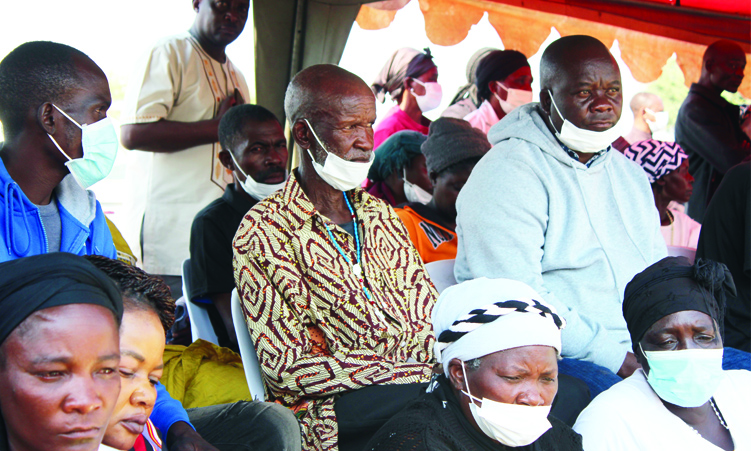
The 16 victims were buried at Kayova village on Saturday, where hundreds of mourners gathered.
The burial was also attended by minister of works and transport John Mutorwa, minister of defence and veterans affairs Frans Kapofi, Kavango East governor Bonifatius Wakadumo, Kavango West governor Sirkka Ausiku, and members of parliament, including the leader of the official opposition, the Popular Democratic Movement, McHenry Venaani.
Kapofi said considering the circumstances of the incident and the magnitude of the loss to one family, the government decided to assist the family with the burial.
“Indeed the entire government expresses sorrow and extends its condolences,” he said during Saturday’s church service.
One life lost is one too many,” he said.
“We regret that things happened this way, perhaps as a result of a lack of food.
“As leaders, we should learn from this and other similar tragic events and be on the ground so that when you come across cases where people are hard-pressed, you notify the government institution nearest to you.
“The government will not hesitate to provide assistance when there are people reported to be in a dire situation of whatever kind,” Kapofi said.
“It pains me to admit that we have not as a government been able to address the issue of statelessness of many of the people in its entirety. However, the government is hard at work to resolve this problem, which is a requirement of the United Nations that statelessness should not be allowed,” he said.
Kapofi said national documents will enable people to access social and other grants.
Most of the victims were pupils at Katere Combined School.
They were all described as obedient and helpful by their grandparents, Gotfried Shishugho and his wife, Elizabeth Shishugho.
In a message read on their behalf, the boys were remembered as helping at the homestead, harvesting reeds and catching fish, while the girls pounded mahangu for the family.
The victims are Innocentia Shishugho (6), Lishaka Shishugho (12), Albertina Shishugho (6), Chisola Litwayi (9), Roswitha Mungamba (5), Mwengere Kampungu (7), Rosalia Shishugho (10), Bertina Shishugho (33), Gende Mushongo (3), Kandjeke Kamuyoyo (2), Mununga Shishugho (13), Petrus Shishugho (21), Gilbert Shishugho (16), Litwayi Shindimba (9), Johannes Manguyi (4) and Liyomkela Matjayi (1).
Surviving family members Bernard Shishungho, Hamutenya Shishungho, Silvester Kambinda, Lisho Joseph Mushongo, and Alberthina Shishugho (27) have been discharged from the Nyangana Catholic Hospital.
One family member remains in the Rundu Intermediate Hospital, reported to be in a stable condition.