



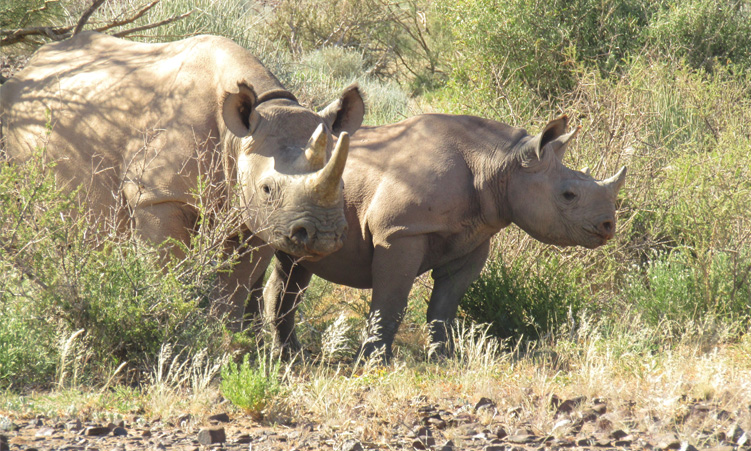
When pioneers crossed the Orange River into Namibia in the 1700s and 1800s, their journals often recorded encounters with black rhino roaming the vast southern landscape.
Over time, decades of agricultural expansion, the species vanished from the Fish River Canyon region. Today, thanks to decades of ecological restoration and wildlife reintroduction efforts by Gondwana Collection, together with a landmark conservation partnership, the black rhino has not only returned, but it is beginning to thrive once again.
The Gondwana ERP Black Rhino Sanctuary, envisioned as one of the world’s largest black rhino reserves, is entering an exciting new chapter. With the recent birth of a calf, a fully operational high-tech anti-poaching unit, and plans to introduce a rhino tracking activity for guests, the sanctuary is demonstrating how ambitious, collaborative conservation can restore both a species and an ecosystem.
Namibia remains one of the last places on earth where black rhino still roam across vast unfenced landscapes. The species is one of the world’s most endangered large mammals, with fewer than 5 500 remaining in the wild.
The sanctuary’s success is rooted in a collaboration between two organisations bringing different but complementary expertise.
Elephant Rhino People (ERP) focuses on restoring large rangelands where megafauna can thrive while also creating economic opportunities for surrounding communities.
The organisation contributes advanced technology and security expertise for protecting rhino.
Gondwana Collection brings the rangeland, the dedicated management thereof, along with decades of experience in landscape restoration and nature-based tourism.
Nearly 30 years ago, the company began buying degraded livestock farms across the canyon landscape. Years of overgrazing had left the land expended, with biodiversity significantly reduced.
CALF SIGNALS SUCCESS
The recent birth of a rhino calf within the sanctuary has been one of the most encouraging signs of success. The rhinos now in their restored habitat are not merely surviving; they are reproducing and thriving. The birth of a calf is a powerful indicator of an ecosystem in restoration and signifies that conservation efforts are effective.
Each new calf reinforces the sanctuary’s long-term viability and contributes to efforts to restore black rhino populations on a global scale.
Black rhinos play a major role in the ecosystem: their browsing patterns, movement and dung distribution reshape the environment in ways that are beneficial to many other species. Their presence is a clear sign of a functioning, flourishing ecosystem.
Protecting the critically endangered rhinos across vast landscapes requires a sophisticated combination of people, intelligence, and advanced technology. The sanctuary’s anti-poaching unit is fully operational, gathering trained personnel and monitoring systems within a multi-layered protection strategy.
This technological arsenal comprises using Earth Ranger software to track field data, acting as enablers for proactive security planning. Drones, emerging artificial intelligence applications, as well as networks of sensors across the landscape, further strengthen the monitoring and protection of the rhino.
With a growing population and strong security systems in place, the sanctuary is preparing to share its conservation story.
Soon, guests staying at Gondwana’s Canyon Collection will have the chance to experience this work firsthand through guided rhino tracking.
Expert guides will lead the activity, which will be carried out in accordance with stringent conservation regulations.
In addition to learning about rhino ecology, tracking methods, and the conservation efforts that keep them safe, visitors will follow the rhinos through their natural habitat.
Bringing black rhinos back to this region marks a defining moment in Namibia’s rich conservation journey: proof that we can restore not just what was lost, but create something that will endure for generations to come.
In an age of information overload, Sunrise is The Namibian’s morning briefing, delivered at 6h00 from Monday to Friday. It offers a curated rundown of the most important stories from the past 24 hours – occasionally with a light, witty touch. It’s an essential way to stay informed. Subscribe and join our newsletter community.

The Namibian uses AI tools to assist with improved quality, accuracy and efficiency, while maintaining editorial oversight and journalistic integrity.
Stay informed with The Namibian – your source for credible journalism. Get in-depth reporting and opinions for
only N$85 a month. Invest in journalism, invest in democracy –
Subscribe Now!