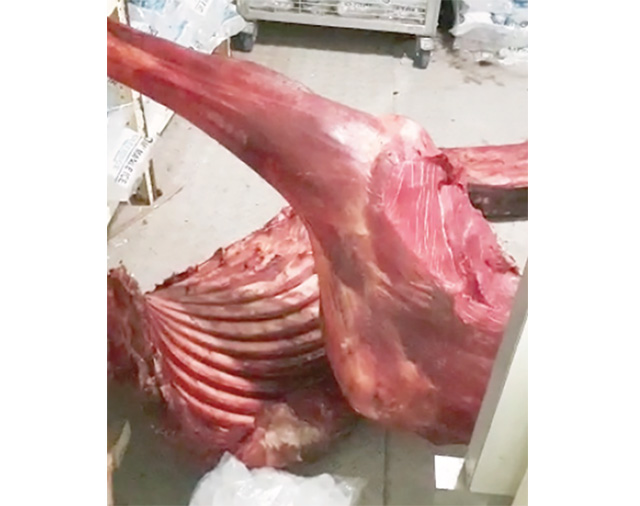
The NWR has said the giraffe meat that incited much alarm on social media did not come from a poached animal.THE Namibia Wildlife Resorts and the environment ministry have concluded an investigation into circumstances surrounding a giraffe carcass that was found in a fridge at one of its locations by tourists.
In a statement released on Wednesday, the Namibia Wildlife Resorts (NWR) said the alleged giraffe meat that incited much alarm did not come from a poached animal, as was being alleged on social media.
Last week, a video circulated of a group of tourists at the Namutoni Lodge in Etosha National Park stumbling upon some meat being stored at the back of an ice freezer which was accessible to guests at the lodge’s tourist shop.
“Here is some nice ice,” the tourist narrated on the video in German as he made his way to the freezer in which the meat was stored.
“And there in the back […] Giraffe, or what?” he speculated.
Upon the initial surfacing of the video, NWR released a statement which promised that they would undertake an investigation into the matter, and that it would receive their fullest attention.
“Equally, I would like to appreciate the efforts of those members of the public who brought this to our attention. We want to assure them that such incidents will not be allowed to persist at our resorts,” said NWR acting manager director Matthias Ngwangwama in the statement.
“To those individuals who allowed this situation to prevail, they should know that their behaviour is damaging the good name of our company.”
In a subsequent statement released by NWR on Wednesday, it was concluded that the carcass did not come from a poached animal, but was rather meat belonging to the anti-poaching unit within Etosha National Park that was being stored at the resort.
“Due to some unforeseen circumstances, it [the carcass] ended up being temporarily stored in a storeroom in the shop while the resort was waiting to create space in the freezers of the kitchen, where they usually store meat,” the follow-up statement said.
Ngwangwama chalked the incident up to a misunderstanding by the guest who recorded a video of the carcass, and cautioned guests to first verify the information they gather before sharing it on social media.
The NWR’s manager of corporate communications Mufaro Nesongano explained to The Namibian yesterday that while he could not attest to the type of meat, he confirmed that the meat was being stored for the anti-poaching unit.
“The anti-poaching unit consumes meat, and if they don’t have space to store it, they usually ask us to store it on their behalf,” he stated.
Nesongano said NWR’s investigation was not to probe the type of meat, but rather the reasons why it was in the fridge.
However, ministry of environment spokesperson Romeo Muyunda was able to confirm that it was indeed giraffe.
The Namibian was not able to get comment from the anti-poaching unit at Etosha.
However, one of the area wardens at the park’s central location at Okaukuejo was able to clarify that meat is procured and stored for consumption for the various employees who reside in the park.
The warden explained that the ministry supplies them with meat, which is often bought from surrounding farms.
“It’s not necessarily that they eat giraffe every time. But if they get giraffe on a farm – which is the place where one would buy it – they’ll go for it because it’s enough meat for a lot of people in the field,” he noted.
Although giraffe is not an endangered species in Namibia, it was reclassified from ‘least concern’ to ‘vulnerable’ status in 2016 on the International Union for the Conservation of Nature’s Red List of threatened species. However, some sub-species of giraffe are listed as endangered.
The Namibian previously reported that the giraffe population was dwindling globally, and had seen a decline of almost 40% over the last three decades. Currently, the Giraffe Conservation Fund estimates that there are a total of 111 000 individual giraffes around the world. The fund estimates Namibia’s giraffe population to be around 12 000.
Furthermore, most of the giraffe in Namibia are said to be of the Angolan giraffe sub-species, which is listed as being of ‘least concern’.
In an age of information overload, Sunrise is The Namibian’s morning briefing, delivered at 6h00 from Monday to Friday. It offers a curated rundown of the most important stories from the past 24 hours – occasionally with a light, witty touch. It’s an essential way to stay informed. Subscribe and join our newsletter community.

The Namibian uses AI tools to assist with improved quality, accuracy and efficiency, while maintaining editorial oversight and journalistic integrity.
Stay informed with The Namibian – your source for credible journalism. Get in-depth reporting and opinions for
only N$85 a month. Invest in journalism, invest in democracy –
Subscribe Now!