



The invention of plastics saw the world experience an immense growth spurt.
In many areas, these synthetic materials made things easier and increased economic profit.
The same happened with industrial fishing.
Fishing gear became cheaper and more resilient against natural forces, but resulted in the growing problem of abandoned, discarded or lost gear drifting in the oceans.
Some ‘ghost gear’ can persist in the environment for more than 500 years.
Ghost fishing occurs when lost gear catches or entangles marine life.
Apart from its deadly impact, it does not benefit anyone.
It is estimated that eight million tonnes of plastic a year enters the ocean.
Of this about 640 000 tonnes is ghost gear.
This means roughly 10% of all ocean plastic has an extremely high likelihood of killing marine life, often out of sight.
In some regions, including seamounts, ocean ridges and the Great Pacific Gyre, ghost gear makes up around 85% of all marine debris.
NAMIBIA AFFECTED
Lost fishing gear is also a serious problem in Namibian waters.
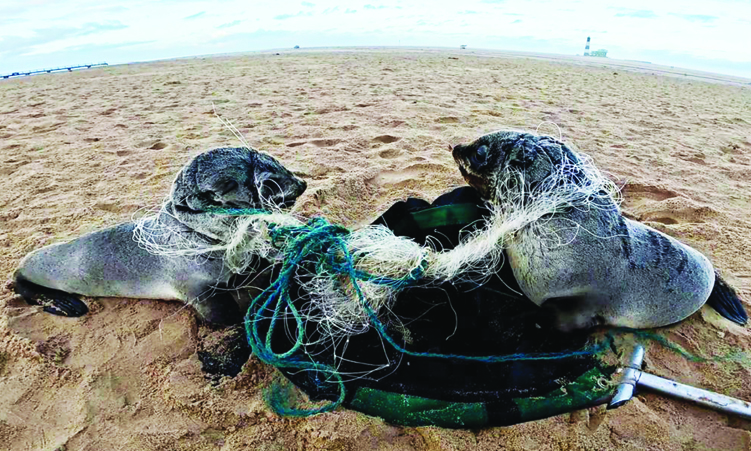
In 2025, about 50% of the more than 1 000 seals rescued by Ocean Conservation Namibia (OCN) were entangled in ghost gear that would likely have killed them.
Ghost gear can take the form of fishing nets, traps and pots, lines, and Fish Aggregating Devices (FADs).
If left in the ocean, it continues to trap marine life such as fish, crustaceans, seabirds, sea turtles, and even seals, dolphins, and whales.
With no chance of escaping, these animals may starve, suffocate or drown.
Worst of all, dead animals attract larger predators, which can also become entangled, drawing in even more life, increasing the ghost gear’s deadly toll.
When large and heavy nets sink to the ocean floor, they can snag on delicate reef structures, breaking them apart or smothering vital habitats under their weight.
‘FRAGMENTED’ FOOD
Other seabed habitats are also disturbed when this gear covers or interferes with important breeding and feeding grounds.
Over decades or even centuries, the highly persistent synthetic fibres in fishing gear break down into tiny plastic fragments known as microplastics.
Some sink to the ocean floor, altering the chemical composition of marine sediments.
Others are ingested by plankton and fish and accumulate up the food chain, eventually reaching humans through seafood consumption.
As a result, these fragments not only disrupt ecosystems and harm marine life, but may also pose serious health risks to people.
TACKLING THE ISSUE
The United Nations and many international, regional, and local institutions have long recognised the problem and have introduced projects and legislation to address it.
UN initiatives include the Sustainable Fisheries Resolution, the Fish Stocks Agreement, and the Marine Environment Protection Committee and the Committee on Fisheries and Global Partnership on Marine Litter.
Beyond the UN, other active approaches include the Global Ghost Gear Initiative (GGGI), a cross-sector alliance working to tackle the issue through better fishing gear management.
Ghost gear is a complex problem, affecting many sectors and a vast ocean space, of which two-thirds lies beyond any country’s jurisdiction.
As a result, fragmented governance approaches have so far been inadequate to solve the crisis.
Many hopes now rest on the new High Seas Treaty, which aims to provide an overarching framework to protect marine life from ghost gear beyond national borders.
However, it will need to overcome many of the same challenges that have limited previous efforts.
- Damian Schreiber, marine conservation communications, field and research officer at OCN; involved in seal rescues, education outreach, and beach clean-ups. He holds a master’s in ecology and society from the University for Peace (Costa Rica).
In an age of information overload, Sunrise is The Namibian’s morning briefing, delivered at 6h00 from Monday to Friday. It offers a curated rundown of the most important stories from the past 24 hours – occasionally with a light, witty touch. It’s an essential way to stay informed. Subscribe and join our newsletter community.

The Namibian uses AI tools to assist with improved quality, accuracy and efficiency, while maintaining editorial oversight and journalistic integrity.
Stay informed with The Namibian – your source for credible journalism. Get in-depth reporting and opinions for
only N$85 a month. Invest in journalism, invest in democracy –
Subscribe Now!