



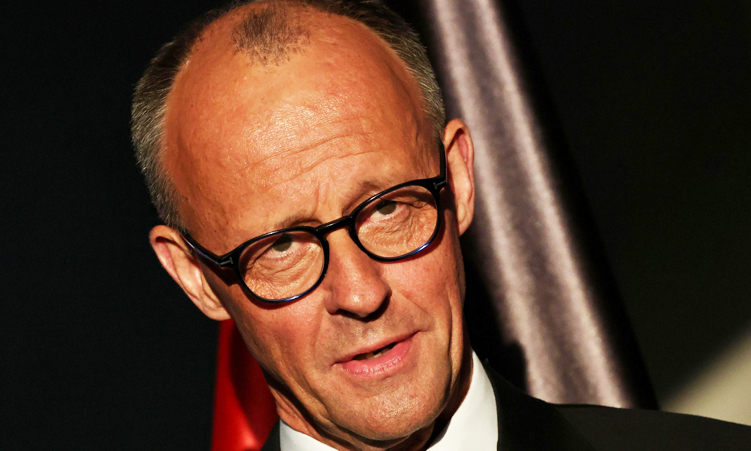
The election of Friedrich Merz as Germany’s chancellor yesterday is a big step in what has been an unconventional political career – as well as a leap into the unknown.
Merz (69) heads the conservative Christian Democratic Union (CDU), but has never previously held a top governmental office with significant leadership responsibilities.
He has never been a federal minister, or a state premier, or even mayor of a small town.
He is the oldest chancellor to take office since Konrad Adenauer, the first post-war German head of government (1949 to 1963).
As the new head of Germany’s government, Merz now has to lead a coalition between the CDU, its Bavarian sister party, the Christian Social Union (CSU), and the Social Democratic Party (SPD), and mediate between their interests.
According to the German business magazine Wirtschaftswoche, Merz is a “trans-atlanticist, friend of Europe, and reformer”.
This, it wrote, could mean he was “exactly the right person for the current times”.
From 1989 to 1994, Merz was a member of the European parliament.
This was followed by 15 years in the Bundestag, between 1994 and 2009, during which he rose to become head of the CDU’s parliamentary group, only to lose out to Angela Merkel in a struggle for the party leadership.
Over these years, he took a particular interest in Germany’s relationship with the United States (US).
A commercial lawyer, Merz hails from Sauerland, an area of North Rhine-Westphalia, east of the Ruhr, where he still lives.
It’s predominantly a middle-class, rural region, popular with tourists, that tends to espouse conservative, Catholic values.
Merz was clearly more traditionally conservative than his East German rival, the quantum chemist Angela Merkel.
He chose not to stand for parliament again in 2009, and went on to pursue a career in business.
From 2016 to 2020, he was chairman of the supervisory board of the German arm of BlackRock, currently the world’s largest asset management company, and during this time he was often in the US on business.
It wasn’t until 2021 that Merz ran again for the Bundestag, and was elected.
Now, as CDU leader, he has been fleshing out his plans for the government.
In doing so, he is sometimes more outspoken than Olaf Scholz, his predecessor as chancellor.
Merz frequently makes a point of mentioning that, for several months now, he has been in regular contact with European heads of government.
In a particularly striking example, Merz gave an hour-long TV interview eight days before the Easter weekend, in which he spoke about continuing military aid to Ukraine, going significantly beyond the “red line” repeatedly drawn by Scholz.
With this rhetoric and level of detail, Merz has positioned himself in direct opposition to Scholz, who consistently warned against any further escalation of the war between Russia and Ukraine.
Continued support for Ukraine is only one element of the broader political upheaval in Germany that has resulted from the policies of the new US administration – an upheaval that at times has caused Merz’s standing and credibility to plummet.
“We have great tasks ahead of us,” Merz said in his TV interview, “and they demand appropriate answers.”
He added that he doesn’t “look at poll numbers every day”.
The CDU leader declared that he wanted Germany to become “bolder and more optimistic” again.
Meanwhile, Merz – and all the mainstream parties – have the far-right Alternative for Germany (AfD) pressuring them from behind.
Observers say the AfD’s gains in the most recent election have prompted the future coalition partners to include stricter immigration policies and a greater focus on internal security in the coalition agreement.
Now, Merz says he wants to boost the confidence of the German people.
“We are a great country of more than 80 million people, who live and work here and take care of their families,” he said.
He wants to show “that the effort is worth it”.
– DW
In an age of information overload, Sunrise is The Namibian’s morning briefing, delivered at 6h00 from Monday to Friday. It offers a curated rundown of the most important stories from the past 24 hours – occasionally with a light, witty touch. It’s an essential way to stay informed. Subscribe and join our newsletter community.

The Namibian uses AI tools to assist with improved quality, accuracy and efficiency, while maintaining editorial oversight and journalistic integrity.
Stay informed with The Namibian – your source for credible journalism. Get in-depth reporting and opinions for
only N$85 a month. Invest in journalism, invest in democracy –
Subscribe Now!



