



• Henning MelberColonial rule in ‘German South West Africa’ (1884-1915) was a relatively short period during the final stages of the so-called scramble for Africa. But in an even shorter period of time (1904-1908), it experienced a military encounter, which in today’s perspective of the locally involved and affected communities is termed the Namibian War.
The consequences for colonised communities living in the eastern, central and southern parts of the territory were devastating.
It took almost 110 years until the German government was willing to accept the classification as genocide. As a result, this chapter of German-Namibian relations became, by the end of 2015, a matter of bilateral negotiations between special diplomatic envoys of both states, tasked with finding adequate recognition of such history.
While these negotiations continue, an amicable solution does not seem near. This also regards the hitherto inadequate involvement of representatives of the descendants of the mainly affected groups, which remains among the contentious issues.
Much has been researched and published on German colonial rule in what became, from 21 March 1990, the sovereign Republic of Namibia.
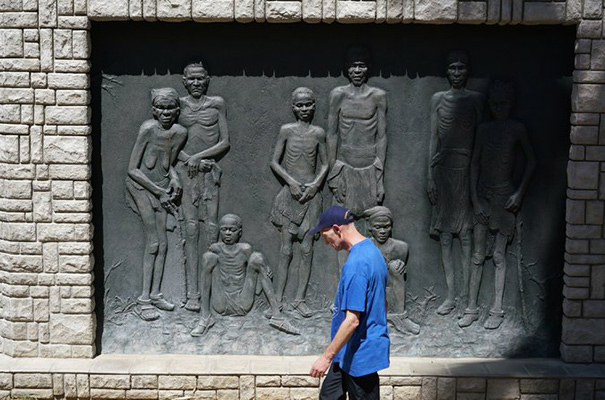
As a result of the war, an estimated two-thirds of the Ovaherero (including the Mbanderu) and one-third to half of the various Nama (denounced as ‘Hottentotten’) were eliminated. The Damara (in German derogatorily called ‘Klippkaffern’), living among and in between the various Nama and Ovaherero communities, became victims too.
They were in today’s euphemistic jargon a kind of ‘collateral damage’, since the German soldiers could not (or did not want to) differentiate. Settlers also organised hunting safaris on Bushmen communities, tantamount to a “genocide in slow motion” (Mohamed Adhikari).
Survivors among these local communities were denied their earlier social organisation and reproduction. While concrete figures of people killed remain a matter of dispute, there is clear evidence of the “intent to destroy” as regards their established way of life. This is the core definition of genocide. In terms of this understanding, the ‘Whitaker Report’ presented to ECOSOC in 1985 lists the German warfare in 1904 as the first genocide of the 20th century.
In her seminal work on ‘A History of Namibia’ (2011), Marion Wallace puts this chapter in its appropriate perspective:
“The atrocities in Namibia can be understood as standing at the extreme end of a continuum of violence and repression in which all the colonial powers participated. Nevertheless, it is important to name what happened in 1904-8 as genocide, not least because those who deny this continue to foster a debate that is really ‘a constant exercise in denial of historical evidence’ (quoting Werner Hillebrecht, then head of the Namibian National Archives; HM). Because of the tenacity with which they make their arguments, it needs to be restated that the way in which they minimise African suffering is contrary to the weight of historical evidence and the conclusion of most recent research.”
Since the turn of the century, genocide studies have emerged as a new field internationally, adding to and transcending the former exclusive focus on the Holocaust. Despite ill-motivated accusations questioning the singularity of the Shoa (at times amounting to being anti-Semitic), genocide scholars thereby added important perspectives to the domain.
The contextualisation of genocides (in the plural) also included and promoted engagements with the South West African case. Within a short period of time since the end of the 20th century, aspiring young (mainly German) scholars have produced a variety of new insights on matters related to the genocidal warfare in South West Africa.
While German governments of all party political persuasions remained in denial, a turnaround finally happened in 2015, after the German Bundestag – on the occasion of another centenary – recognised the Armenian genocide.
This not only enraged Turkish president Erdogan, who pointed to the hypocrisy of selective perspective given the unacknowledged German colonial genocide. Many established German media also questioned the double standards and voiced long articulated views of the German community of postcolonial initiatives. For the first time, the genocide in Namibia became a wider public issue.
Last but not least, the social democratic foreign minister Walter Steinmeier of the Social and the Christian Democrats coalition government could not escape the fact that his party, while in opposition, had tabled a (dismissed) parliamentary motion on Namibia jointly with the Green Party, which introduced the term genocide.
At a press conference in July 2015, the foreign ministry spokesperson confirmed that the term genocide now also applied to what had happened in South West Africa. As a result, by the end of 2015 the German and Namibian governments had appointed special envoys to negotiate how to come to terms with such recognition and its implications.
The German side entered the negotiations without offering any apology. Rather, it declared that finding an adequate form for such an apology would be one of the agenda items. But admitting genocide as a precursor to negotiations over the implications of such an admission should require an immediate apology as a first sign of remorse. In the absence of such a symbolically relevant gesture, the point of departure for negotiations based on mutual respect seems at best dubious.
Not surprisingly, meetings since then have not produced any concrete results yet but have created some embarrassing moments due to a lack of German diplomacy. Much to the frustration of Namibia, the German side at times set the agenda unilaterally and made public its views on pending matters discussed behind closed doors. It also tried to influence the schedule according to domestic German policy matters.
So far, neither government has offered any meaningful direct representation to descendants of the affected communities. While they do not speak with one voice, and some smaller groups cooperate with the Namibian government, their main agencies have remained marginalised.
For the Namibian government, it is an affair between two states and its German counterpart gladly complies. Such understanding, however, also ignores those who as a result of the genocide live in the diaspora and are therefore, by implication, denied representation.
On 5 January 2017, Ovaherero Paramount Chief Vekuii Rukoro, together with Chief David Fredericks as chairman of the Nama Traditional Authorities Association, as the main plaintiffs, together with the Association of the Ovaherero Genocide in the USA Inc, filed a federal class action lawsuit in New York.
The plaintiffs claim “the legitimate right to participate in any negotiations with Germany relating to the incalculable financial, material, cultural, intellectual, religious and spiritual losses suffered”.
Their complaint submitted under the Alien Tort Statute asks for the award of punitive damages and the establishment of a Constructive Trust. Into this, the defendant (Germany) should pay the estimated “value of the lands, cattle and other properties confiscated and taken from the Ovaherero and Nama peoples”.
International media follow the German-Namibian negotiations with great interest – as do the governments of other former colonial powers. After all, despite its degree of violence, the German colonial adventure was relatively limited.
Putting the likely material reparations in relation to the size of the German state coffers, compensation for damages could solve a problem and might even be an investment in Germany’s reputation. But it would not only open a can of worms for other claims against the German state – related to its other colonial territories– but more importantly to not yet compensated crimes during World War II among civilian populations in Eastern Europe, Greece and Italy.
In an age of information overload, Sunrise is The Namibian’s morning briefing, delivered at 6h00 from Monday to Friday. It offers a curated rundown of the most important stories from the past 24 hours – occasionally with a light, witty touch. It’s an essential way to stay informed. Subscribe and join our newsletter community.

The Namibian uses AI tools to assist with improved quality, accuracy and efficiency, while maintaining editorial oversight and journalistic integrity.
Stay informed with The Namibian – your source for credible journalism. Get in-depth reporting and opinions for
only N$85 a month. Invest in journalism, invest in democracy –
Subscribe Now!