





THE Kavango regions have consistently been home to among the poorest communities in Namibia.
Poverty often begets poverty, and for 10-year-old Vihinda ‘Masozi’ Kavavu and his family, this is a reality.
Tormented by poverty for generations, his family has now become a source of cheap labour for the community, working as cattle herders and regulars in minimum-wage jobs.
Masozi’s great-grandparents dragged through life as uneducated ‘day labourers’, eager to get their hands on any type of job, and so did their children, while his mother, Christina Shipipa (51), left school in the first grade to work as a babysitter for her uncle, and never got the chance to be educated again – nor to catch a break.
Masozi’s brothers Shipipa Kavavu (15) and Faustinus Kavavu (22) quit school at primary level and subsequently found work as cattle herders – and so the cycle of poverty goes.
Masozi’s daily battle of finding water, food, proper shelter, and clothing, coupled with a lack of role models to look up to in the family sets him up for failure early in his life.
Yet Masozi is adamant education will liberate his family from abject poverty.
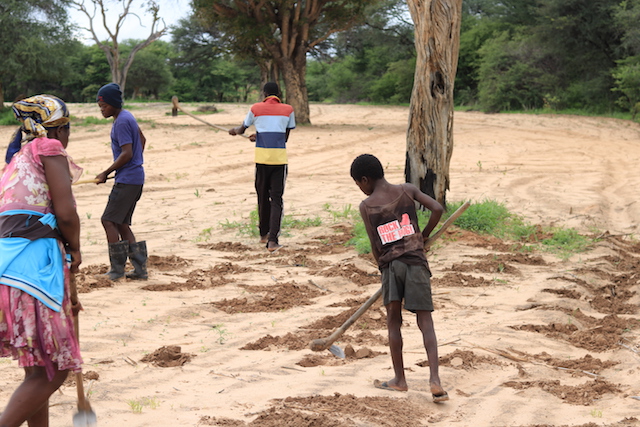
He lives with his family in the Makandu settlement area at Ndonga Linena in the Kavango East region.
His older siblings left home in 2018 for Rundu in pursuit of a better life and have not returned since.
There are five thatched huts in the family’s homestead, made out of yellow thatching grass and pale mud.
Masozi and his mother share the most spacious one.
Inside the hut is a steel wire cutting across the room with clothes hung over it, also serving as a barrier preventing people from seeing inside.
Behind this barrier of clothes is the bedding, with no mattress – just a single layer of 50 kg maize meal bags knit together on a cold mud floor, covered with two blankets.
“Falling asleep on this bedding is quite difficult to achieve,” Christina, who is also battling tuberculosis, says.
Masozi tells he usually goes to school on an empty stomach if there are no leftovers from the previous night’s supper, and sometimes relies on his classmates to share their breakfast with him.
“Food is usually rationed to ensure it lasts for the month, and sometimes supper is just too little to fill my stomach and save some for breakfast. On those days I have to be a man and just go to school on an empty stomach,” Masozi says.
He says although his classmates share their breakfast with him at times, he does not always accept this as he wants to maintain some dignity.
During our visit Masozi wears a white shirt scribbled with the words ‘Mamba-7’, which he says is his nickname on the football pitch, paired with patched-up grey school trousers.
“These are the only trousers I have that are not torn. I wear them to school and play in them after school. My mother has to patch them up often and I barely get the chance to wash them … sometimes once a month,” he says.
With their mother unemployed, uneducated, and battling tuberculosis, Masozi and his brothers have no one to depend on or to put food on the table but themselves.
Masozi says he and his brothers try to bring food to the house by doing random jobs.
“My brother Faustinus is a cattle herder, and on some days when he needs rest, I take up this role,” he says, adding this means he cannot attend school on those days.
Faustinus says: “I was not bad at school, but I left because of extreme poverty. I could not take it any more. I also had no shoes, wore a torn school uniform, and went to school on an empty stomach.”
He adds he would often be blighted with physical pain from eating little food and being overworked, as well as suffer daily humiliation over his torn clothes.
“It is painful seeing some of my friends progressing in school while I take care of other people’s cattle for a mere N$500.”
“I hope it’s different for Masozi. I will fight for him to be educated. He is now our last hope to get out of this trap,” Faustinus says.
It is almost 19h00 in Makandu, and supper is almost ready at the Kavavu residence. The boys want to know what is for dinner.
“The usual, pap and mutete. We have had it every day for the last two weeks, but mum promised we will have some dry maize tomorrow for a change,” Masozi says..