






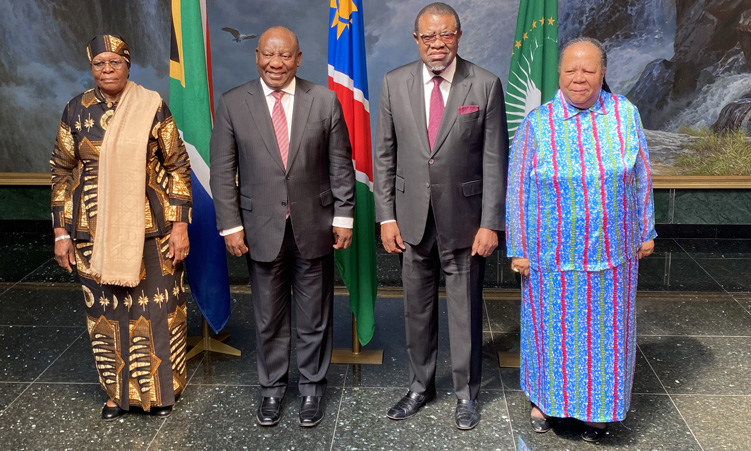
President Hage Geingob has called for an equal trade relationship between Namibia and South Africa.
Geingob was speaking during the opening of the bi-national commission between the two countries held in the capital on Friday morning.
“Furthermore, given the fact that a large majority of Namibia’s imports emanate from South Africa, resulting in a trade imbalance, the bi-national Commission will allow us to explore opportunities to balance trade between our countries,” he said.
South Africa is Namibia’s top importer of goods.
In August 2023, the neighbouring country topped Namibia’s imports with 36,1%.
Motor vehicles for the transport of goods were mainly sourced from South Africa, and Namibia imported ‘fish, crustaceans, molluscs and other aquatic invertebrates’ valued at N$45,5 million of which most was sourced from South Africa. However, South Africa was the country’s largest export destination, with a share of 23,6% of all goods exported.
In July, Namibia imported 37,8% of goods that came into the country from South Africa. This is according to the Namibia Statistics Agency’s monthly trade statistics.
Last year, Namibia and South Africa’s trade numbers were N$67,1 billion, which increased from N$59,1 billion in 2021.
Later on Friday, Geingob made a case for South African goods to be produced in Namibia. Especially goods that are mostly imported from the neighbouring country.
“Since Namibia is a consumer of many South African goods, there must be a business case to produce some of these goods in Namibia.
“Moreover, there should even be a bigger case for the re-exports of such goods from Namibia to service the larger African market,” the president said. South African president Cyril Ramaphosa called for the two countries to diversify their exports to each other. “Namibia is South Africa’s largest trading partner in the region. There is capacity to increase our exports to Namibia beyond current products such as chemicals, machinery, vehicles and steel.
“Similarly, Namibia could go beyond exporting precious metals, iron and steel products, live animals and other goods to South Africa,” he said.
To address these issues, the commission resolved to establish a financing facility and a Namibia-South Africa Business Council.
“The development of a cooperative framework and social compact to increase bilateral trade and accelerate the implementation of strategic industrial and infrastructure projects in various sectors of the economy.
“Promotion of regional value chains, including green hydrogen, that can drive industrialisation and the use of critical minerals for industrialisation on the African continent,” noted a joint communiqué issued on Friday.
Ministry of Mines and Energy acting executive director Bryan Eiseb told The Namibian yesterday that an energy agreement was not signed but deferred.
“Because we want to make it more inclusive with some more components on critical raw materials which are now more in demand with the anticipated energy transition,” Eiseb said. The joint communiqué noted that the countries agreed to intensify cooperation in energy.
“The heads of state, in this regard, directed that an agreement to this effect be speedily concluded to cover new areas of cooperation in green hydrogen, oil and gas, as well as electricity.”