



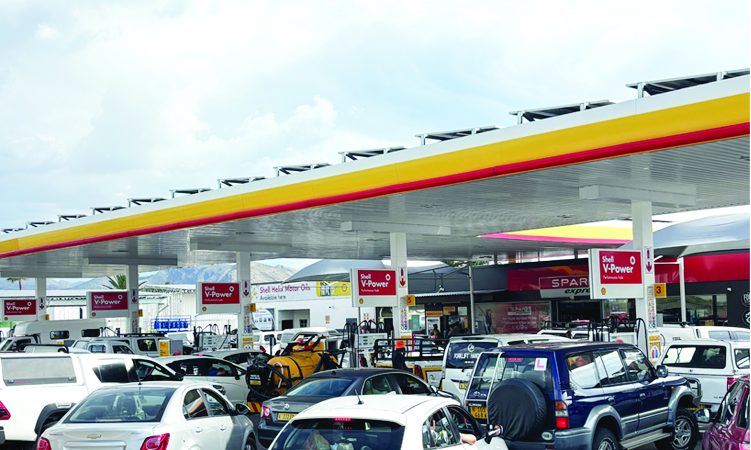
Long queues formed around service stations across the country yesterday as motorists tried to fill up their cars before major fuel price increases come into force today.
Some service stations in Windhoek and Walvis Bay stopped selling fuel during lunch hour yesterday, telling clients that the tanks would arrive at midnight.
Last Friday, minister of industries, mines and energy Modestus Amutse announced that petrol will increase by N$2.50 a litre and diesel by N$4 a litre on 1 April.
Further complications include bulk suppliers sitting on orders from stations, allegedly to profit from the higher prices despite pre-existing agreements, while private users tried to hoard fuel, as fear of future shortages gripped the nation.
The government maintains there is no fuel shortage. In a briefing last week, Amutse insisted Namibia holds sufficient petrol and diesel stocks to cover between one and two months of national demand.
He said imports through Walvis Bay and existing storage infrastructure support the system, but that panic buying and unsafe storage remain concerns.
The government has temporarily reduced fuel levies by 50% to cushion consumers from the full effect of the increase.
Ohangwena-based fuel retailer Jafet Kadila told The Namibian yesterday that wholesalers have withheld the supply of fuel ordered last week.
“They are refusing to release it, waiting to sell it at a higher price, although we paid for it at the current price,” he said.
Kadila said fuel retailers should expect to pay an additional N$48 000 on 12 000 litres ordered before the price increase.
He also said there had been an increase in fuel smuggling from neighbouring Angola known as ‘ngungula’, which is sold for cheap on the streets of Oshikango.
Four companies import fuel into the country: the National Petroleum Corporation of Namibia (Namcor), Puma, Vivo and TotalEnergies. They are considered wholesalers, who sell to the service stations. Retailers make orders for fuel in advance, with wholesalers expected to deliver on contracts at the agreed date in compliance with the regulated fuel price.
In a letter to the energy ministry, the Fuel and Franchise Association of Namibia (Fafa) accuses wholesalers of failing to deliver contracted orders at March prices.
Fafa chairperson Michael Ludeke says the association is willing to provide proof from retailers of delayed and reduced orders to the ministry.
“If wholesalers are permitted to manipulate supply around regulated price adjustments, the downstream industry and the public will bear the immediate consequences in the form of dry forecourts and regional fuel outages,” Ludeke says.
The association has asked for an urgent ministerial directive to deliver outstanding orders to prevent a national fuel crisis.
Namcor spokesperson Paulo Coelho says its service stations are fully stocked and ready to serve clients. Vivo Energy, which sells fuel to Shell-branded service stations, has declined to comment.
Puma Energy did not respond to requests for comment by the time of going to print and TotalEnergies could not be reached for comment.
Yesterday, some motorists were seen stocking up fuel in 200-litre drums and 1 000-litre bulk units around Windhoek.
They included member of parliament James Uarikua, who was filling three 200-litre drums at a service station in Windhoek.
Questioned by The Namibian, Uarikua said: “I’m trying to do my part as a farmer, trying to fill up and get my game in order. I’m urging all Namibians: go out and fill up where you can.”
Ministry of Industries, Mines and Energy executive director Moses Pakote last week warned against fuel storage and black market sales.
He said fuel storage is regulated, with limits set at 200 litres within local authority areas and 600 litres outside such areas without authorisation.
Agra Limited has put out a notice to stop bulk fuel sales at its service stations, including the filling of drums and storage containers.
To support fair access and prevent supply disruptions and panic buying, Agra says no bulk fuel purchases would be allowed at its sites from 24h00 on 28 March until further notice.
Agra operates fuel stations across the country, including in Windhoek, Keetmanshoop, Gobabis, Otjiwarongo and Opuwo.
Farmers say these restrictions are disrupting their operations, especially for those who rely on bulk fuel purchases, including emerging and previously disadvantaged producers.
Previously Disadvantaged Namibian Commercial Farmers Union chairperson Jane Kuhanga says limitations on access are beginning to affect daily farming activities.
“Farming depends on timing. If you delay, you lose productivity,” she says.
Kuhanga says the government should consider measures to protect the sector.
“We need agriculture to be treated as a priority. Farmers should be allowed controlled access to bulk fuel,” she says.
A farmer in the Oamites area south of Windhoek, John Coetzee, says restrictions are not applied the same everywhere, which creates confusion.
“In some places you can still fill up, but at the truck port they say no containers at all,” he says.
Namibia imports all its fuel and remains exposed to global oil price fluctuations, particularly amid the war in the Middle East.
Questions sent to Agra’s manager of stakeholder engagement, Trudy Howard, were not answered by the time of publication.
In an age of information overload, Sunrise is The Namibian’s morning briefing, delivered at 6h00 from Monday to Friday. It offers a curated rundown of the most important stories from the past 24 hours – occasionally with a light, witty touch. It’s an essential way to stay informed. Subscribe and join our newsletter community.

The Namibian uses AI tools to assist with improved quality, accuracy and efficiency, while maintaining editorial oversight and journalistic integrity.
Stay informed with The Namibian – your source for credible journalism. Get in-depth reporting and opinions for
only N$85 a month. Invest in journalism, invest in democracy –
Subscribe Now!