


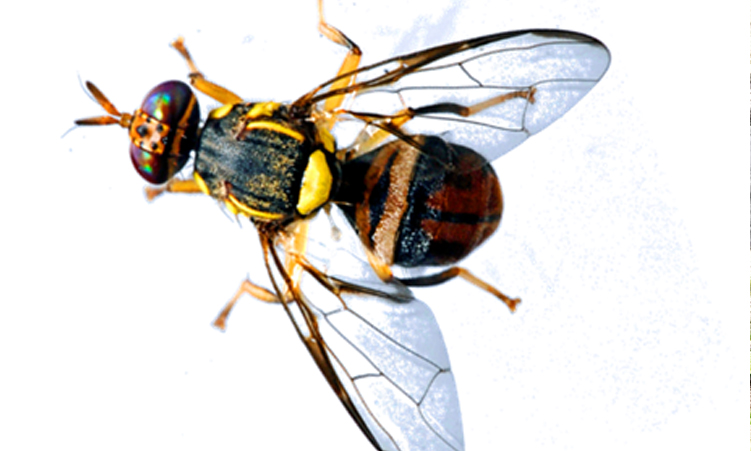
The government says fruit flies are becoming a growing threat to Namibia’s horticultural sector, particularly the country’s export-driven table grape industry along the Orange River.
This warning was issued by James Nzhengwa, the deputy director in the directorate of agricultural production at the Ministry of Agriculture, Fisheries, Water and Land Reform, during a fruit fly management workshop at Aussenkehr last week.
He said invasive fruit fly species are posing increasing risks to agricultural productivity and trade.
“Fruit flies, particularly invasive and highly destructive species such as the oriental fruit fly (Bactrocera dorsalis), continue to pose serious challenges to agricultural productivity and trade across the Southern African Development Community (SADC) region,” he said.
Nzehengwa said the pest presents a risk especially to Namibia’s table grape industry along the Orange River, one of the country’s key horticultural export sectors.
“The impact of this pest extends beyond the field, affecting compliance costs and presenting a significant phytosanitary barrier that limits access to lucrative markets.
“For Namibia, effective management of these risks is not only a plant health priority, but also a strategic trade and economic imperative,” he said.
The workshop focused on strengthening fruit fly surveillance, pest identification and control systems to ensure Namibia complies with phytosanitary requirements in export markets.
Fruit flies, particularly invasive species such as the oriental fruit fly, are among the most destructive pests affecting horticultural crops across southern Africa.
These pests cause crop losses, increase production costs and trigger strict phytosanitary requirements from importing countries, making effective management critical for countries seeking to export fresh produce.
The training was organised under the European Union-funded Stosar II programme in partnership with the Food and Agriculture Organisation and the SADC.
Participants also reviewed surveillance protocols and discussed measures such as establishing pest-free areas and areas of low pest prevalence to meet international standards for agricultural exports.
Ferdinard Mwapopi, the assistant FAO representative in Namibia, on behalf of the interim FAO representative in Namibia, Patrice Talla, said strong pest management systems are essential for protecting agricultural production and ensuring Namibia can access global markets.
“Early detection, coordinated surveillance and integrated pest management are essential not only to protect crops, but also to improve yields, ensure compliance with phytosanitary requirements and expand access to regional and international markets,” he said.
The head of cooperation at the European Union Delegation to Namibia, Alexandre Baron, said strengthening phytosanitary systems is key to unlocking agricultural trade opportunities.
“Fruit flies pose serious risks to horticultural production and to Namibia’s export ambitions.
They increase production costs, cause yield losses and trigger stringent phytosanitary requirements from trading partners.
“Effective management of these pests is therefore not only a technical necessity, it is an economic imperative,” he said.
Over the course of the workshop, participants reviewed surveillance protocols, strengthening pest identification capacity and exploring systems such as pest-free areas and areas of low pest prevalence in line with international standards.
According to organisers, the initiative will also support the development of a national fruit fly action plan aimed at strengthening coordination between government institutions, researchers, farmers and exporters.
Officials say improving fruit fly management is critical to protecting Namibia’s crops and maintaining access to international markets for horticultural products.
- Additional reporting FAO Namibia
In an age of information overload, Sunrise is The Namibian’s morning briefing, delivered at 6h00 from Monday to Friday. It offers a curated rundown of the most important stories from the past 24 hours – occasionally with a light, witty touch. It’s an essential way to stay informed. Subscribe and join our newsletter community.

The Namibian uses AI tools to assist with improved quality, accuracy and efficiency, while maintaining editorial oversight and journalistic integrity.
Stay informed with The Namibian – your source for credible journalism. Get in-depth reporting and opinions for
only N$85 a month. Invest in journalism, invest in democracy –
Subscribe Now!