




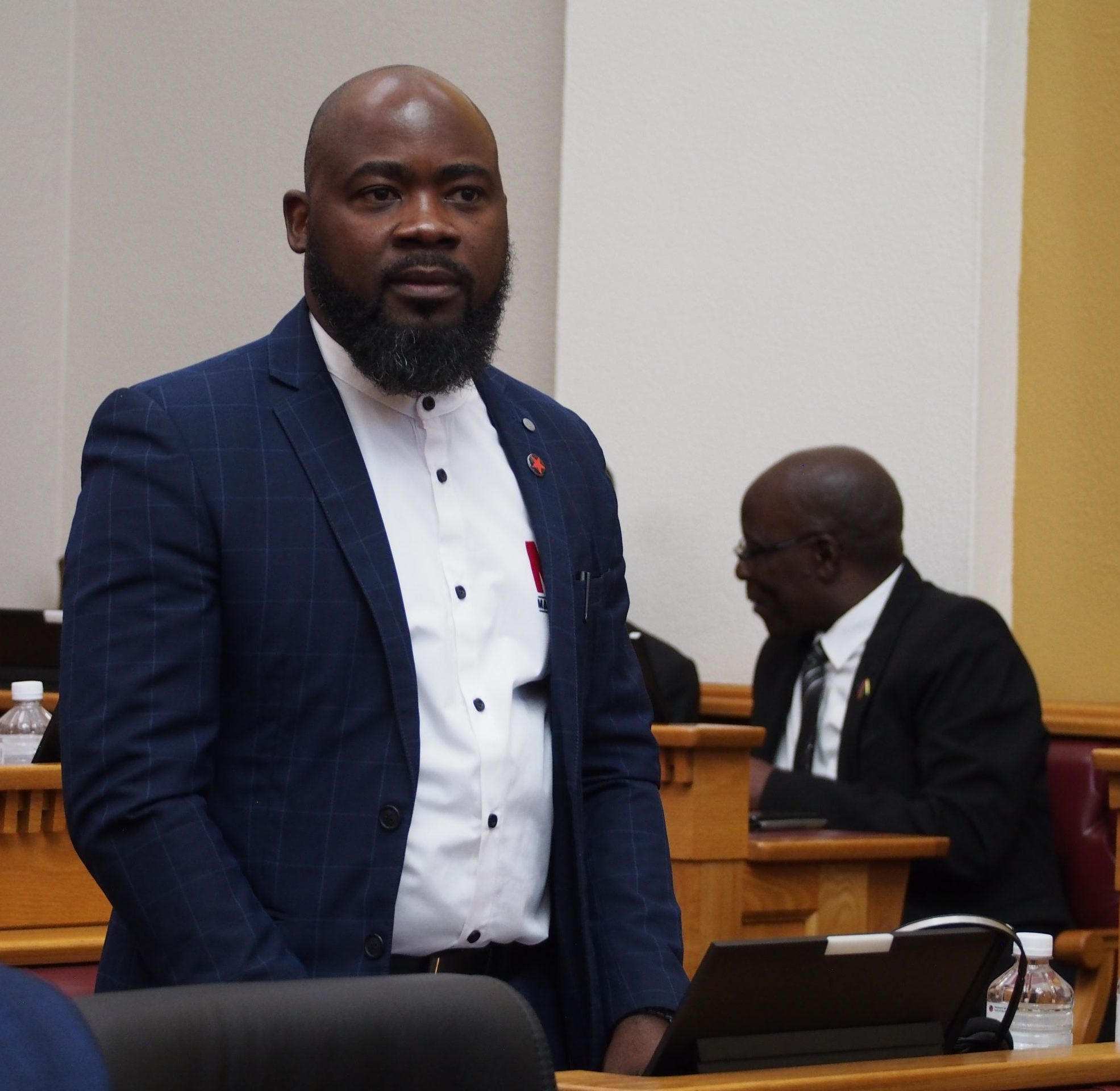
Speech by Fridrick Twiindileni Shitana, member of parliament, 8th National Assembly of Namibia, 23 April 2025.
First and foremost, let me appreciate and thank God the Almighty for the gift of life, for His divine guidance, and for His unwavering protection. It is only through His grace that dreams come true, and it is by His will that all things are made possible. Allow me to begin with the powerful words from the Book of John, Chapter 1:
“In the beginning was the Word, and the Word was with God, and the Word was God. In him was life, and that life was the light of all mankind. The light shines in the darkness, and the darkness has not overcome it. There was a man sent from God whose name was John.”
The same Johannes Shitana who fathered Fridrick Shitana now serving in the eighth parliament under the Affirmative Repositioning, led by Job Amupanda. Okaana Komuborni. I salute you, my leader.
Allow me to rise and address this esteemed august house with a heavy heart. There is no person who cries in a different language than their mother tongue, for pain speaks from the soul, and sorrow finds its voice in the language of our roots. Today, I speak filled with sorrow that has lived within me since I was two years old when my father was brutally murdered.
I was born in a humble village called Ouhongo wa Nghikelwa ya Kamhulu, in the Ohangwena region, to my beloved mother Tukondjeni Kashala and my late father, Johannes Shitana. My father was not just a parent, he was a pillar of our community. A businessman who owned a shop and a patriot who bravery supported the Swapo Plan fighters during the liberation struggle. He risked his life by providing them with food from his own business and shelter driven by the dream of a free Namibia.
But freedom came at a cost. Someone betrayed and reported him to the South African soldiers. From that day, our house was no longer a home, but a target. It was placed under surveillance, patrolled by South African troops, watching and hunting my father. He never got to see the Namibia he fought for. I never got to know the man whose blood runs in my veins.
On the 11th of March, 1988, my father left home for his business as usual. But that day was different because he never returned. When the family went to the shop looking for him, they found it locked from the outside with padlocks. This was the first sign that something was wrong.
Six days passed, and we started smelling a bad smell in the village. At the time, no one could imagine that it was the smell of my father’s decaying body. The shop was forcefully opened, and my father’s body was on top of the shop counter. His hands and legs were tied behind his back with wires, and his legs were also tied. His body had stab wounds all over. It was a horrific and heartbreaking incident. My brother, the late tate Jason Shitana, immediately went to report the murder to the South African military camp stationed at Ohangwena township. He returned with 13 South African soldiers. But what followed was even more cruel and dehumanising.
The soldiers insisted that my father be buried with his hands and legs still tied with the same wires. When the late tate Jason, in dignity and protest, refused saying this was not right and not our culture, they assaulted him brutally. For three hours, he suffered their beatings, until finally, they allowed the wires to be removed. My father was buried without a casket, but only wrapped in a blanket, with no flowers, like someone whose life held no value. But to us, he was everything. A father, a freedom sympathiser, a man of courage and conviction. May his soul rest in peace.
After the tragic death of my father, life was never the same again. His absence left a void in our hearts, and in our home. My mother, a strong but grieving woman, was left with the burden of raising us alone under very difficult terms. Out of love, she made a painful decision to divide us among family members, hoping that each of us would at least have a chance to be supported. In 1993, she relocated to Omauni village to stay with her elder sister, Tusnelde Kashala and I was left in the care of my late aunt, Teopolina Kashala, the firstborn of the family. It was at Omauni Village where my Mother met a remarkable man, mister Apollos Mukumangeni (my late step father).
Their union brought a brief sense of hope and renewal to her life. However, tragedy struck once again. On 20th July 1997; tate Apollos Mukumangeni was involved in a car accident that left him permanently disabled. It was yet another blow to our family, another chapter written in sorrow and survival.
My late aunt Teopolina’s house was situated right along the Namibia-Angola border but on the Angolan side. From there, I would cross the borderline every day to attend school at Edundja Primary School, from Grade 1 to Grade 5 which was about 6 to 7 Kilometers away.
We were children living in a war zone. At that time, the brutal civil war between Unitta and Mpla was tearing Angola apart. As innocent kids, life along the border was difficult and dangerous. There were nights we couldn’t even sleep in our own house. We have to cross over to the Namibian side and sleep at a neighbor’s house, not out of choice, but out of fear. Unitta soldiers would sometimes storm homes at night, searching for male children to abduct and force into military training, a terrifying practice they called Devshirme/Lusika.
As a young boy, I was scared to be forced into a war I did not understand, in a country that was not even my own. Every night we ran, hid, and prayed we wouldn’t be the next target. Those nights shaped me. They taught me courage and the value of a peaceful home, and of a future worth fighting for. Sometimes we had to stop going to school due to the danger around us. Eventually, my mother decided to bring me to stay with her, so I could continue my education in a safer environment. In 1998, I went to Oshalande, where I was enrolled at Shatipamba Combined School at Omauni which was still a primary school at the time.
In 1999, I was forced to take a gap year, not because I wanted to, but because Shatipamba Combined School did not offer Grade 6 at the time. When I was finally admitted back in 2000, I had to repeat Grade 5, having been out of school for a year. In 2002, I completed my Grade 7 at Shatipamba Primary School. I was then proudly admitted to Oluwaya Combined School.
Even with the grades to move forward, I could not proceed to Grade 8. The situation at home was too demanding. I was the only able-bodied man in the household and duty called. My education had to be put on hold so that I could stand in the gap for my family. I made the difficult decision to sacrifice my own schooling to support and care for my mother and siblings. I took on the full responsibility of managing the household, looking after livestock (cattle and goats) on our family farm in the Kavango region. Then, in 2004, another blow came. We were among the many farmers who were forcefully evicted from the Kavango West region and returned to our regions with around 200 heads of cattle. In 2005, many of our cattle died of hunger.
On 9 January 2006, I informed my mother of my intention to travel to Windhoek in search of a job. Due to a lack of funds, I took six 20kg bags of Mahangu (pearl millet) with me. I gave two of these bags to mister Moses Kwambi as payment for transporting me from the village to Eenhana. Upon arrival at Eenhana, I sold the remaining four bags of Mahangu for N$40 each, earning a total of N$160. This amount was enough to cover the bus fare to Ondangwa. I made this journey together with my friend, Teofilus Muyamba, and together we paid N$120 for transportation to Windhoek.
We arrived in Windhoek around 09h00 on Tuesday, on 10 January 2006, and I went to Ombili Informal Settlement where my sister, Pashukeni Shitana, was living. While we were there, a vehicle from Inter Africa Security Services happened to pass by. My sister stopped the car and asked the driver by the name Jeremiah if there were any job openings at the company, explaining that her younger brother had just arrived and was looking for work.
The officer informed her that they were indeed looking for security guards, and if I was ready, I should report to the pickup point at Ombili four-way Stop at 15h30 that same day. I followed the instructions, and remarkably, the day I arrived in Windhoek was also the day I began working at Inter Africa Security Services.
I was posted at Kheng-Kheng Auto Sales, a car dealership located next to City Junction in the city centre, what is now known as Hvr Auto Garage. It was my first night on the job.
On the job, and as a young man fresh from the village, it was a frightening experience. I had just arrived in the city that morning, and by nightfall, I found myself alone on a night shift, armed with a firearm, in an unfamiliar environment. It was a moment that marked the beginning of a completely new chapter in my life.
Creative Industry – Musical career
I’ve always been passionate about music. I started writing and creating songs as early as Grade 6, and continued even after I moved to the farm. I even built my own traditional guitar, which I used to entertain myself and nurture my creativity. When I arrived in Windhoek, I came with an exercise book full of songs that I had written over the years. While working as a security guard I remained focused on my dream. I worked hard and saved every penny, very determined to record my music professionally one day.
To cut a long story short, I managed to produce my very first album (Ito hepa Una Omwenyo) (meaning you will not suffer, when you are alive) while still working as a security guard. And since then, I’ve released 10 albums under my own label (Lt Shitana) without any sponsorship, any Musical award or having performed at any big government sponsored national event.
My presence in this house is not by accident. I am here on a mission to be the voice and the ears of every underprivileged Namibian, just like myself. I did not come here to play politics. As you know it, I am not someone who knows how to pretend; I will always call a spade a spade. I don’t fake!
Activism is not just something I speak about; it is part of who I am. This is evident in my music, and in the work I have done even before I became a public figure. I have been on the ground, facing the harsh realities of discrimination and favouritism. Since arriving in Windhoek, I have been living in informal settlements, (in the Getto) until I left the city in 2022 and returned to fulfill this national duty on the 19th March 2025. My activism has focused on critical issues such as unfair labour practices, land ownership in urban areas, and the protection of intellectual property rights in the creative industry.
I want to draw the attention of this House to the predicament of the people living in Goreangab Dam and other locations, individuals who were relocated from the Single Quarters early 2000. These people have been living on that land for more than 20 years, but they are still unable to build proper homes or get erven deeds. Why is that still the case, who are we waiting for?
On the matter of copyrights, I strongly urge this House to treat the repeal of the outdated Copyright Act Number 6 of 1994 as a matter of urgency. This act no longer serves its intended purpose, nor does it protect the rights of those in the creative industry. Our laws must address today’s realities, and ensure that artists and creators receive the protection, recognition, and ownership they rightfully deserve. I stand before you as living proof of how ineffective and harmful the current Copyright Act is. I am both a victim and an ex-accused targeted for wrongdoing, but for standing up for what is rightfully mine, I was fighting against copyright infringement. And for that, I was arrested on the 19 June 2017 at Walvis Bay for the first time in my life.
This is the reality many artists face, and it is unacceptable. How do we expect Namibian artists to survive when opportunities are reserved only for those with political connections? How can I honestly tell an upcoming artist that they can build a sustainable career by showcasing their talent — when our national events are constantly handed to international artists, paid thousands of dollars, while our own local artists are overlooked?
There is an urgent need for fairness and structure in this industry. We must implement standardised performance fees for artists at national events — whether it’s an expo, independence celebration, or political rally. It is unacceptable for one artist to walk away with N$80 000 while others receive only N$500 for the same event. Namibian talent deserves respect, opportunity, and equal treatment.
On the issue of decentralisation of public services and the allocation of resources, I must raise serious concerns. There are regions in Namibia that have been continuously neglected. If we look at the recently released 2025 Proximity Report by the Namibian Statistics Agency, we begin to see a troubling pattern. The report reveals significant differences in access to public services across the country.
The Ohangwena region, for example, when compared to other regions: the distance residents must travel to access basic services is alarmingly high. This is a clear indicator that something is wrong with how services and resources are being distributed.
We cannot claim to serve all Namibians equally while entire communities are left behind. As I stand here today, I must speak on a matter close to home. In my own village, the local school Shatipamba Combined School only offers education up to Grade 9. This remains a serious concern. Pupils are forced to leave the village to go seek Grade 10 to 12 to places like Okongo or other towns. This puts pressure on parents, especially those who depend heavily on their children for support at home.
I want to express my deep appreciation to the school management of Shatipamba Combined School. They are doing everything in their power to serve the community. There is a construction project underway for two classroom blocks, which began in 2023, is nearing completion. However, the school still needs funding to install the roof, with the quoted cost standing at around N$230 000.
As usual, progress is delayed by a lack of resources. That is why I am standing here today to pledge N$10 000 toward the roofing fund of Shatipamba Combined School. It is a small step, but I hope it serves as a catalyst for others both individuals and institutions to contribute and support this vital cause. Decentralisation must be more than a policy on paper, it must be a lived reality for every Namibian, regardless of where they were born or where they live.
In conclusion, I want to give special thanks to my beautiful wife Lavinia Shitana, and my two beautiful daughters, Iyaloo Shitana and Pashukeni Shitana, my loving mother Tukondjeni Kashala, and my sister Pashukeni Shitana. Your unwavering love and support have been my greatest source of strength.
To the Affirmative Repositioning, thank you for walking this journey with me and intensifying the voice of justice. To the Ovakwamalanga family, your support has been a solid foundation I could always lean on. And to all Namibians, every single person who bought the music, joined the fights and believed in the vision, your support didn’t just fuel a movement, it helped turn a voice into a seat in parliament. From the bottom of my heart, thank you.
This is your victory.
In an age of information overload, Sunrise is The Namibian’s morning briefing, delivered at 6h00 from Monday to Friday. It offers a curated rundown of the most important stories from the past 24 hours – occasionally with a light, witty touch. It’s an essential way to stay informed. Subscribe and join our newsletter community.

The Namibian uses AI tools to assist with improved quality, accuracy and efficiency, while maintaining editorial oversight and journalistic integrity.
Stay informed with The Namibian – your source for credible journalism. Get in-depth reporting and opinions for
only N$85 a month. Invest in journalism, invest in democracy –
Subscribe Now!



