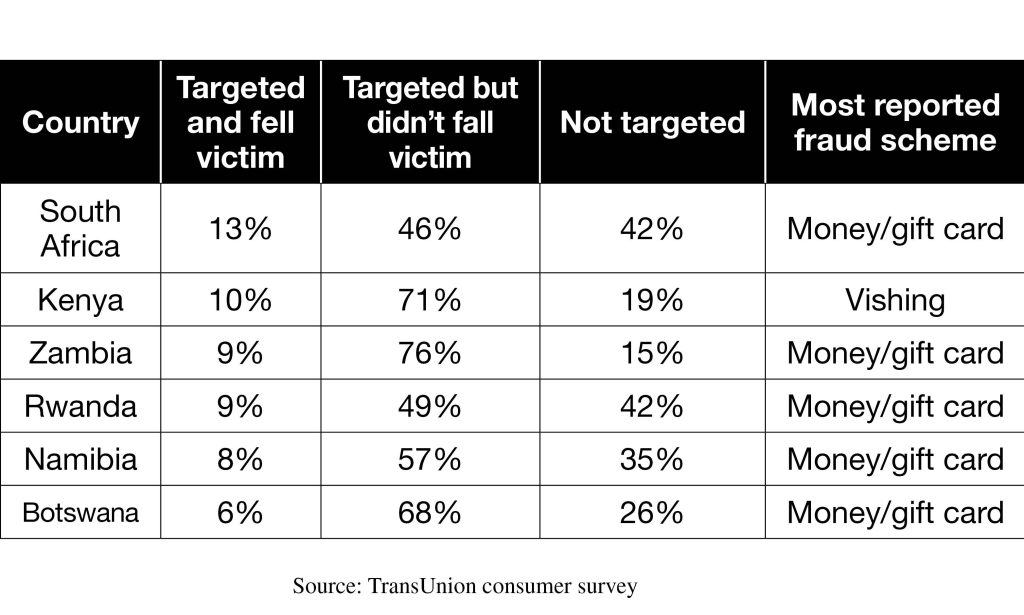
* Money or gift card scams were the most prevalent email, online, phone call or text messaging fraud attempt type from February to May 2025, reported by more than one-third (37%) of Namibians who said they were targeted with fraud
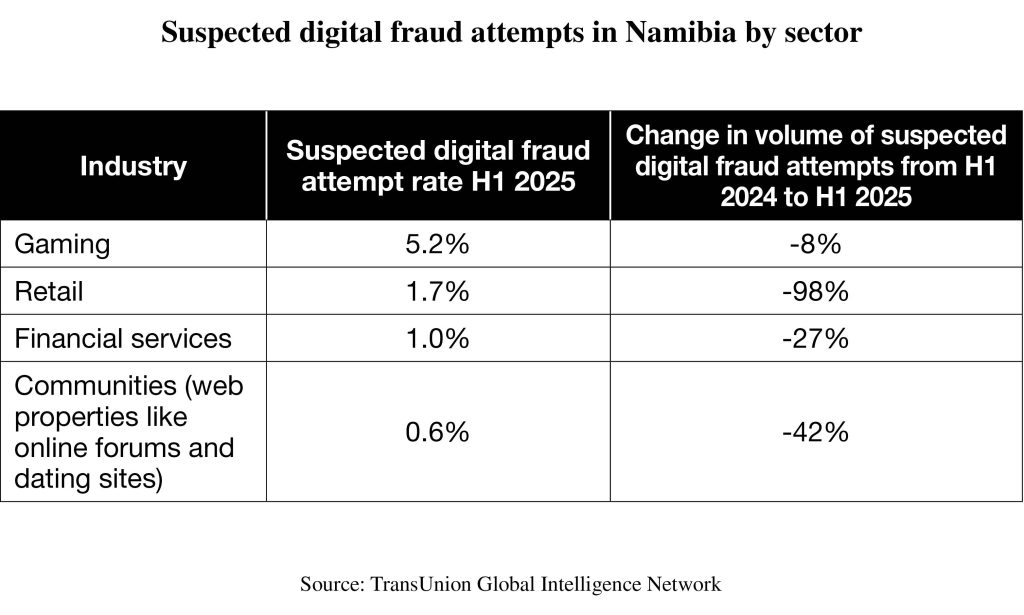
* Transactions with gaming companies, where the consumer was in Namibia, were most suspected of digital fraud in the first half of 2025 among industries analysed
FRAUDSTERS are increasingly targeting new digital accounts in Namibia, mostly through money or gift card scams.
The latest TransUnion® (NYSE: TRU) report, titled ‘H2 2025 Update to the Top Fraud Trends’ says Namibia has recorded the highest rate of suspected digital fraud in the consumer life cycle at account creation.
In the first half of 2025, 2.8% of account creation attempts by consumers in the country were suspected of digital fraud.
This aligns with account creation fraud being the highest in the consumer lifecycle globally, where 8.3% of these type of transaction attempts were suspected of digital fraud in the first half of 2025.
The report, which draws on proprietary data from TransUnion’s global intelligence network from billions of transactions from over 40 000 websites and apps and a consumer survey across 18 countries, reveals that fraud is growing in certain areas.
“The complexity of digital fraud attacks are accelerating as fraudsters leverage artificial intelligence (AI), impersonation tactics and social engineering to exploit gaps in verification and awareness,” says TransUnion Africa senior director of fraud product management Amritha Reddy.
“Our global business survey found financial losses from fraud are growing, indicating that although some defence mechanisms are working, fraudsters are shifting tactics, scaling up or moving into less defended sectors.”
RAPID ESCALATION
According to analysis of TransUnion’s customers in its global intelligence network, digital account takeover volume worldwide grew 21% year over year (YoY) from the first half (H1) of 2024 to H1 of 2025, signalling a rapid escalation.
The volume of digital account takeovers surged 141% from H1 2021 to H1 2025, underscoring a persistent rise of this fraud type over time and reflecting the increasing sophistication of fraudsters who exploit stolen credentials and bypass authentication systems.
“As account takeover fraud surges, businesses can no longer afford solely reactive defences,” Reddy says.
“The growing sophistication of fraudsters demands a proactive investment in layered security and identity intelligence. In today’s threat landscape, protecting customer accounts is not just a priority, it’s a business imperative.”
THE VIDEO GAMING HOTSPOT
Among industries analysed globally, the video gaming sector recorded the highest percentage of suspected digital fraud attempts in the first half of 2025, reaching 13.5%.
This represents a significant 28% rate increase compared to the same period in 2024, underscoring the growing vulnerability of this sector to fraudulent activity.
For transactions where the consumer was in Namibia, the rate of suspected digital fraud attempts in H1 2025 was the highest in gaming (online sport betting, poker, etc.) at 5.2%.
PREVENTION
“As the risk from consumer scams threatens identity integrity, organisations should rely on a mixture of data, risk signals, technology and tools to prevent fraud,” Reddy says.
“The report highlights that business leaders rank identity verification, device reputation and behavioural biometrics as the leading three fraud prevention technologies.
“Businesses and financial institutions should also invest in sustained education and awareness campaigns to mitigate against schemes like account takeovers. Preventing fraud must by necessity be a multi-pronged strategy, if businesses and consumers are to stay ahead of fraudsters whose strategies continue to evolve too,” she says.
“By harnessing advanced technologies, fostering cross-sector collaboration, and prioritising consumer trust, Namibia can chart a path toward a secure and inclusive digital future.”
BEWARE THAT EMAIL
Globally, consumers continue to face a wide range of scams, with tactics often tailored to regional behaviours and vulnerabilities.
TransUnion’s survey found that 48% of consumers surveyed globally reported being targeted by email, online, phone call or text messaging fraud from February to May 2025, with 65% of Namibians saying the same thing.
Globally, 52% were unaware that they were targeted, as were 35% of Namibians, indicating potential fraud under-recognition and a gap in fraud awareness.
Consumers in five of the six African countries surveyed reported money or gift card scams as the most experienced fraud type.
In Namibia, money or gift card scams was the most common fraud type – reported by 37% of those who said they were targeted with fraud from February to May 2025.
Among those Namibians who said they were targeted, the next most frequently reported scams were vishing (33%), phishing (29%), and smishing (25%), with these three designed to deceive individuals into giving up their valuable personal or financial information.
Namibia had the second-lowest percentage of respondents in Africa indicating they fell victim to fraud from February to May this year.
EVOLVING FAST
“Namibia’s digital transformation is unlocking new avenues for growth and inclusion. Yet, fraudsters are evolving faster, exploiting emerging vulnerabilities. Success will hinge on strengthening identity verification frameworks, accelerating cross-industry intelligence sharing, modernising technology infrastructure, and empowering consumers through education and awareness,” Reddy says.
“A safer digital Namibia is achievable when trust becomes a shared responsibility. As scammers continue to evolve their tactics to enrich themselves, it’s more important than ever for consumers to regularly review their credit reports to ensure all listed information is accurate.”