



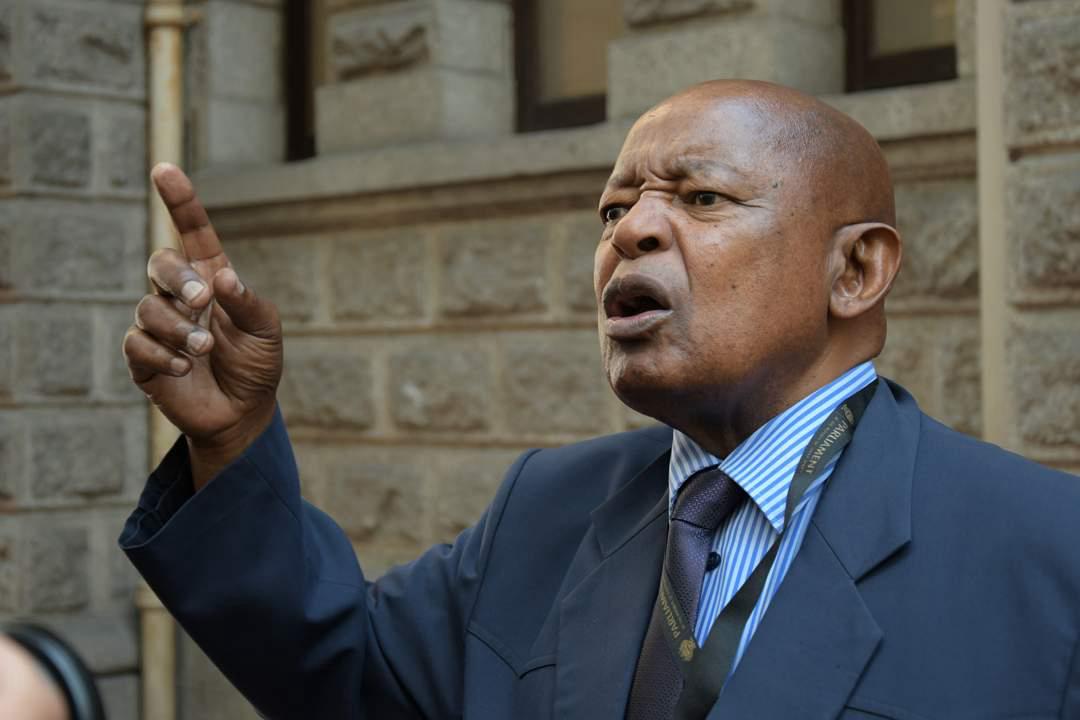
South Africa’s former defence minister and anti-apartheid campaigner Mosiuoa Lekota has died at the age of 77.
He played a key role in the struggle against apartheid and was imprisoned on Robben Island alongside former president Nelson Mandela.
Lekota went on to become chairperson of the African National Congress (ANC), but broke away to form a rival party, the Congress of the People (Cope), citing allegations of corruption in the party which has led South Africa since 1994.
He died after a “period of illness”, Cope says in a statement.
President Cyril Ramaphosa has paid tribute to the “freedom fighter and a servant of the people”.
“His life was one of resilience, courage, and steadfast belief in justice,” Ramaphosa says in a statement.
Lekota was one of South Africa’s longest-serving ministers, heading the defence ministry for a decade between 1998 and 2008.
He also served as the chairperson of the ANC for a decade and was the first premier of the newly-established Free State province after 1994, when South Africa entered the democratic era.
Lekota, nicknamed ‘Terror’ due to his prowess on the football field, left the ANC in 2008 shortly after former South African president Thabo Mbeki was removed by the party.
Among his reasons for leaving was disillusionment with how the ANC was governing and mounting allegations of corruption against some of its senior leaders.
He founded Cope in 2008 alongside another former ANC leader Mbhazima Shilowa, who also left after Mbeki’s exit. Both were staunch allies of the former president.
The party did well in the general elections held a year later, gaining 30 seats in parliament, but its electoral fortunes declined over the years – mainly due to a leadership battle between Lekota and Shilowa.
By the 2024 elections, Cope failed to secure enough votes to have any seats in parliament.
Last August, Lekota stepped back from public office because of his health. At the time, his party confirmed that he was receiving treatment for an undisclosed illness.
Lekota spent most of his life in politics, first as an anti-apartheid activist and then a leading figure in the ANC and Cope.
He was first imprisoned in 1974 under the then Terrorism Act and spent several years on Robben Island, where Mandela and other senior ANC leaders were also being held.
He was again arrested a few years after his release in 1982 for his role in the United Democratic Front (UDF), of which he was one of the leaders.
The UDF was a prominent umbrella organisation made up of hundreds of groups fighting racial segregation.
He was again charged with treason in what was known as the Delmas Treason Trial, according to South African History Online. After a lengthy trial, he was among 11 people convicted but the sentences were later overturned by South Africa’s Supreme Court of Appeal.
Trevor Manuel, a friend and former UDF leader, hailed Lekota as an “amazing human being”, who was deeply committed to South Africa.
Speaking on local radio station 702, Manual reflected on Lekota’s role in fighting apartheid.
“His commitment was deep, and I think it’s that and the entire personality that kept a number of us close to him,” he said.
Manuel told the broadcaster he last saw a “very ill” Lekota two weeks ago in intensive care and said he had fought a “brave and long battle”. – Additional reporting by Pumza Fihlani in Johannesburg, IOL News
In an age of information overload, Sunrise is The Namibian’s morning briefing, delivered at 6h00 from Monday to Friday. It offers a curated rundown of the most important stories from the past 24 hours – occasionally with a light, witty touch. It’s an essential way to stay informed. Subscribe and join our newsletter community.

The Namibian uses AI tools to assist with improved quality, accuracy and efficiency, while maintaining editorial oversight and journalistic integrity.
Stay informed with The Namibian – your source for credible journalism. Get in-depth reporting and opinions for
only N$85 a month. Invest in journalism, invest in democracy –
Subscribe Now!