


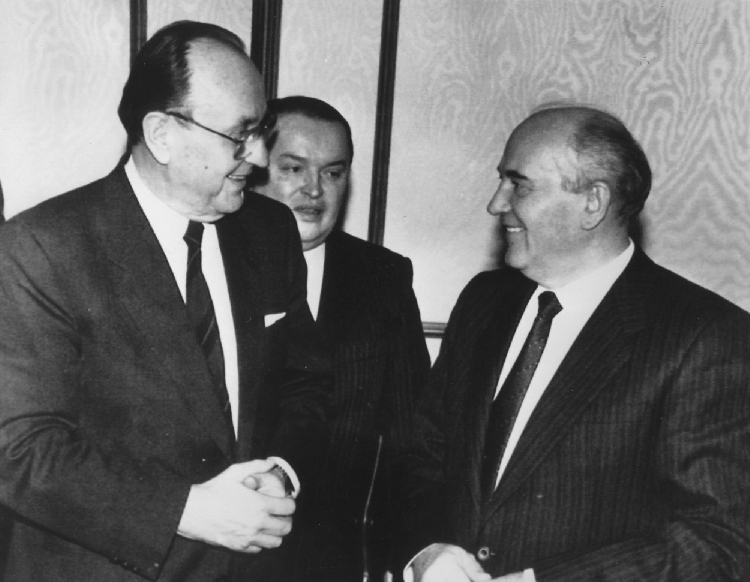
Hans-Dietrich Genscher, the longest-serving German foreign minister who was one of the key architects of the country’s 1990 reunification between East and West, has at 89 last Friday.
Foreign minister Frank-Walter Steinmeier lauded his predecessor, saying Genscher had “literally written history”.
“Overcoming the division of Germany and the split in Europe was his life’s work,” said Steinmeier.
Genscher served as foreign minister, first of West Germany and then of the reunited nation, for 18 years under chancellors Helmut Schmidt and Helmut Kohl. During this period, he was also very involved with Namibia on the diplomatic front.
He remained active and well-connected long after his retirement, working behind the scenes in his mid-80s to help secure the release of former Russian oil tycoon Mikhail Khodorkovsky.
Genscher championed détente with the Soviet bloc in the 1970s and 1980s, and was in the vanguard of those who took Soviet leader Mikhail Gorbachev at his word when he declared Soviet aggression a thing of the past.
That trust, and West German insistence on reaching out to help Moscow, helped hasten the end of the Cold War. It also ultimately brought about German reunification at the heart of an increasingly integrated Europe.
“European unity is the answer to the mistakes of the Germans and of European history,” Genscher said as he announced his retirement from Parliament in 1998. “It is the answer to a terrible world war. These reasons stand even today.”
In comments to the Interfax news agency, Gorbachev said Genscher was “a world-class politician, a gifted statesman”.
“It is said that there are no friends in politics. It is not true. In recent years, Hans-Dietrich was a true friend to me, and I have lost this friend,” Gorbachev said.
Genscher was centre stage as cracks in the Iron Curtain opened up in 1989.
In September 1989, thousands of East Germans had packed into the West German embassy in Czechoslovakia’s capital, Prague, seeking to escape to the West at a time when East German soldiers shot those who tried to flee across the Berlin Wall.
After weeks of diplomatic manoeuvring, Genscher on 30 September told the East Germans they could go to the West.
“I call you fellow citizens, and express a hearty welcome,” Genscher said from an embassy balcony. He told reporters outside it was “the most moving point of my political career”.
After the Berlin Wall fell on 9 November, Genscher was at the forefront of efforts to unite East and West Germany – a goal achieved on 3 October 1990.
Still, Genscher sometimes rankled his allies. He angered president Ronald Reagan’s sceptical US administration by insisting on cooperating with Moscow early in Gorbachev’s tenure. His insistence in 1989 on linking the reduction of short-range nuclear weapons in Europe with cuts in conventional arms also initially provoked tensions with Washington.
After reunification, Genscher raised eyebrows in 1991 when he virtually pushed the European Community into recognising Croatia – which had been a part of Yugoslavia – by indicating that Germany planned to take the step by itself.
The push deeply angered Serb-led Yugoslavia, which broke up amid wars from 1991-99 that took up to 200 000 lives. Germany’s assertiveness on the Croatia issue also raised worries that it could use its might, anchored in its powerful currency at the time, the German mark, to get its own way on other European matters.
Yet Genscher was also clear about the lessons Germany had learned from the horrors of its Nazi past.
“I have always considered it my generation’s responsibility to prevent a repetition of the events of the period from 1933-1945 in Germany, committed by Germany,” he wrote in his memoir. “That task will go on in perpetuity. We must prevent even a relapse into a new nationalism.”
During his long tenure, Genscher became a political cult figure. His ceaseless travel to foreign capitals earned him the nickname ‘Genschman’ – an allusion to Superman – and the yellow sweater-vest he wore under his suit became his trademark.
Referring to that heavy travel schedule, then-Soviet foreign minister Eduard Shevardnadze once quipped that whenever two airliners pass each over the Atlantic, “Genscher is on both of them”.
Drafted into the regular German army in the final months of World War II, he was captured by American forces in 1945 and imprisoned in Britain. After the war, he studied law at Leipzig University, but became disenchanted with communist East Germany and escaped to the West in 1952.
There, he joined the small Free Democratic Party – for decades West Germany’s political kingmaker – starting a political career that would make him one of the country’s most popular and respected figures.
In an age of information overload, Sunrise is The Namibian’s morning briefing, delivered at 6h00 from Monday to Friday. It offers a curated rundown of the most important stories from the past 24 hours – occasionally with a light, witty touch. It’s an essential way to stay informed. Subscribe and join our newsletter community.

The Namibian uses AI tools to assist with improved quality, accuracy and efficiency, while maintaining editorial oversight and journalistic integrity.
Stay informed with The Namibian – your source for credible journalism. Get in-depth reporting and opinions for
only N$85 a month. Invest in journalism, invest in democracy –
Subscribe Now!