



ALL over the world, the Society for the Prevention of Cruelty to Animals (SPCA) is a symbol of hope for homeless pets. In Windhoek, the organisation turns 70 this year. Despite this milestone in age, the organisation occupies only a small plot across the road from Maerua Mall.
As one enters the building, its blue and white exterior stands out. It is laid-back, simple and welcoming to the visitor.
A security guard stands with his back against the side of a number of self-locking drop boxes which have been left slightly open.
The boxes are sheltered under a zinc roof. Two extra large boxes are built under three small-sized ones. Inside each box is a dark grey blanket, a stainless steel or plastic water bowl, and an uncompleted ‘strays/surrender’ form.
The form is parted in half. One half is to be completed by someone who has brought in a stray animal, and asks for relevant detail such as who brought it in, where the pet was found, the description of the animal, and the contact details of the person who found the animal.
The other half is to be filled in by someone surrendering their pet. This section asks for details such as the animal owners’ name, whether the animal is up-to-date with vaccinations, and if it was spayed or neutered.
Behind a large black driveway gate is a white wall which stretches across a long paved-brick driveway. Inscribed on the wall are some interesting animations outlined in black, as well as animal positive quotes also in black. They read:
“Rescued is my favourite breed.”
“Until one has loved an animal, part of their soul remains unawakened.”
“An animal’s eyes have the power to speak a great language.”
“Some angels choose fur instead of wings.”
It is at this animal shelter I commit to spend some hours to observe the animals who call it home, albeit temporarily.
The SPCA is open from 08h00 to 13h00, then again from 14h00 to 17h30 Monday to Friday. It is open from 09h00 to 12h00 on Saturday, and is closed for adoptions on Wednesdays, on Sundays and public holidays.
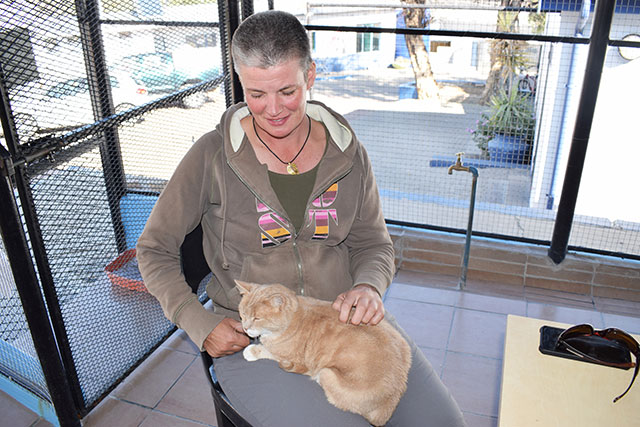
A door bell rings as I enter the reception area, before I meet Kimberley Ross, a permanent volunteer of the SPCA.
She jokingly describes herself as part of the SPCA furniture, in reference to the time she spends at the organisation. She lets me in on some of the organisation’s history, before we embark on a tour of the premises.
Single paper sheets are scattered over a large wooden desk. I can imagine those to be records of past and current residents of the animal shelter.
“The day-to-day (routine) is quite hectic. We never have a quiet moment. There is always a mad rush,” Ross says of the job which gives second chances to injured, lost or surrendered animals.
According to her, the SPCA receives between 200 and 300 dogs, and between 150 and 200 cats a month. The adoption rate varies, though. She says some months are positive, while others are not. It all comes down to the economic standing of adoptive families, she suggests.
“Today is the first day of the month, and we already have eight additional dogs. There’s never a day when we don’t get one dog or a cat,” she continues.
In the background, some volunteers grab leashes from the reception to take the dogs for walks. Others are returning from the walks.
The returning ‘four-legged man’s friends’ appear refreshed. Unknowingly, some dogs may have participated in the Saturday walk twice due to the large number making it difficult to keep proper stock, Ross admits.
Windhoek International School pupil Cedric Li (17) is one of the volunteers at the centre. He started volunteering about five or six months ago, and comes in bi-weekly.
“I walk the dogs to make sure they get the attention they need, and sometimes I help when they need to be bathed,” he says.
Another volunteer, also from Windhoek International School, Dora Huang (16), says she started volunteering last year.
The self-confessed animal lover said she has four dogs, adding that: “I try to come biweekly, but because of school work, sometimes I come in the third week.”
Some volunteers are playing with dogs in a large garden adjacent to the reception area. Ross explains that the garden is where the compatibility of dogs is tested by potential adoptive families.
SPCA general manager Hanna Rhodin says the society received about 3 700 animals in 2018.
“The expenses for a healthy dog during its first month at the SPCA amounts to an estimated N$3 100,” Rhodin adds.
The SPCA also houses quarantined animals. A dog quarantine sits a few metres from the reception area.
In an age of information overload, Sunrise is The Namibian’s morning briefing, delivered at 6h00 from Monday to Friday. It offers a curated rundown of the most important stories from the past 24 hours – occasionally with a light, witty touch. It’s an essential way to stay informed. Subscribe and join our newsletter community.

The Namibian uses AI tools to assist with improved quality, accuracy and efficiency, while maintaining editorial oversight and journalistic integrity.
Stay informed with The Namibian – your source for credible journalism. Get in-depth reporting and opinions for
only N$85 a month. Invest in journalism, invest in democracy –
Subscribe Now!