


The Directorate of Veterinary Services is warning farmers it will cull cattle that are found to have been vaccinated against foot and mouth disease (FMD) illegally.
Chief veterinary officer Kenneth Shoombe delivered this warning during a presentation on the state of FMD at the Meat Corporation of Namibia’s annual general meeting on Friday.
“These animals should not be part of the cattle population,” he said.
Concerns that recent outbreaks of the disease in South Africa and Botswana could spread to Namibia have led the Ministry of Agriculture, Fisheries, Water and Land Reform to increase surveillance and awareness of FMD in border regions.
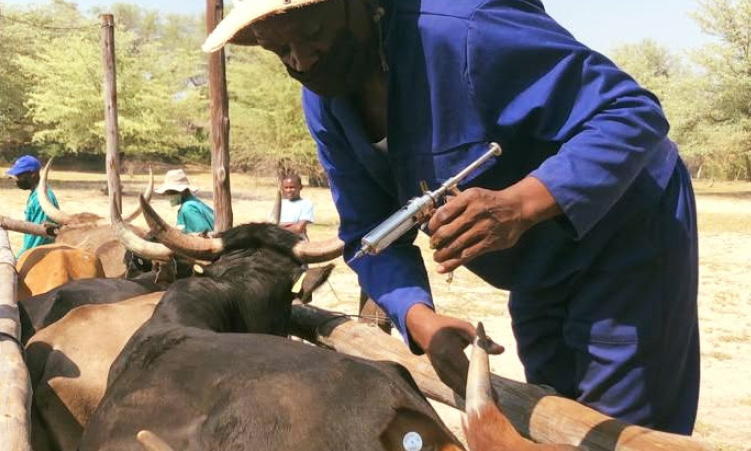
But Shoombe warned that vaccination is not an option.
In Namibia, only state veterinarians are able to inoculate against the disease, and only north of the veterinary cordon fence (redline). South of the redline, Namibia’s status is ‘FMD-free without vaccination’.
This status allows producers in this region to have access to international markets for their beef products.
Vaccinating against FMD would lead to Namibia losing this status and its export market, Shoombe said.
He explained that during regular testing of farm animals – or during a suspected FMD outbreak – a farm will be closed until the veterinarians are able to draw blood and have the blood tested for antibodies.
If antibodies are present, the Directorate of Veterinary Services (DVS) will test to see if it is because the animal was infected or because it has been vaccinated.
‘SMUGGLED VACCINE’
“If we find out it is vaccination, you’re going to lose the whole herd. You have smuggled the vaccine,” Shoombe said. He said Namibia has never previously had a problem with vaccines being administered illegally.
The agriculture ministry has confirmed that the Animal Health Act 1 of 2011 is the legal instrument that governs the use of vaccines for FMD and the right of the state to kill cattle if owners contravene directives.
The Namibia National Farmers Union (NNFU) says it supports DVS directives.
“Dr Shoombe is an expert and heads the DVS in Namibia. NNFU, with its members, relies on the guidance of the chief veterinary officer and therefore relies on his advice,” NNFU chief executive Kuniberth Shamathe says.
Several farmers the The Namibian has spoken to have urged for calm and trust in the directives.
“I’m not really worried unless a case is reported in Namibia. It’s not the first time it’s been in our neighbouring countries,” Lucky Shindume says. Shindume has farms at both Karibib and north of the redline.
Vehaka Tjimune, who has been a farmer in the Erongo region and has worked in the livestock industry for 36 years, says vaccination is not an option for Namibia.
“With vaccination, the meat is not eligible for any high-paying markets. At the moment, Namibia is the only African country exporting to the Americas. That is why DVS is saying if they find a farmer smuggling the vaccine they will cull the herd.
“For me as a farmer, that is the right choice. By no means should you vaccinate if it’s against the policy,” he says.
Tjimune urges farmers to take steps to prevent the spread of FMD.
“Farmers must forget about vaccination, but there are many things they must do. We need to be disciplined. Indiscipline has brought South Africa to where it is today,” he says.
Farmer Joram Ngutjinazo says vaccines are not needed south of the redline, as long as patrols are in place to monitor movement and strict controls are applied to the movement of animals and animal products.
THE DISEASE
FMD is a highly contagious viral infection. It spreads easily through contact between infected animals, but also through other vectors like car tyres, shoes, and clothing.
The virus rarely kills adult cattle, but leads to economic losses because dairy cattle do not produce and their meat is not safe for consumption, according to information from the World Organisation for Animal Health. The last outbreak of FMD in Namibia was in 2015 in the northern communal areas. In the Zambezi region – called the ‘infected zone’ – the state currently vaccinates cattle three times a year. In the protection zone, the state vaccinates high-risk cattle twice a year.
In an age of information overload, Sunrise is The Namibian’s morning briefing, delivered at 6h00 from Monday to Friday. It offers a curated rundown of the most important stories from the past 24 hours – occasionally with a light, witty touch. It’s an essential way to stay informed. Subscribe and join our newsletter community.

The Namibian uses AI tools to assist with improved quality, accuracy and efficiency, while maintaining editorial oversight and journalistic integrity.
Stay informed with The Namibian – your source for credible journalism. Get in-depth reporting and opinions for
only N$85 a month. Invest in journalism, invest in democracy –
Subscribe Now!