




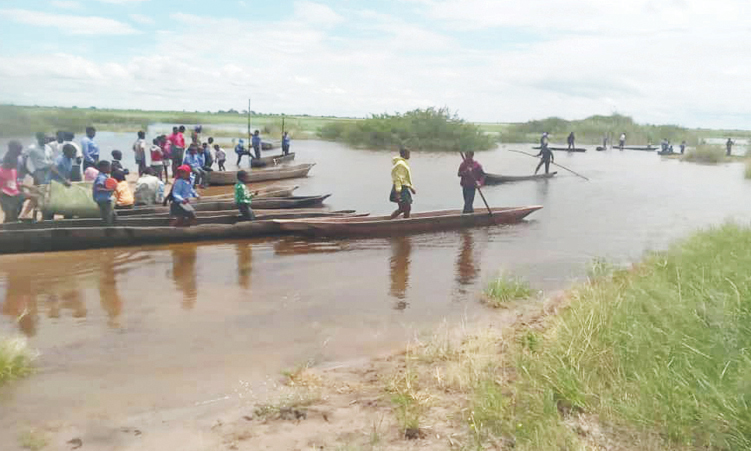
Floods in the Zambezi region continue to wreak havoc, with some schools, clinics, and villages accessible by boat only.
Zambezi governor Dorothy Kabula-Simushi says the floods pose a threat to communities, with those in the Kabbe South and Kabbe North constituencies being the hardest hit. Five schools have been identified to be completely inaccessible so far.
Roads such as the Sifuha-Bukalo road have also been damaged.
The flood risk is elevated in the region this year as the Hydrological Services of Namibia reports that the Zambezi River’s water level stands at 6.75m.
Last year during the same time, it stood at 2.17m.
Kabula-Simushi yesterday said the floods have already spread into the communities and the water is not expected to subside any time soon.
The immediate plan, she said, is to relocate pupils and residents to higher ground.
“The water levels are very high and will continue to rise. Our disaster risk management teams have identified the most affected areas. We will start relocating communities and schools very soon.
“Ministry of Health and Social Services officials will also send mobile teams to places that are completely cut off. The donation of tents, food, water tanks, and other items by the Office of the Prime Minister has also arrived,” she said.
Kabula-Simushi urged residents to start relocating and to inform the constituency offices if they need help.
Muzzi Combined School principal Robert Shakwa says the school is in dire need of relocation, because it’s completely surrounded by floods.
He says some of the pupils who are commuting from home on a daily basis are at risk because of the presence of crocodiles and snakes.
“It would be best if the schools were relocated for safety reasons. The commuting of pupils on these traditional canoes by themselves is not advisable.
“There is a stream between our community hostel and the school, so pupils have to use canoes – even at night – to access ablution facilities,” he says.
Shakwa says while they are waiting to be relocated, they urgently need mobile ablution facilities at the community hostel and tents.
Nankuntwe Combined School acting principal Harrison Lyamine says the presence of snakes and crocodiles is high, as the school is completely surrounded by water.
He says the pupils’ lives are further placed at risk because they have to commute 3km daily amid flooding.
“We are surviving daily due to God’s grace. Teachers and pupils are forced to walk in water to get to their classrooms, while the teachers’ houses are flooded.
“School attendance is also affected because parents keep their children at home when it rains for safety reasons. It’s really an unconducive and unsafe environment for both teachers and pupils,” he says.
‘BUILD CANALS’
Former Kabbe South constituency councillor John Likando has urged regional and national leaders to act swiftly to contain flood risks.
“The climate-change resilient approach is much needed in this regard. Old ways cannot withstand the risk that is involved. The schools that were supposed to be unearthed must also be done without any further delay, because they are affected annually.
“The government should also look into building canals between the Zambezi and Chobe rivers to start harvesting floodwaters. The Kapelwa-Kabajani ferry should also be fully operational to help with relocation activities,” he says.
The deputy director of the directorate of disaster risk management within the Office of the Prime Minister (OPM), Flory Ashipala, last Thursday said officials were dispatched to the region to assess the situation.
He said the directorate provided support through tents, food, and water tanks.
The OPM has provided the region with 60 tents, 50 mattresses, 50 blankets, 4 104 bottles of cooking oil, 2 663 tins of fish, and 9 097 40kg bags of rice.
“These goods will be allocated to the identified affected households,” Ashipala said.
Zambezi education director Alex Sikume could not be reached for comment yesterday.
In an age of information overload, Sunrise is The Namibian’s morning briefing, delivered at 6h00 from Monday to Friday. It offers a curated rundown of the most important stories from the past 24 hours – occasionally with a light, witty touch. It’s an essential way to stay informed. Subscribe and join our newsletter community.

The Namibian uses AI tools to assist with improved quality, accuracy and efficiency, while maintaining editorial oversight and journalistic integrity.
Stay informed with The Namibian – your source for credible journalism. Get in-depth reporting and opinions for
only N$85 a month. Invest in journalism, invest in democracy –
Subscribe Now!