Five of Namibia’s regions are struggling with the aftermath of floods that have left 8 500 pupils unable to attend school and disrupted food distribution to drought-hit communities.
The waters, which began rising in recent weeks, have submerged roads, mahangu fields and surrounding villages.
The Kunene, Omusati, Oshana, Ohangwena and Zambezi regions are all affected.
CROCODILES, SNAKES AND HIPPOS
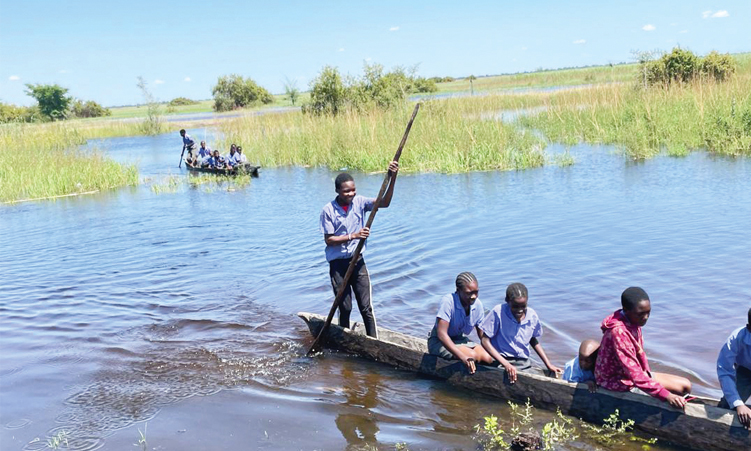
In the Zambezi region, for example, commuting to school is risky for pupils in the floodplains as they are exposed to crocodiles, snakes, and hippos on a daily basis.
They are forced to use traditional canoes or old banana boats to access their schools.
Teachers and staff face the same dangers.
The Kabbe South and Kabbe North constituencies are the hardest hit.
Oshana governor Elia Irimari at a media briefing at Oshakati yesterday said 12 schools in his region have had to close, while 2 600 pupils are unable to attend school.
He said four more schools are affected by the floods, but have not been closed yet.
CATCHING UP
The governor said the closed schools would compensate for missed classes once the water subsides.
Pupils have been relocated to nearby houses while some have been provided tents.
Oshana regional commander commissioner Naftal Sakaria says 16 people have drowned in the region since March.
“It is of serious concern, and we recorded two drowning incidents over the weekend,” he says.
Sakaria says the region has never experienced so many drownings.
“There is a need for education on how people should behave around water,” he says.
Control administrative officer Elizabeth Shipunda says 11 schools in the Etayi constituency in the Omusati region have closed, with 5 752 pupils staying home.
“Some 113 hectares are affected, with five mahangu fields totally destroyed. Two outreach centres for the Ministry of Health and Social Services are inaccessible,” she says.
Shipunda says some villages are surrounded by floodwaters, but residents have refused to be relocated, raising concerns over their livestock and who would take care of their homes if they leave.
STUCK IN THE MUD
“A total of 36 households are affected. It has also become very difficult to distribute drought-relief food in the constituency as trucks carrying food get stuck in mud,” she says.
Shipunda says three trucks and a wheel loader slid off the gravel road at Etayi last week.
She says 52 cases of malaria have been recorded in the constituency, of which 28 involve Namibians and 24 Angolan nationals.
Omusati governor Erginus Endjala yesterday said 25 schools in his region are closed, but there could be more as he was still waiting for a report from education director Paulus Kashiimbi.
Kashiimbi could not be reached for comment yesterday.
Kunene police commander commissioner James Nderura says the floods have devastated roads and isolated some communities.
“The road from Ruacana Waterfall to Epupa Falls and onwards to Swartbooisdrift has been completely washed away,” he says.
Nderura says last week’s flood also caused damage to lodges in the region.
Mahangu fields along the Kunene River are submerged in water, while a Namibian Defence Force helicopter is used to distribute food to those whose houses are surrounded by water, he says.
RELOCATED
Ohangwena governor Sebastian Ndeitunga says the Ongenga, Engela, and Oshikango constituencies are the most affected in his region.
He says houses at Onamhinda, Onghala B and Eshoke are completely submerged.
Ndeitunga says doctors have been airlifted to treat patients at Onghala B, with some patients also being transported to hospitals at Engela.
He says about 250 people have been relocated to higher grounds.
ZAMBEZI
In the Zambezi region, pupils at Nankuntwe Combined, Muzii Combined, and Mpukano Junior schools either walk or use traditional canoes or old banana boats to access schools.
The risk of them drowning is high if the canoes or boats capsize, as some streams are deep.
A crocodile roaming around Muzii Combined School’s premises was shot last Wednesday.
School principal Robert Shakwa says the crocodile was spotted around the community hostel two days prior to being shot by staff members and pupils on separate occasions.
He says when the school board chairperson spotted the animal around 22h00 on Wednesday, he shot it for the safety of the pupils and staff.
“The crocodile was spotted in the stream the pupils use to commute to school daily. However, it would go back into the water as pupils passed it.
“The pupils were really frightened, but had no choice because it is the only stream they can use to get to school,” he says.
Shakwa says the community hostel, which houses about 100 pupils, is about 150m from school and completely flooded.
“We only have one traditional canoe and an old banana boat that can only load six pupils per trip. This results in several trips, and some pupils miss out on the morning periods,” he says.
Nankuntwe Combined School principal Gift Samboma says access to the school has been very difficult for the past three weeks as the floodwaters keep rising.
He says some of the pupils are camping on the school grounds to avoid paddling to school in unsafe canoes.
“The children who camp on school come with little food, while others don’t have any at all. We are also experiencing hygiene problems as our septic tanks are filling up and overflowing due to flooding.
“The school does not own a boat and uses the boat of one of our community members. In case of sickness for both teachers and pupils we use our old banana boat that doesn’t have an engine, and it takes close to three hours to reach the nearest clinic,” he says.
Samboma says the directorate should either relocate all schools in the floodplains or close them temporarily.
“Teachers in the floodplains should also be given danger allowances,” he says.
Mpukano Junior Primary principal Joseph Mbeha says the school needs tents, boats, life jackets, snake repellent, food, and building materials to put up temporary structures for pupils.
INTERRUPTED LEARNING
“Learning and teaching is interrupted on a daily basis because of the various challenges we face due to floods. We have an enrolment of 80 pupils, and 20 pupils were absent from school on Friday because of transportation difficulties.
“The presence of snakes is very high on the school premises, and hippos are also spotted in some of the streams pupils use to commute,” he says.
Regional education director Alex Sikume did not respond to questions sent to him.
In an age of information overload, Sunrise is The Namibian’s morning briefing, delivered at 6h00 from Monday to Friday. It offers a curated rundown of the most important stories from the past 24 hours – occasionally with a light, witty touch. It’s an essential way to stay informed. Subscribe and join our newsletter community.

The Namibian uses AI tools to assist with improved quality, accuracy and efficiency, while maintaining editorial oversight and journalistic integrity.
Stay informed with The Namibian – your source for credible journalism. Get in-depth reporting and opinions for
only N$85 a month. Invest in journalism, invest in democracy –
Subscribe Now!